
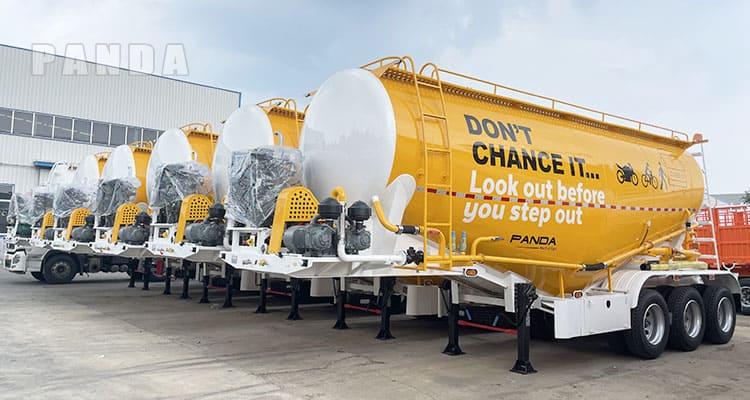
Pneumatic Cement Transport
Bulk Cement Transport with Pneumatic Cement Tankers
We start with the job your tanker needs to do. We check payload, cement density, local axle limits, road conditions, your tractor and your receiving silo. For many export fleet projects, we first look at our 3-axle 50-ton / 40 m³ cement tanker. We then change the tank, axles or air system when the route needs a different setup.
30–85TConfigurations
>1.5 t/minCement unloading
3 / 4 axlesProject options
200+QC checks
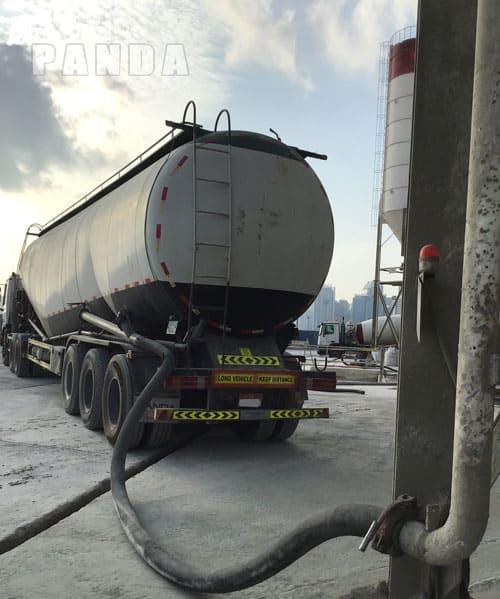
Bulk Cement Transport for Plants, Fleets and Projects
Two tankers with the same rated size can work very differently in real use. Trip distance, tractor weight, road condition and the receiving silo all matter.
Cement Plants
We focus on payload, unloading time, silo connection and fleet reliability. For multi-unit orders, we also keep the agreed specification consistent across the fleet.
Transport & Logistics Fleets
We balance payload, empty trailer weight, axle layout, road conditions and service parts. We also check unloading speed so the tanker fits the daily fleet schedule.
Engineering & Construction Projects
We check access roads, local weight limits, tractor fit, silo height and the discharge line before we release the final trailer specification.
This page covers industrial, non-food dry bulk cement transport. If you carry flour, wheat powder, starch or another food powder, tell us before we quote. We use a dedicated food-powder tanker setup because cleaning, material and contamination control are different.
Quick Answer
What Is the Best Way to Transport Bulk Cement?
For high-volume road transport, we normally use a sealed pneumatic cement tanker. It loads dry cement at the plant and uses compressed air to unload into a silo. We do not choose the tanker from cubic meters (m³) alone. We first check tonnes per trip and bulk density, which tells us how much space the powder needs. We also check legal gross vehicle weight (GVW), axle limits, your tractor, the road and the silo.
PayloadRequired tonnes per trip.
Bulk DensityShows how much tank space the cargo needs.
GVW & AxlesShows how much weight the road rules allow.
TractorFifth wheel, kingpin, air and electrical connections.
RoadHighway, rough roads, slopes and daily use.
SiloHeight, pipe length, bends, backpressure and filter capacity.
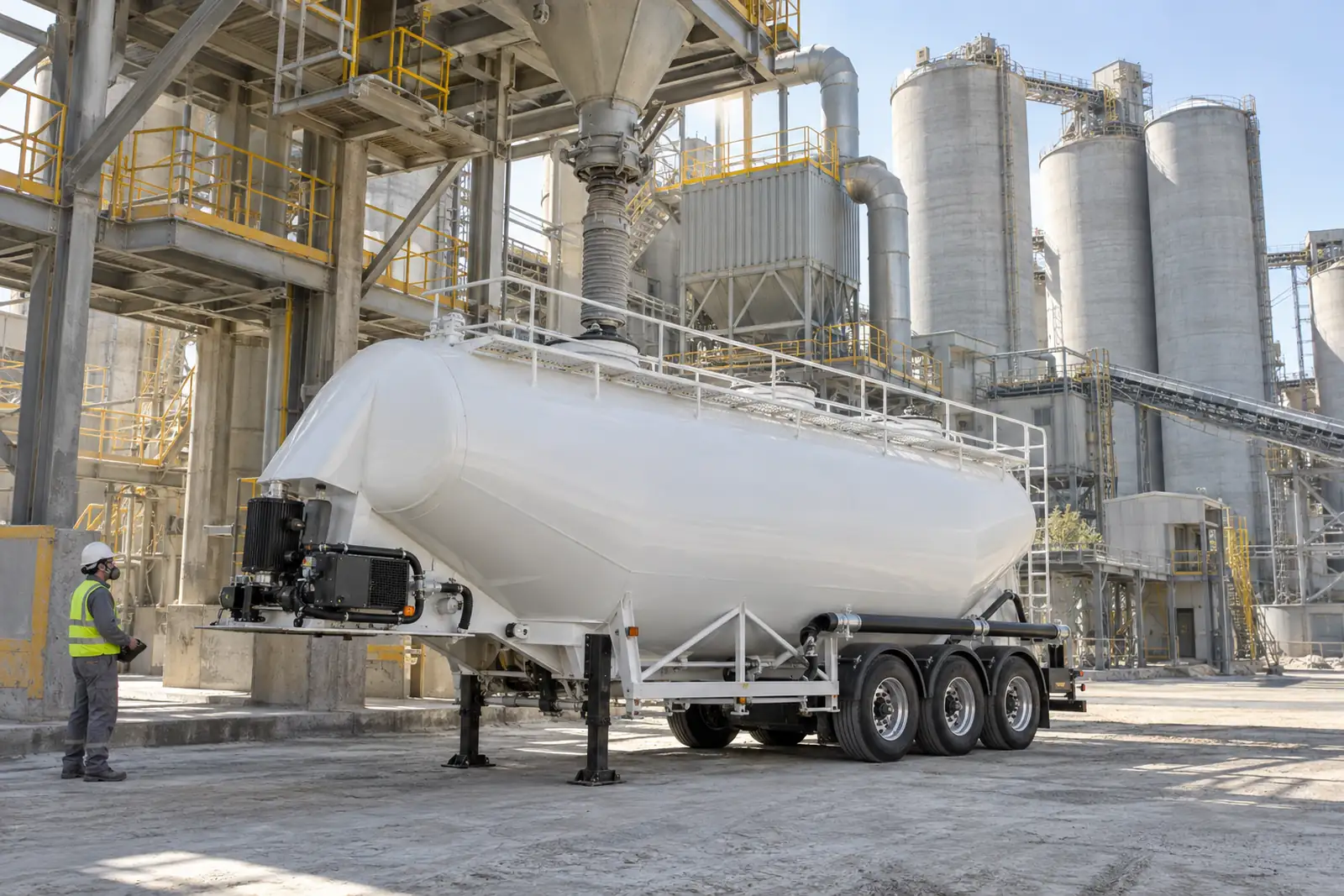
Bulk Cement Needs More Than a Tank with Enough Volume
Dry cement is a fine powder that must stay dry and move cleanly through the air system. Moisture, residue, dust and poor flow can all reduce transport and unloading performance.
01
Keep Cement DryMoisture can make cement cake, flow poorly or start to harden. Tank seals, manholes and piping need to keep water out.
02
Control ResidueOld powder left in the tank can contaminate the next load and can also make unloading less consistent.
03
Manage Fine DustLoading and unloading should follow the site dust-control and personal protective equipment procedures.
04
Support Powder FlowCement does not simply fall out of the tanker. Air helps the powder move toward the outlet and through the discharge line.
How We Choose the Right Cement Tanker
We start with your cargo and the weight you need to carry. Then we check local road limits. Tank volume comes after these checks, not before them.
01Cargo
Confirm the powder and its condition.
02Payload
Set the target tonnes per trip.
03Volume
Use cargo density to size usable tank volume.
04Axles & Route
Check legal axle loads and road condition.
05Tractor & Air
Check fifth wheel, kingpin and air source.
06Silo
Check height, distance, bends and backpressure.
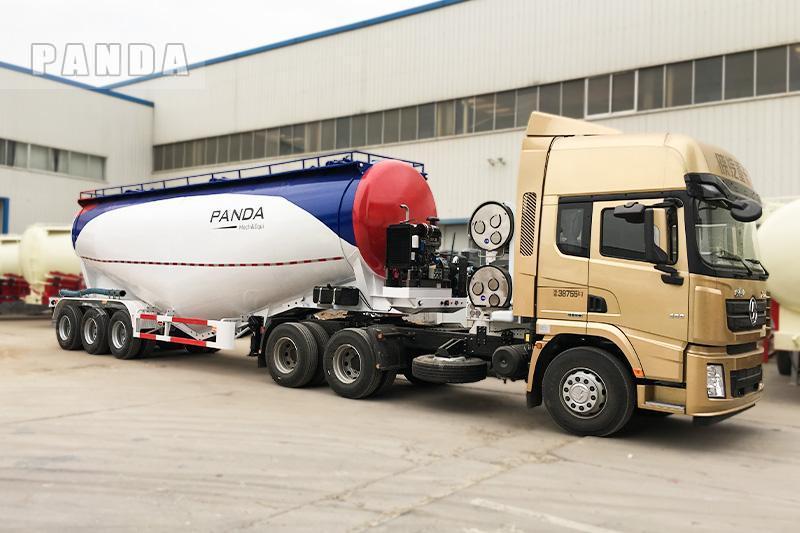
Common starting point for high-capacity projects
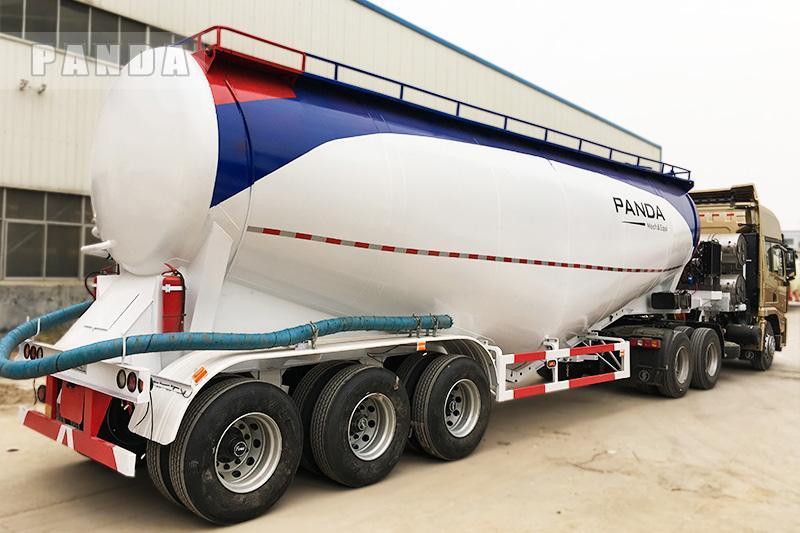
Why We Often Start with a 3-Axle 50 Ton / 40 m³ Cement Trailer
Our 3-axle 50-ton / 40 m³ model is a common starting point for high-capacity cement transport. It is not the right legal setup for every country or route. Before we confirm it, we check your tractor, local axle limits, road conditions and receiving silo.
50 tonPayload class
40 m³Nominal volume
3 axleAxle setup
>1.5 t/minUnloading
Choose this setup when you need high payload and local weight rules allow it. Do not choose it only because 50 tons sounds better. Axle limits, tractor weight or route restrictions may make another setup a better fit.
Which Panda Mech Cement Tanker Should You Start With?
These are common Panda Mech model pairings. They are not a universal rule for every cement tanker. Your legal payload still depends on cargo density, tractor and trailer tare weight, GVW and local axle limits.
| Panda Mech model | Nominal volume | Typical axle setup | Choose this when… | What we check before quoting |
|---|---|---|---|---|
| 30 Ton Cement Tanker | ≈25 m³ | 2 axle | You need a lower payload or a smaller tanker. | Local GVW, route and tractor weight. |
| 40 Ton Cement Tanker | ≈30 m³ | 3 axle | You need about 40 tons for normal regional transport. | Local axle rules and actual cement density. |
| 50 Ton Cement TankerCOMMON START | ≈40 m³ | 3 axle | You need a high-capacity fleet tanker and local weight rules allow it. | Tractor empty weight, road limits and silo conditions. |
| 55 Ton Cement Tanker | ≈45 m³ | 3 axle | You need more payload and local weight rules allow it. | Axle load, empty weight and road condition. |
| 60 Ton Cement Tanker | ≈50 m³ | Check 3 or 4 axles | You need higher payload and the axle loads have been checked. | Local 3-axle vs 4-axle rules and tractor weight. |
| 80T / 85T Heavy-Duty | Built for the project | Built for the project | You need a heavy-duty tanker and the route and legal loads have been checked. | Local law, route, structure, axle setup and working conditions. |
Panda Mech also has a separate 48-ton / 40 m³ model. We keep its exact specifications separate from the 50-ton / 40 m³ model so the two products are not mixed together.
Payload vs. Volume
40 m³ ≠ 40 ton
Tank Volume Is Not the Same as Legal Payload
Tank volume tells you how much space is inside the tank. Payload tells you how much cargo weight you carry. Your legal road payload also depends on tractor and trailer tare weight, GVW rules and axle limits.
Required tank volume ≈ target cargo mass ÷ cargo bulk density
The formula is only the first step. We then check usable volume, tractor and trailer tare weight, GVW and axle limits.
Simple Panda Mech example
A 40 m³ tank does not automatically mean a 40-ton payload. In our main cement tanker range, 40 m³ is paired with the 50-ton payload class. We still check the route and local weight rules before quoting.
Check the Cement Before We Finalize the Tanker
The same payload can need a different tank or unloading setup when the cement condition changes. These four details help us avoid sizing and discharge problems.
01Is the Cement Dry?
Damp cement can flow poorly and leave more material inside the tank after discharge.
02What Is the Bulk Density?
Bulk density tells us how much tank space your target cargo weight needs. It is one of the first sizing inputs.
03Is the Cement Loaded Hot?
If cement comes directly from production and is still hot, send us the expected loading temperature before we confirm the tanker and components.
04Will You Carry Other Powders?
Tell us if the tanker will also carry fly ash, lime or another industrial powder. Density and flow behavior may be different.
What this means in practice: do not choose tank volume from a tonnage label alone. Cargo density, condition and the actual route all affect the final setup.
How Road Conditions Change the Tanker Setup
A catalogue model is only a starting point. Long trips, rough roads, axle limits and local service conditions can all change the final setup.
LONG HAULFrequent Long-Distance Routes
For long trips, empty weight, tires, running gear and easy-to-find service parts matter more.
Focus: total operating cost, service and practical empty weight.ROUGH ROADRough or Mixed Roads
Rough roads put more shock and twisting force into the chassis and suspension over time.
Focus: chassis strength, suspension and running gear.AXLE LIMITStrict Per-Axle Limits
An extra axle can spread the weight. It does not automatically make a heavier trailer legal.
Check: axle count, empty weight and legal load per axle.HIGH CYCLESHigh-Frequency Unloading
Frequent unloading puts more demand on the air system, valves and seals.
Focus: stable airflow, reliable parts and low residue.HIGH SILOHigh Silo or Long Discharge Line
A higher silo, longer pipe and more bends make the cement harder to move.
Check: pipe route, silo backpressure and filter condition.COASTALHot, Coastal or Corrosive Conditions
Heat, coastal salt and maintenance conditions can change the coating and parts we recommend.
Check: corrosion protection and component choices.3 Axles or 4 Axles?
More axles can spread the load, but axle count alone does not decide the legal payload. We also check trailer tare weight, tractor weight and local axle limits.
3 Axles
4 Axles
Common use
Standard starting point for many fleet cement tankers.
Used when the project needs different weight distribution or a heavier-duty road setup.
Main benefit
Simpler and usually lighter than adding another axle.
Spreads the load across more axles.
What we check
Payload, tare weight and legal load per axle.
Local axle rules, total tare weight and tractor combination.
Do not assume
Three axles always mean a low payload.
Four axles automatically make a heavier load legal.
Our rule: more axles do not automatically mean more legal payload. We choose axle count from the required payload and local road rules.
We Confirm the Tractor Before Finalizing the Trailer
The tanker must fit the tractor, not just the payload. A mismatch can cause coupling, clearance or air-system problems.
Tractor make / modelHelps us check the basic tractor-trailer match.
Fifth-wheel heightHelps us set trailer height and coupling position.
Kingpin requirement2 in or 3.5 in, where the project needs it.
Turning clearanceChecks clearance when the tractor turns.
Brake & electricalChecks tractor-to-trailer air and electrical connections.
PTO availabilityNeeded if you want tractor power take-off for the air system.
Combination weightTractor empty weight affects how much cargo you can legally carry.
Pneumatic Unloading and Silo Fit
We Match the Tanker to the Receiving Silo
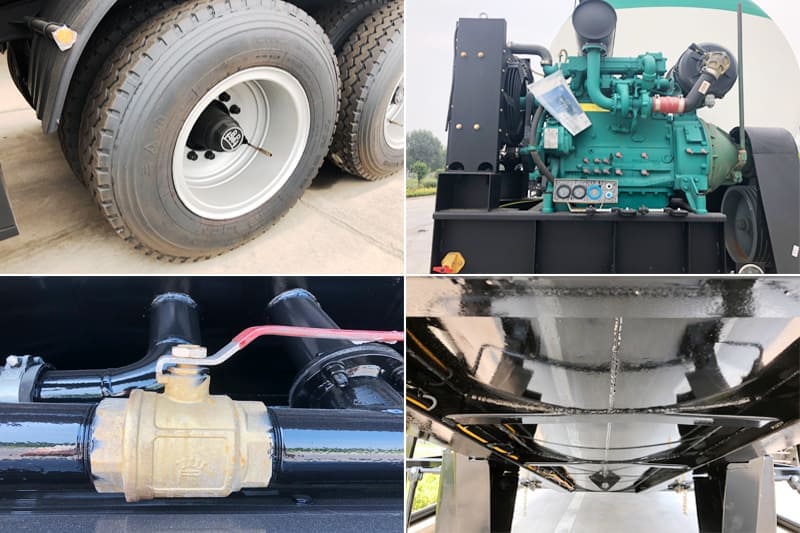
The compressor or blower is only one part of unloading. Pipe diameter, bends, silo height, backpressure and the silo filter can all change the unloading rate.
01
Tank BodyHolds the dry cement and pressure used during discharge.
02
Aeration SystemAdds air below the powder so it can move toward the outlet.
03
Compressor / BlowerProvides the airflow needed for pneumatic unloading.
04
Air & Discharge PipingRoutes air into the system and cement toward the receiving silo.
05
Silo Filter / VentLets displaced air leave the silo and helps control backpressure.
What can slow unloading?
Horizontal distanceLonger discharge lines add resistance.
Vertical liftA higher silo makes the material harder to move.
Pipe bends & diameterSmall pipes or too many bends can restrict flow.
BackpressurePoor venting or a blocked silo filter can resist incoming air and cement.
Cargo conditionMoisture can make cement harder to fluidize and discharge.
Our current cement tanker baseline is >1.5 t/min under suitable conditions. This is a mass unloading rate, not a fixed total unloading time.
How Bulk Cement Moves from the Plant to the Receiving Silo
The tanker is only one part of the job. Loading, road weight, connections and the receiving silo all affect the full transport cycle.
01Load
Confirm the tank is dry, clean and ready for the planned cement.
02Weigh
Check actual gross and axle loads before normal road operation.
03Transport
Run within the route, axle and tractor limits for the project.
04Connect
Connect the discharge hose and confirm the receiving silo is ready.
05Pressurize
Build air pressure using the approved operating sequence.
06Discharge
Monitor pressure and material flow until unloading is complete.
Simple Checks Before Loading and Unloading
These are general checks, not a replacement for the tanker operating manual or your site safety procedure. Use the approved procedure for the exact tanker and plant.
Before Loading
- Confirm the tank is dry and clean, with no water or unwanted residue.
- Check manholes, seals, valves and main piping for obvious damage.
- Confirm the cargo, planned load and loading method with the plant.
- Confirm the final road weight and axle loads after loading where required.
Before Unloading
- Confirm the receiving silo, filter and venting system are ready.
- Connect the discharge hose securely and check the planned pipe route.
- Follow the approved pressure and valve sequence for the exact tanker.
- Make sure the system is fully depressurized before opening any pressure-retaining cover after discharge.
If Unloading Is Slow, We Check the Whole System First
A bigger tank or compressor is not always the fix. Slow unloading or high residue can come from the air system, pipe route, cement condition or receiving silo.
| Operating problem | Likely cause | What Panda Mech checks first |
|---|---|---|
| Slow unloading | Not enough airflow, too much pipe resistance, poor cargo flow or high silo backpressure. | Air source, pipe route, tank aeration and silo filter. |
| High residue after discharge | Poor fluidization, damp cement or an internal flow problem. | Aeration system, cement condition and unloading steps. |
| Discharge line blockage | Damp powder, low airflow or too much pipe resistance. | Moisture, airflow, pressure, bends, pipe diameter and line length. |
| Tank is full before target payload | The cargo density or required volume was estimated incorrectly. | Cargo density, rated vs usable volume and target payload. |
| Low legal payload | The tractor or trailer is too heavy, or the axle setup does not fit local rules. | Tractor and trailer empty weight, GVW, axle limits and weight distribution. |
| Silo pressure rises during discharge | The silo cannot vent enough air, or the discharge line has too much resistance. | Silo backpressure, filter capacity, pipe route and airflow. |
| Uneven tire wear | Axle alignment, suspension or poor weight distribution. | Axles, chassis alignment, suspension and normal working load. |
| Pressure loss | Valve, seal or piping leakage. | Air lines, valves, gaskets and connections. |
After unloading: follow the operating manual and site procedure. Confirm the tanker is depressurized, check residue, hoses, valves and seals, and clean the system as required before the next cargo.
When a Pneumatic Cement Tanker Is the Right Choice
A pneumatic cement tanker is excellent for the right job, but it is not the right tank for every powder.
Choose this solution when…
- You regularly move dry bulk cement by road.
- The cargo is loaded in bulk and discharged into silos.
- You care about payload per trip and keeping the fleet productive.
- You want to unload bulk cement directly into a silo with compressed air.
- You can share your tractor and unloading-site details before we build.
Choose another setup when…
- Your operation mainly moves bagged cement rather than bulk powder.
- Your cargo is wet, sticky, corrosive or needs another type of tank.
- You carry flour, starch or another food powder that needs hygiene and cleaning controls.
- The planned payload is above the legal limit for the tractor-trailer combination.
- The silo or air source has not been checked for a high or long discharge route.
Compare the Main Cement Tanker Classes
Use these Panda Mech models to compare the main size classes. Then send us your route and silo details so we can confirm the legal road setup and unloading system.
Common Start
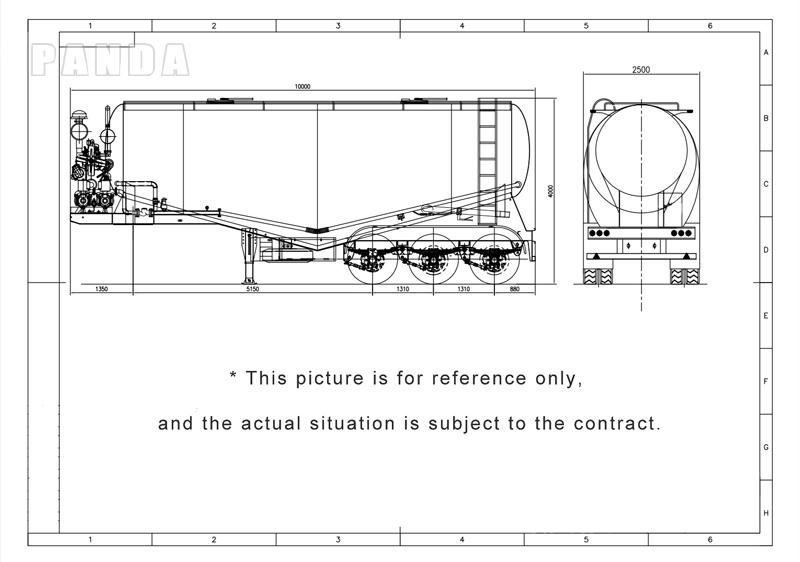
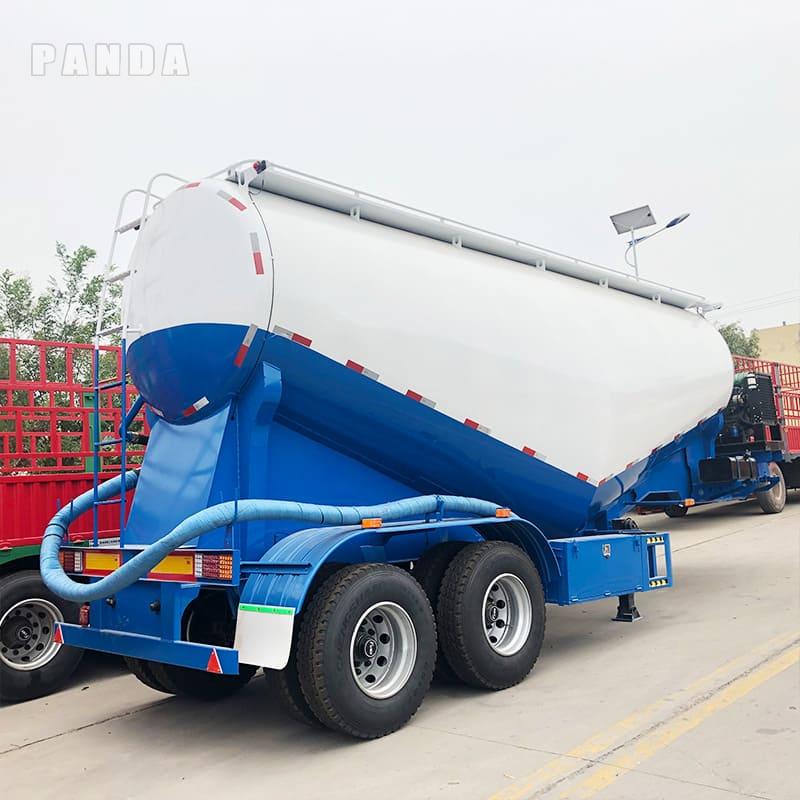
3 Axle 50 Ton Cement Tanker
A common starting point for high-capacity cement transport where local road and axle rules allow it.
50 tonPayload
40 m³Volume
3 axleAxles
>1.5t/min
Real Panda Mech Projects
What Real Cement Tanker Projects Show
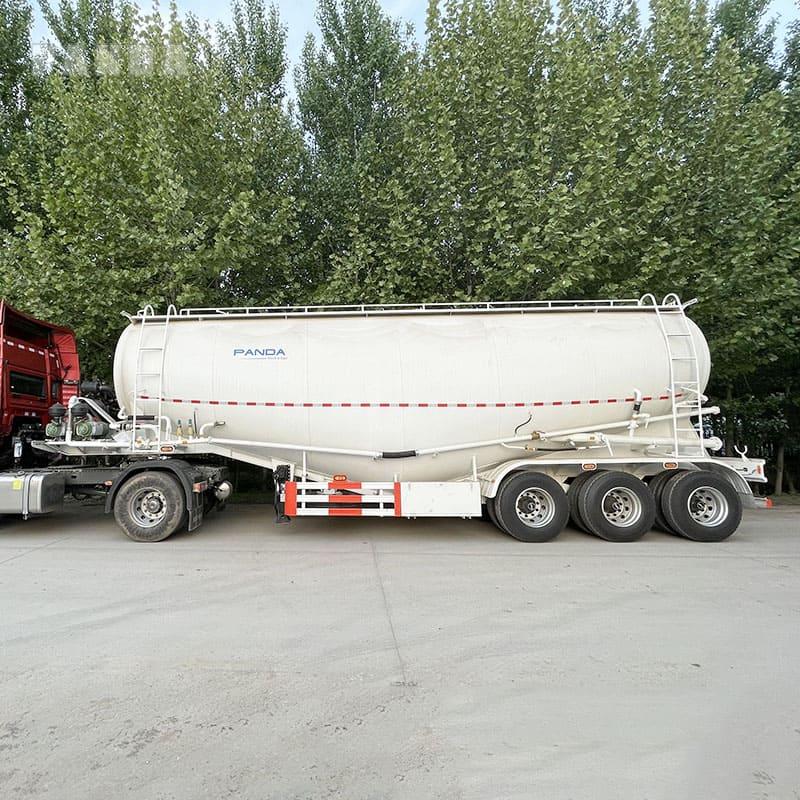
These projects show how payload, axle rules and maintenance needs changed the final setup. They do not mean the same configuration is right for every country.
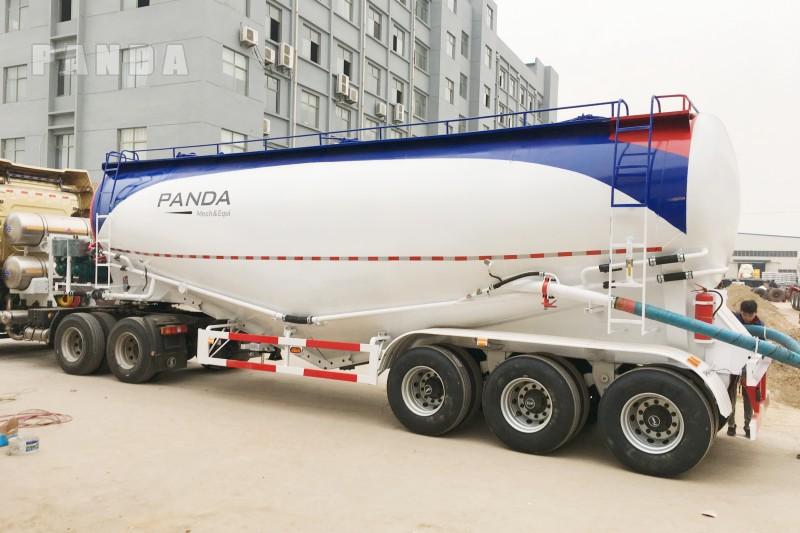
60 Units · 55 Ton · 3 Axle
A fleet in the Philippines ordered 60 units of 55-ton cement tankers with 3 FUWA axles. The project record lists about 6 tons tare weight for that supplied setup.
What this project shows: large fleet orders need one agreed configuration repeated consistently across the supplied units.
Read the Philippines project →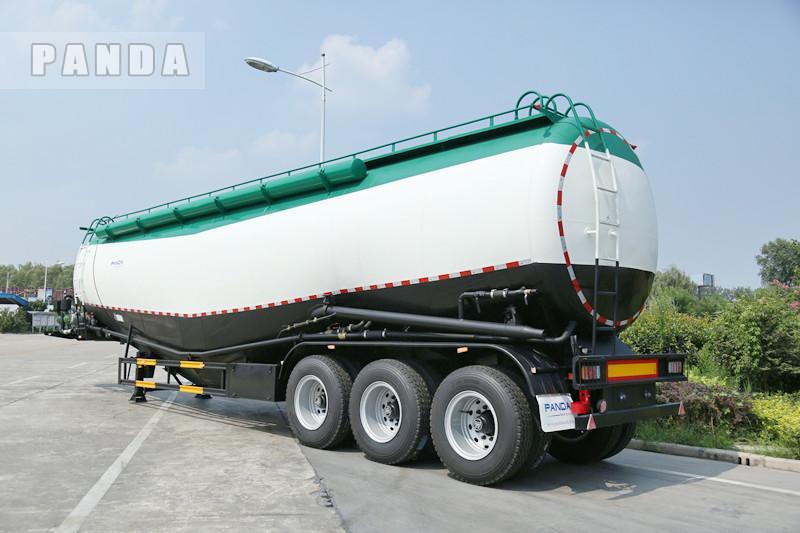
85 Ton · 60 Units Planned
A UAE construction-material fleet planned 60 heavy-duty 85-ton cement bulkers in batches. The first batch covered 20 units. Maintenance needs also affected the parts selected for the project.
What this project shows: heavy-duty fleet planning is not only about payload. Parts and maintenance planning also matter.
Read the UAE project →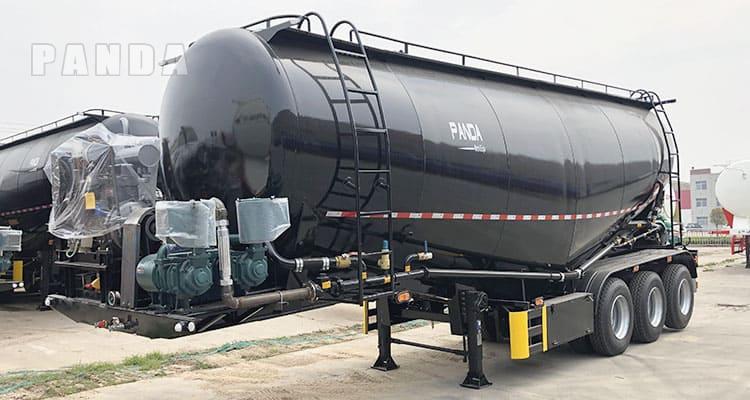
2 Axles Requested · 3 Axles Recommended
The customer first asked for a 2-axle cement bulker. After we checked the local weight limits, we recommended a 3-axle setup instead.
Why the setup changed: the local weight limit made the requested 2-axle layout unsuitable for the project.
Read the Ethiopia project →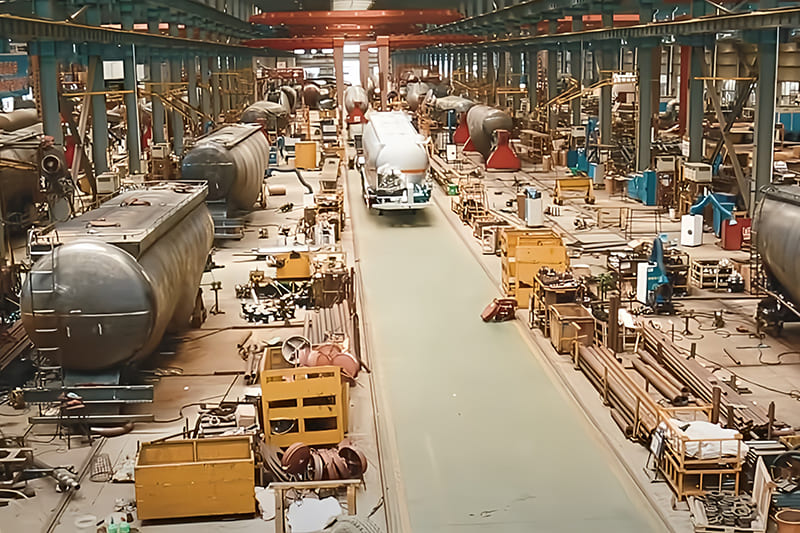
Manufacturing & Quality Control
We Check the Tank, Air System and Running Gear Together
For a pneumatic tanker, we do not treat the tank, chassis and air system as separate products. We check that the main systems match the approved project setup and work together as one transport system.
200+quality-control checks across production
Tank fabricationBuild and main dimensions against the approved specification.
Weld inspectionWeld consistency and rework control.
AirtightnessTank and air-system leak checks before shipment.
Pneumatic systemCompressor or engine installation, piping and valves.
Axles & brakesSuspension, brakes and running gear.
Final shipmentSurface finish and shipping protection before delivery.
Need the exact technical specification?Tell us the payload, country, tractor and unloading conditions. We can provide the specification for the configuration we recommend.
Request Technical SpecificationWhat Changes the Cost of a Bulk Cement Transport Trailer?
We do not use one price for every cement tanker. Price changes with payload, tank size, axles, suspension, air equipment, selected parts and shipping.
Payload & tank volume30T, 40T, 50T, 55T, 60T or a heavy-duty project setup.
Axles & suspensionAxle count, axle brand/rating and mechanical or air suspension where available.
Pneumatic packageAir source, compressor or blower, engine or PTO setup, valves and piping.
Tank shell materialConfirmed for the selected tanker and can affect tare weight, corrosion behavior and price.
Chassis / structural materialConfirmed separately from the tank shell.
Options, quantity & shippingRunning gear, tires, kingpin, order quantity, destination and export protection can change the final quotation.
30% + 70%General payment term
7–25 daysTypical production time
Destination dependentSea transit time
Within 1 hourTarget inquiry response
Bulk Cement Transport FAQ
What size cement tanker do I need?
Start with how many tonnes you need per trip and the cement bulk density. Then check tank volume, tractor and trailer tare weight, local GVW, axle limits, road conditions and the receiving silo. We often start by checking the 3-axle 50-ton / 40 m³ model, but it is not legal or suitable for every route.
Is a 40 m³ cement tanker the same as a 40 ton tanker?
No. m³ measures volume, while tons measure cargo mass. In our current cement tanker range, about 30 m³ is paired with the 40-ton class. About 40 m³ is paired with the mainstream 50-ton class. Your legal payload still depends on the complete tractor-trailer combination.
Should I choose a 3-axle or 4-axle cement tanker?
Three axles are a common starting point for many Panda Mech cement tankers. Four axles may make sense when you need different weight distribution or local axle rules require it. We check axle count, tare weight and legal load per axle before we recommend either setup.
What affects cement tanker unloading speed?
Unloading speed depends on the air source, cement condition, tank aeration, pipe diameter, distance, silo height and bends. Leaks, silo backpressure and the receiving filter also matter. Our current cement tanker baseline is above 1.5 t/min under suitable operating conditions.
What tractor information should I send before quotation?
Send the tractor make and model, fifth-wheel height and kingpin requirement if you know it. Also send the air and electrical connection details. If you want a PTO-driven air system, tell us that too. Tractor tare weight also affects the legal payload.
Can the same tanker carry fly ash?
One pneumatic dry-bulk tanker can sometimes carry both cement and fly ash. We still need to check density, moisture and how each powder fluidizes before we confirm one setup for both cargos.
Can a standard cement tanker be used for flour or starch?
No. We do not treat flour or starch like industrial cement. Food powders need a dedicated food-powder tanker setup with the right material, cleaning design and contamination controls.
Send Your Project Requirements
Tell Us the Route. We’ll Configure the Tanker Before Quoting.
You do not need every number before you contact us. Send what you know. We can flag missing engineering inputs before we finalize the setup.
Cargo & Capacity
- Cargo / powder type
- Bulk density, if known
- Loading temperature
- Target payload
- Target volume
- Other / previous cargo
Vehicle & Route
- Destination country
- Road condition
- Tractor model
- Fifth-wheel height
- Local GVW / axle limits
- Quantity
Silo & Delivery
- Silo height
- Horizontal discharge distance
- Pipe bends / diameter
- Desired unloading time
- Preferred air source
- Destination port
Send what you already know.
We will use your cargo, tractor, road and silo information to choose the tank size, axle setup and pneumatic system before we quote.