
Quick Answer
How Long Does a Cement Tanker Take to Unload?
Panda Mech cement tankers are designed to unload cement at more than 1.5 t/min. At 1.5 t/min, the main discharge takes about 20 minutes for 30 tons, 26.7 minutes for 40 tons and 33.3 minutes for 50 tons.
Total unloading time also includes pressure build, final cleanout and depressurization. Your hose length, silo height and pipe diameter also matter. So do compressor airflow, how evenly air loosens the cement inside the tank (aeration), and resistance from the receiving silo (backpressure).
If you need to meet a specific unloading time, send us your site details. We check the tanker, discharge line and receiving silo together as one pneumatic unloading system.
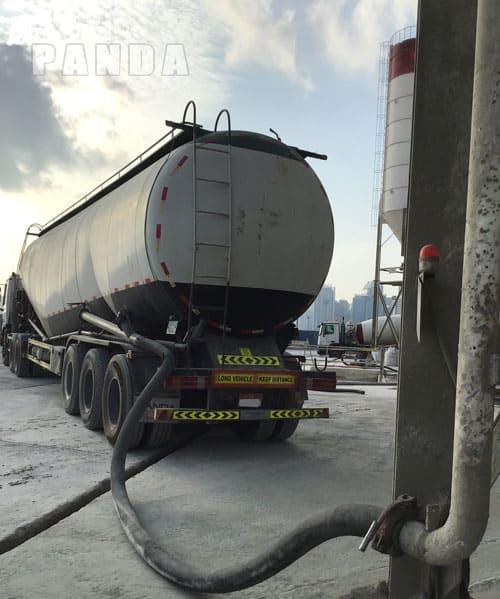
This is the cement mass discharge rate. Your site conditions still affect the total unloading time.
Payload Planning
Estimated Main Discharge Time for 30, 40 and 50 Tons of Cement
These figures use 1.5 t/min as the planning rate. If your tanker stays above 1.5 t/min under similar conditions, the main discharge will take less time than shown below.
| Cement Payload | Planning Rate | Main Discharge Time |
|---|---|---|
| 30 tons | 1.5 t/min | ≈ 20.0 min |
| 40 tons | 1.5 t/min | ≈ 26.7 min |
| 50 tons | 1.5 t/min | ≈ 33.3 min |
Add pressure-build, final-cleanout and depressurization time to estimate the full unloading cycle.
Planning a 50-ton configuration? View Panda Mech’s 3 Axle 50 Ton Bulk Cement Trailer.
Complete Unloading Cycle
Total Unloading Time Includes More Than the Main Discharge
We split unloading into four stages. This makes it clear whether a quoted unloading time covers only the main discharge or the whole cycle.
Planning Calculator
Calculate Cement Tanker Unloading Time From Your Site Inputs
Start with 1.5 t/min. If you have measured data from a similar tanker, cement load and receiving silo, you can use that average rate instead.
What you need to enter
- Payload: the amount of cement you need to unload.
- Average discharge rate: how many tons of cement move each minute, shown in t/min.
- Pressure-build time: the time needed to connect the system and build pressure.
- Final-cleanout time: the time needed to clear the cement left after the main discharge.
- Depressurization time: the time needed to release pressure safely and disconnect the hose.
Start with: 1.5 t/min. Use another rate only if you have a measured average from similar working conditions.
Enter the pressure-build, cleanout and depressurization times to calculate the full cycle and average cycle rate.
The main-discharge result does not include pressure build, final cleanout or depressurization.
Send us your payload, discharge distance, silo height, pipe diameter and receiving-silo details. We will check where the real limit is before suggesting a larger compressor or other hardware changes.
Why Site Results Change
Why Can the Same Cement Tanker Unload Fast at One Silo and Slow at Another?
The tanker and the receiving site work as one pneumatic system. The same trailer can unload very differently when the hose route, silo filter, fill pipe or venting changes.
Tanker Side
Receiving-Silo Side
What Affects Unloading Speed
What Controls Cement Tanker Discharge Rate?
Unloading speed depends on the whole pneumatic unloading system, not just the compressor.
- Compressor airflow
- Approved operating pressure
- Air leaks and intake condition
- How evenly air moves through the tank
- How well the air loosens the cement (fluidization)
- Tank shape and how cement moves toward the outlet
- Bulk density
- Moisture and compaction
- Flowability after transport
- Pipe / hose diameter
- Horizontal distance
- Bends and vertical lift
- Silo inlet restriction
- Silo filter / baghouse and venting condition
- Backpressure — resistance from the silo during unloading
Your Unloading Site
Hose Distance, Pipe Diameter and Silo Height Can Change Unloading Time
The tanker is only one part of the unloading system. A long hose, small pipe, many bends or a high silo can slow the flow after cement leaves the trailer.
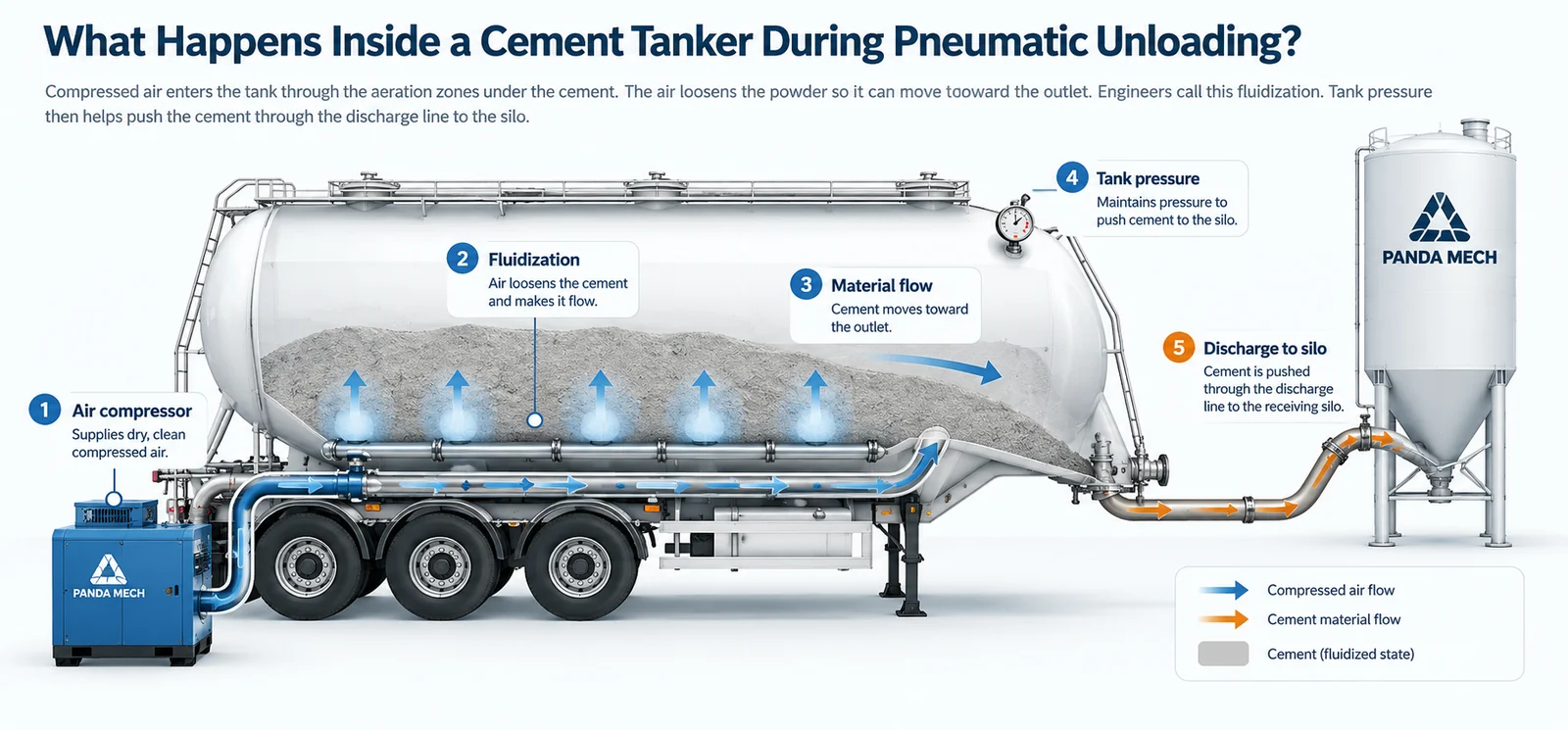 Tank + compressor + discharge line + receiving silo
Pressure vs Flow
Does Higher Tank Pressure Mean Faster Cement Unloading?
No. Higher pressure does not automatically mean more cement is moving each minute. Pressure shows how hard the system is pushing against resistance; discharge rate tells you how much cement is actually moving.
The discharge line also needs enough airflow to carry cement through the pipe. That airflow creates the air speed, or air velocity, needed to keep powder moving. Pipe diameter, hose length, bends and silo height all change the airflow and pressure the system needs.
If tank pressure rises while cement flow falls, look for resistance, poor aeration or receiving-silo backpressure before increasing pressure.
Slow Unloading Check
Why Is My Cement Tanker Taking Too Long to Unload?
Look at when and how the cement flow slows down. That usually tells you where to check first.
| What You See | Likely Cause | Check First | What We Recommend |
|---|---|---|---|
| Slow from the beginning | Insufficient air supply or leakage | Compressor output, intake filter, air leaks, seals and valve position | Check actual airflow and air leaks before choosing a larger compressor. |
| Pressure is high but cement flow is low | Restriction or poor fluidization | Product valve, hose, pipe bends, aeration and silo inlet | Do not raise pressure first. Check for a blocked or narrow flow path, poor aeration, or silo backpressure. |
| Fast start, slow finish | Residual zones or uneven aeration | Front/rear air sequence, dead zones and fluidizing fabric | Check air distribution and how cement moves toward the outlet. Poor balance often makes the last part of the load slow. |
| Flow pulses or stops intermittently | Unstable air/material balance | Secondary air, hose restriction, valve position and silo venting | Check the hose, valves and silo venting before asking the compressor to supply more air. |
| Performance drops when the hose is longer | Pipeline resistance | Hose length, diameter, bends and vertical lift | Check the real hose and pipe route at your site, not a shorter reference route. |
| The same tanker is slow only at one customer | Receiving-site restriction | Silo filter / baghouse, venting, fill pipe, inlet, bends and vertical lift | Compare the receiving site before changing tanker hardware. A restricted silo can make a healthy tanker look slow. |
| Performance gets worse over time | Maintenance or wear | Compressor, intake filter, valves, seals, aeration fabric or pads, worn bends and line cleanliness | Service worn or dirty parts first. Several small losses can add up and make unloading much slower. |
What we recommend checking first
Less Time at the Silo
More predictable unloading means each tanker spends less time at the receiving point.
More Driving Time
Less waiting at the silo leaves more of the working day for transport.
Lower Delivered Cost per Ton
More repeatable unloading times make dispatch and driver planning easier and can reduce delivered cost per ton.
Performance Over Time
Why Does Cement Tanker Unloading Get Slower Over Time?
If unloading gradually becomes slower over several months, check maintenance condition before changing the original tanker specification. Wear, dirt and small air losses can build up.
Panda Mech Engineering
How Panda Mech Builds for Stable Cement Unloading
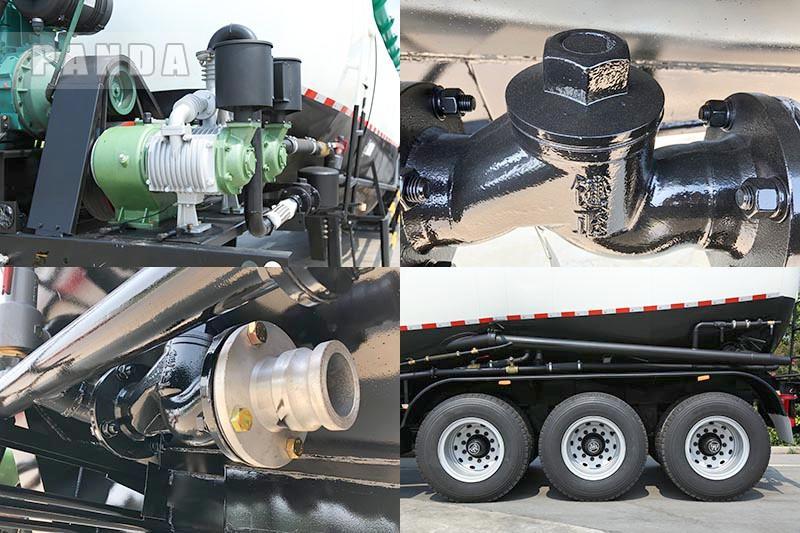
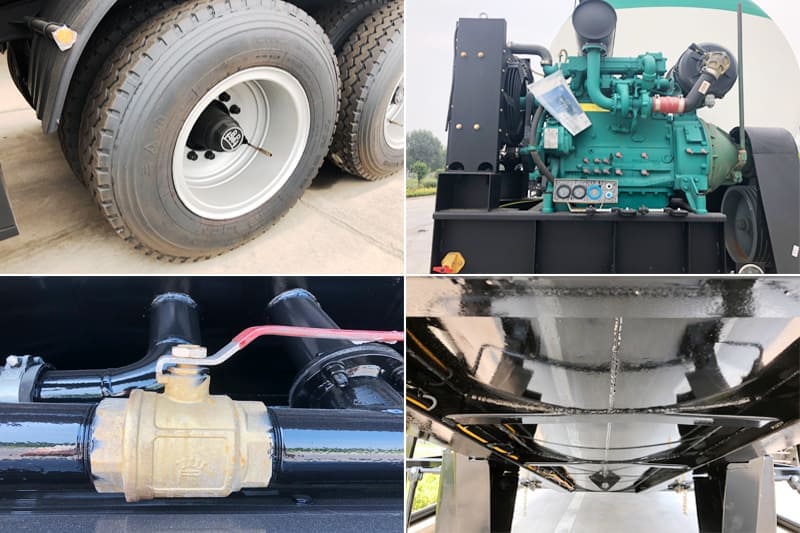
We do not choose unloading hardware from tank tonnage alone. We check compressor airflow, air distribution inside the tank, the discharge pipe and the receiving silo together.

Choosing the Setup
Choose the Right Cement Tanker Setup for Your Unloading Site
Tell us where and how the tanker will unload, not only how many tons it will carry. Hose length, silo height and receiving conditions can change the right setup.
| Your Situation | What Panda Mech Checks | What to Send Us |
|---|---|---|
| Standard cement delivery | Start with our >1.5 t/min cement unloading baseline and standard cement tanker unloading setup. | Payload, destination country, tractor, road condition and receiving silo. |
| Long horizontal discharge line | We check compressor airflow, pipe diameter and line resistance together. | Horizontal distance, pipe/hose diameter and bends. |
| High receiving silo | We check silo height and total line resistance before choosing the compressor. | Silo inlet height, filter/venting condition and backpressure information if available. |
| Tight unloading-time target | We check the compressor, tank aeration, discharge line and receiving silo together. | Target total cycle time and whether the target includes pressure build and final cleanout. |
| Several trailers for one fleet | We can standardize valves, hoses, axles, tires and service parts when your routes allow it. | Common routes, tractors, silo types, maintenance strategy and quantity. |
Cement Tanker Unloading FAQ
Common Questions About Cement Tanker Unloading Time
How long does it take to unload a cement tanker?
Panda Mech cement tankers are designed to unload cement at more than 1.5 t/min. At 1.5 t/min, the main discharge takes about 20 minutes for 30 tons, 26.7 minutes for 40 tons and 33.3 minutes for 50 tons. Add pressure build, final cleanout and depressurization for the full site cycle.
What is the discharge rate of a Panda Mech cement tanker?
Our confirmed cement unloading benchmark is above 1.5 t/min. This is cement mass flow, not compressor airflow. Your actual site rate can change with compressor output, aeration, cement condition, discharge distance, silo height and silo backpressure.
How long does a 30 ton cement tanker take to unload?
At 1.5 t/min, 30 tons takes about 20 minutes for the main discharge. Add pressure-build, cleanout and depressurization time for the full unloading cycle.
How long does a 40 ton cement tanker take to unload?
At 1.5 t/min, 40 tons takes about 26.7 minutes for the main discharge. The full cycle also depends on the tanker, discharge line and receiving silo.
How long does a 50 ton cement tanker take to unload?
At 1.5 t/min, 50 tons takes about 33.3 minutes for the main discharge. If the system stays above 1.5 t/min under similar conditions, this stage will be faster. The full site cycle is still longer because pressure build, cleanout and depressurization are included.
Why is my cement tanker unloading slowly?
Look at when the flow slows down. High pressure with low flow often points to a restriction, poor aeration or silo backpressure. Slow flow from the start can mean low airflow or an air leak. A slow finish often points to leftover cement in low-flow areas or uneven aeration.
Does a larger compressor always unload cement faster?
No. A larger compressor only helps when the rest of the unloading system can use the extra air. The tank aeration, discharge pipe, silo height and receiving silo must also match. If the restriction is somewhere else, more air can add pressure or heat without moving much more cement.
Does silo height affect cement tanker unloading time?
Yes. A higher silo means the cement must be lifted farther, so the air system has to work harder. Send us the silo inlet height, horizontal distance, pipe diameter, bends and filter or venting condition before we finalize the setup.
Why can the same cement tanker unload faster at one silo than another?
The receiving site is part of the pneumatic system. A blocked silo filter or baghouse, poor venting, a restricted fill pipe, longer hose, more bends or higher vertical lift can all add resistance. If the same tanker is slow only at one customer, check the receiving system before changing tanker hardware.
Does higher tank pressure mean faster cement unloading?
No. Higher pressure can mean the system is pushing against more resistance. If pressure rises while cement flow stays low, check the discharge line, aeration and receiving-silo backpressure. Do not exceed the approved working pressure to chase a shorter unloading time.
Configuration Support
Get a Cement Tanker Matched to Your Unloading Target
Tell us your cement payload, discharge route and receiving-silo conditions. We will use them to match the tanker, compressor, tank aeration and discharge system to your site.
You do not need every engineering value before contacting us. Send what you know, and we will tell you which details are still needed before we finalize the setup.
Get My Tanker Setup & QuoteFor cement plants, transport fleets and engineering projects.