
01
Load
Dry cement enters through the top loading port or manhole while there is no pressure in the tank.
Cement Tanker Engineering / Working Principle
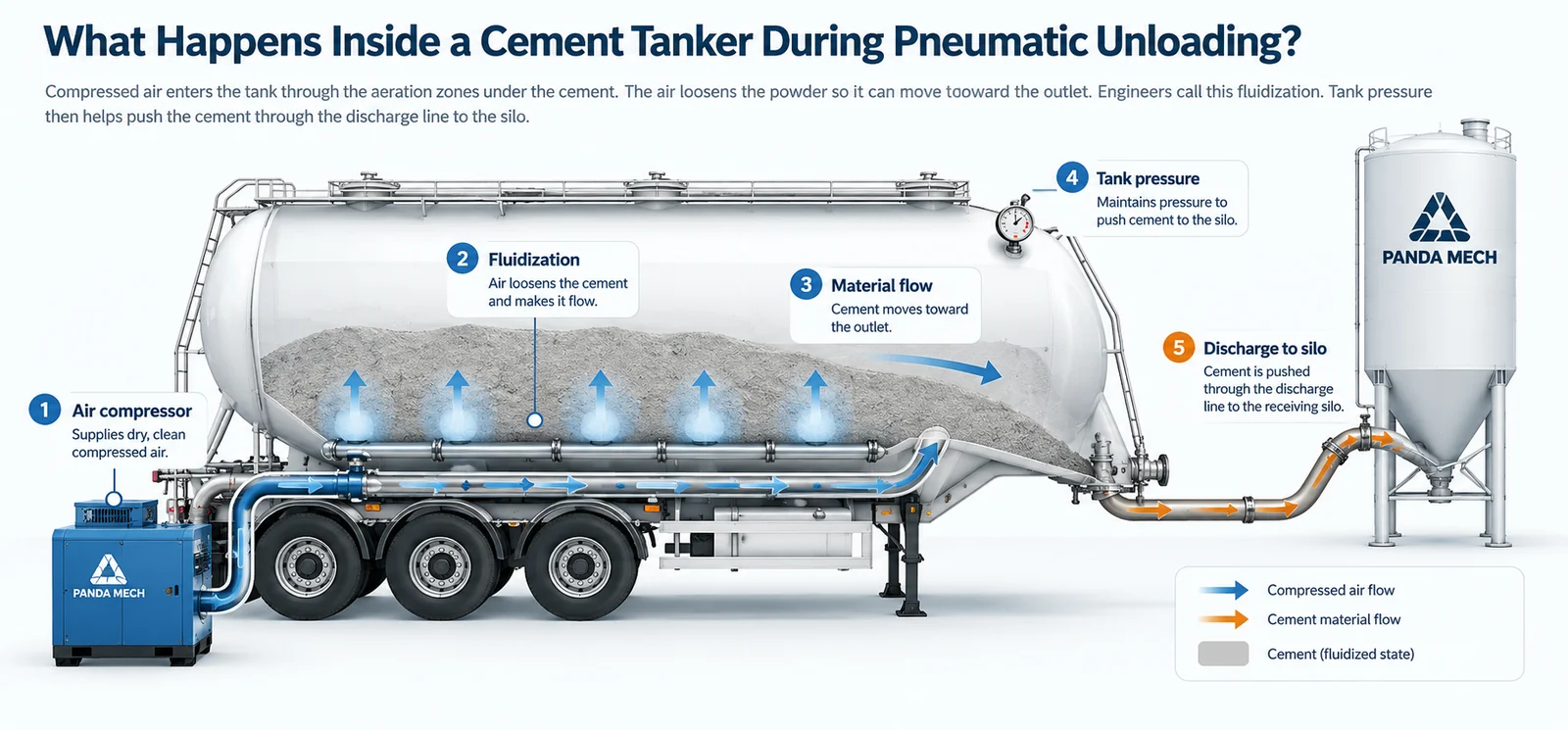
A Panda Mech cement tanker uses compressed air to unload dry cement. This air-powered method is called pneumatic unloading. The compressor supplies the air, and the aeration system spreads it under the cement so the powder can move. The cement then travels through the discharge line into the silo. For our current cement tanker range, the cement unloading baseline is >1.5 t/min when the tanker, cargo, pipeline and silo are correctly matched.
For a first check, send us your cargo, target payload, horizontal discharge distance and silo height.
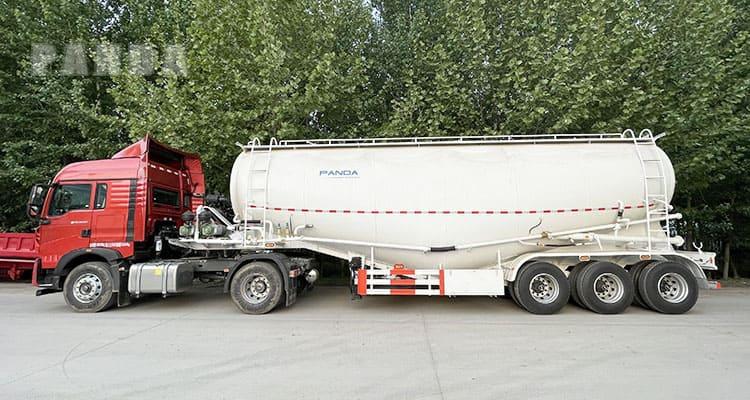
Panda Mech cement tanker for sealed dry-cement transport and pneumatic unloading.
The tanker does not work alone during unloading. The tank, compressor, aeration system, discharge line and silo must work together.
A cement tanker carries dry cement powder and normally unloads it with compressed air. A concrete mixer truck carries wet concrete in a rotating drum. They carry different materials and use different unloading systems.
These are the six main steps. For your tanker, follow the valve order and operating values supplied by Panda Mech.
Dry cement enters through the top loading port or manhole while there is no pressure in the tank.
Before transport, close and secure the manholes, valves and pressure-side connections.
Connect the discharge hose to the silo inlet and make sure the unloading area is ready.
Start the configured compressor. It supplies air until the tanker reaches its approved unloading condition.
Aeration helps the cement move. The pressure difference between the tanker and the receiving side then drives cement through the line.
Clear the remaining cement, stop the air source and safely release the tank pressure.
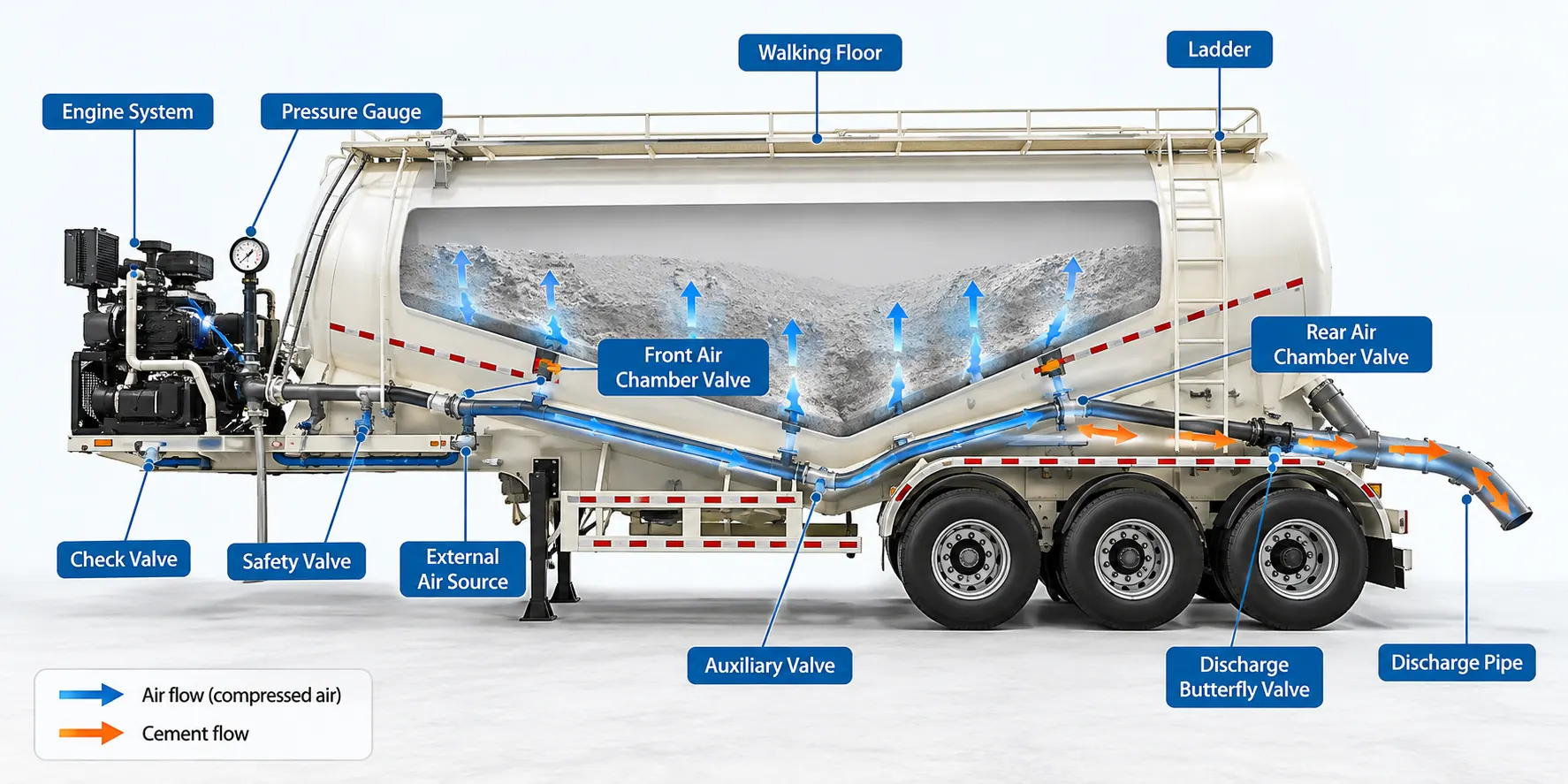
Each pneumatic part has a different job. Good unloading depends on all of them working together.
Stage 1 — Loading & Sealing
On a conventional gravity-loaded cement tanker, dry cement enters through the top opening. Before transport, close and secure the tank and discharge system. This allows the tanker to build pressure later during unloading.
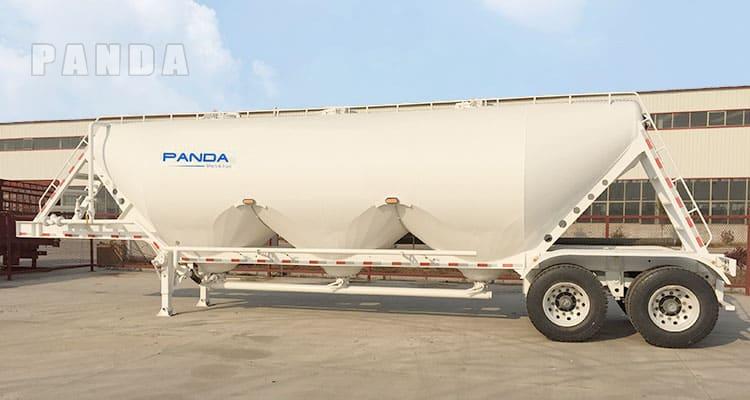
Panda Mech W-type cement tanker showing the sealed tank body and top loading access.
Stage 2 — Pressurization
More pressure does not always mean faster unloading. You need enough airflow, the right pressure and even aeration. A blocked or restricted line can raise pressure while cement flow gets slower.
Supplies air to build tank pressure, loosen the powder and move cement through the discharge line.
Pressure shows how much resistance the system is working against. Higher pressure does not automatically mean faster unloading.
Stage 3 — Fluidization
Air moves through the aeration layer under the cement. This reduces friction between particles and helps the powder move toward the outlet.
Rear pneumatic equipment and discharge piping on a Panda Mech cement tanker.
Stage 4 — Pneumatic Discharge
Once the tanker reaches the approved unloading condition, open the product valve in the correct sequence. The aerated cement moves to the outlet. Air then carries it through the pipe and hose into the silo.
For Panda Mech cement tankers, this is our current cement mass unloading baseline.
t/min = cement mass flow. It is not the same unit as compressor airflow in m³/min.Moisture, caking and particle size can change how easily the cement flows.
Must supply enough air for pressure build-up, aeration and conveying.
Affects how evenly cement moves toward the outlet.
Longer runs, smaller pipes and more bends increase pressure loss.
A higher silo inlet makes the cement harder to convey.
This is pressure inside the receiving silo that resists incoming air and cement. The silo filter and vent affect how easily that air can escape.
Stage 5 — Final Cleanout & Depressurization
Some cement may still remain after the main flow stops. Clear the required areas first. Then stop the air source and release tank pressure before you open pressure-side parts or disconnect the hose.
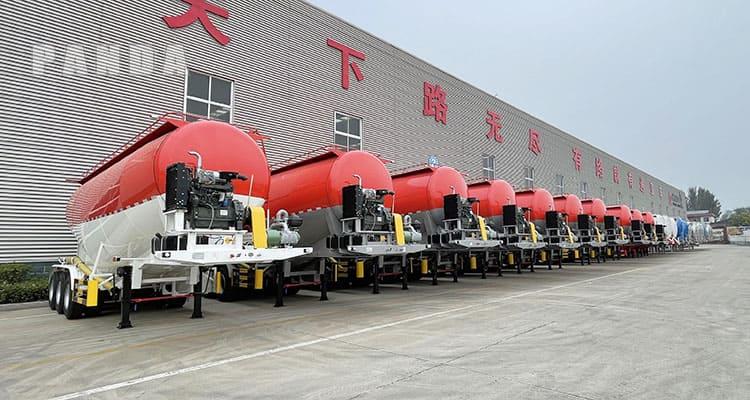
Panda Mech cement tanker lineup showing rear pneumatic equipment and discharge components.
Unloading speed is not controlled by compressor size alone. It depends on three groups of conditions: the tanker, the cement and the receiving site. We check all three together.
| On the Tanker | Your Cement | At the Unloading Site |
|---|---|---|
| Compressor airflow | Bulk density | Horizontal discharge distance |
| Correct operating pressure and airflow | How easily the cement flows | Vertical silo height |
| Aeration system condition | Moisture | Pipe / hose diameter |
| Tank geometry | Caking tendency | Number of pipe bends |
| Product valve / discharge pipe | Changes in cement condition | Silo backpressure, vent and filter condition |
Tank capacity alone is not enough to choose the pneumatic setup. Your silo can change pressure and unloading speed. Before we finalize the tanker, we check the silo height, inlet, vent, filter and pipe route.
A higher silo inlet makes the cement harder to lift. We include this height in the system check.
The silo inlet must match the tanker hose and pipe setup.
The silo vent and filter must let displaced air escape during unloading.
Too much silo backpressure can slow cement flow and raise tank pressure.
Long pipe runs, small pipe sizes and many bends increase resistance.
Make sure the silo has enough free space before unloading starts.
Slow unloading usually means something in the system needs checking. Do not increase pressure first. Start by locating the restriction or loss.
| Symptom | Check First | Common Engineering Cause |
|---|---|---|
| Pressure rises but cement flow stays low | Discharge line + receiving silo | Restriction, excessive backpressure, undersized/blocked line |
| Tank cannot build pressure normally | Manhole seals, valves, pneumatic joints | Air leakage |
| Material flow is uneven | Aeration zones | Uneven fluidization or damaged/blocked aeration path |
| High residual cement remains | Tank geometry + aeration | Dead zones or incomplete cleanout |
| Performance drops with damp cargo | Cargo condition | Moisture, agglomeration or caking |
| Pressure becomes unstable | Air source + pipeline + silo | Compressor fluctuation, leakage or changing restriction |
For applicable Panda Mech cement tanker configurations, our technical operating content uses approximately 0.15 MPa as a line-clearing reference and approximately 0.20 MPa as a discharge-start reference. We confirm the final operating pressure and valve sequence for the actual tanker configuration before delivery.
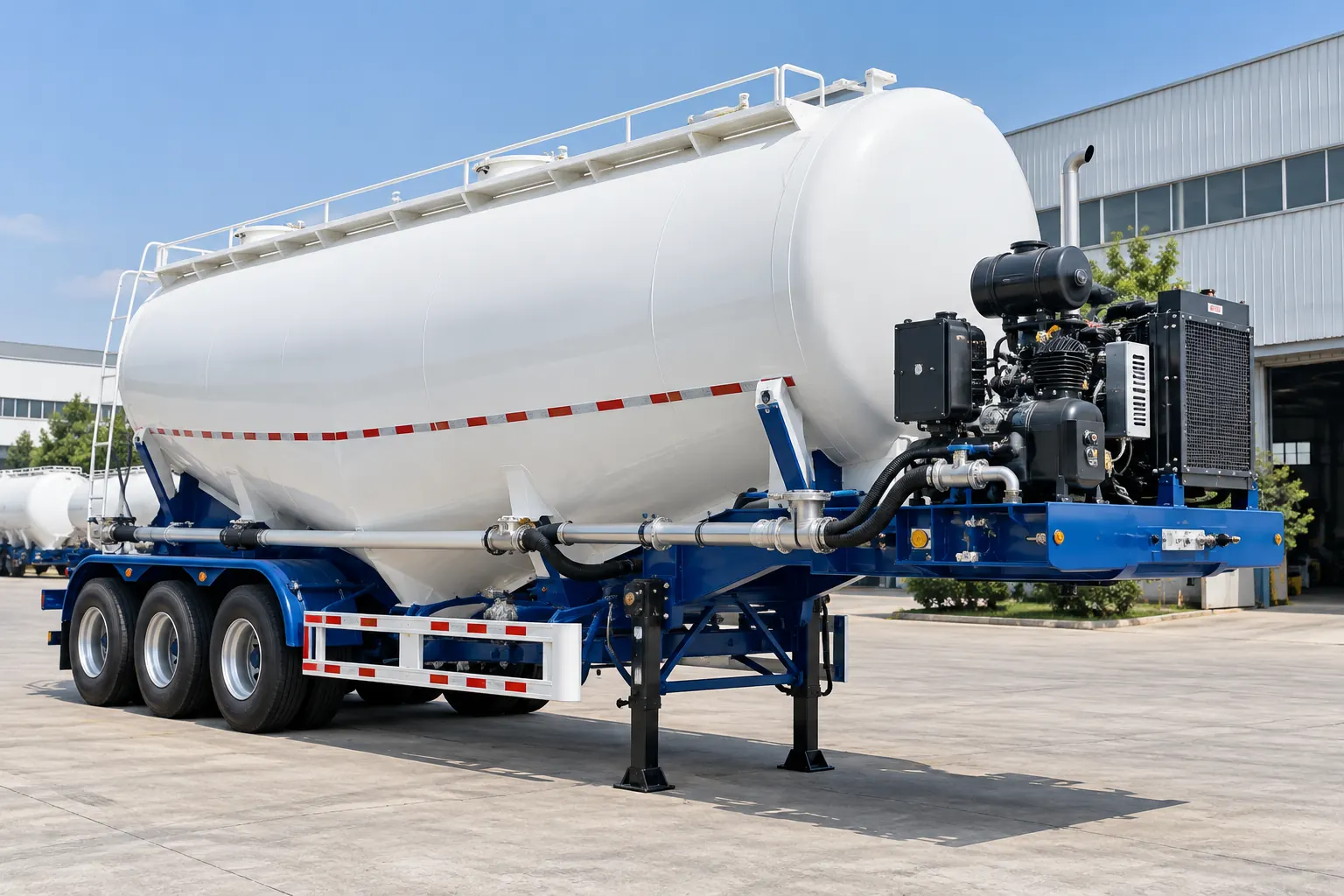
Tell us what you will carry, where the tanker will run and how you will unload it. We use this information to choose the tank size, axle setup and pneumatic system for the quotation.
| Send Us | Why It Matters | What We May Change |
|---|---|---|
| Cargo | Different powders do not flow or unload the same way. | Air system and unloading setup |
| Bulk density | Helps us match your target payload with the tank volume. | Tank volume |
| Target payload | Tells us how much cargo the tanker needs to carry. | Tank size and axle setup |
| Destination country | Road limits and vehicle rules differ by country. | Axles, gross vehicle weight (GVW) and dimensions |
| Road condition | Rough roads and heavy-duty routes can change the chassis and running gear we recommend. | Suspension, axles and chassis setup |
| Tractor specification | The trailer and compressor drive must work with your tractor. | Kingpin, power take-off (PTO) and compressor drive setup |
| Horizontal discharge distance | A longer discharge distance makes cement harder to convey. | Air system and discharge line |
| Silo height | A higher silo inlet adds more conveying resistance. | Air system setup |
| Silo filter / backpressure | A blocked or poorly vented silo can slow unloading. | Silo and unloading setup |
| Target unloading time | Tells us how fast you want the tanker to unload on site. | Compressor, pipeline and operating setup |
Manufacturing & QC
A good design still needs good manufacturing and inspection. Before shipment, we check the tank structure, pressure-side parts, air system, running gear and final order setup.
Check that the finished tanker matches the approved order.
Check the tank structure and weld quality during production.
Check seals and connections so the tanker can build and hold the required pressure.
Check pipe connections and valve operation for leaks or control problems.
Check that the configured compressor or engine system works correctly.
Check that the air path and discharge controls work correctly.
Check the axles, suspension and brakes against the approved order.
Check the finished trailer size and setup before delivery.
Check the paint and surface condition, then prepare the tanker for shipment.
Real Project
For a Philippines fleet project, Panda Mech supplied 60 units of 55-ton, 3-axle cement tankers. For a fleet order like this, repeatability matters: every unit needs the same approved setup. Axles, payload target, pneumatic system, road use and unloading conditions all matter—not just tank size.
This Philippines project used a 55-ton, 3-axle cement tanker setup, with 60 units supplied.
For your project, we still check the cargo, payload, tractor, roads and unloading site before production. A past project shows our experience, but your route still needs its own check.
View the Philippines 60-Unit Project →Not exactly. Aeration first helps the cement move. Airflow and the pressure difference then carry it through the discharge line.
No. A blocked line, high silo backpressure or poor aeration can raise pressure while cement flow stays slow.
No. The real problem may be the aeration system, wet or caked cement, the pipe route, valves or the silo.
No. You still need to clear the remaining cement and release tank pressure safely.
Once you understand the working principle, the next step is choosing the tanker that fits your cargo and route. Start with the full cement tanker range, or go straight to the 3 Axle 50 Ton model if it is close to what you need.
Start here if you are still comparing payload, tank volume and axle options.
Compare Cement Tanker ModelsChoose this page if you are looking for about 50 tons of payload and about 40 CBM of tank volume. Final legal payload still depends on the destination country and approved vehicle setup.
View the 50 Ton Cement TrailerNeed a broader dry-bulk explanation? See how a pneumatic dry bulk trailer works.
The compressor supplies air to the tanker. The aeration system spreads this air under the cement so the powder becomes easier to move. A pressure difference then pushes the cement through the outlet, pipe and hose into the silo.
Panda Mech uses >1.5 t/min as the current cement unloading performance baseline. Actual site performance depends on cargo condition, compressor output, aeration, hose and pipe resistance, vertical lift, bends, silo backpressure and receiving filter condition.
The compressor supplies the air used to build pressure, loosen the cement and move it through the discharge line. A bigger compressor is not always better. It must work with the aeration system, pipeline and silo.
For applicable Panda Mech cement tankers, about 0.20 MPa is a reference point before main discharge. Use the final pressure and valve sequence supplied for your actual tanker.
High pressure can mean the system is fighting resistance. A blocked pipe, poor aeration, wet or caked cement, a high silo inlet or silo backpressure can all slow the flow.
Yes. A higher silo inlet makes the cement harder to convey. We also check horizontal distance, pipe size, bends, venting and silo backpressure.
Cement does not become a liquid. Air moves through the aeration layer and reduces friction between cement particles. This makes the powder easier to move toward the outlet.
No. A cement tanker carries dry cement or similar powder and normally unloads with compressed air. A concrete mixer truck carries wet concrete in a rotating drum.
Before we quote, send us the basic working conditions. We use them to recommend the tank volume, axle setup and pneumatic system.
We check your cargo, route, tractor and silo together. Then we recommend the tanker setup instead of quoting by tank volume alone.
Send My Project DetailsTarget response time: within 1 hour.