
What Is a Pneumatic Trailer?
A pneumatic trailer is an enclosed tank trailer that carries dry, loose solids (dry bulk) and uses compressed air to unload them through a hose. Its cargo can include powders such as cement or flour. Some designs carry granules, meaning small solid pieces such as plastic pellets. Cargo and loading options depend on the tank’s design.
Key Takeaways
- Match the trailer to the exact cargo; one tank design does not suit every dry material.
- Use a food transport setup for food powders, and check contact surfaces, previous loads and cleaning needs.
- Trace the air supply and discharge line to understand how the cargo leaves the tank.
- Check the equipment behind the name: “dry bulk” also describes trailers without pneumatic unloading.
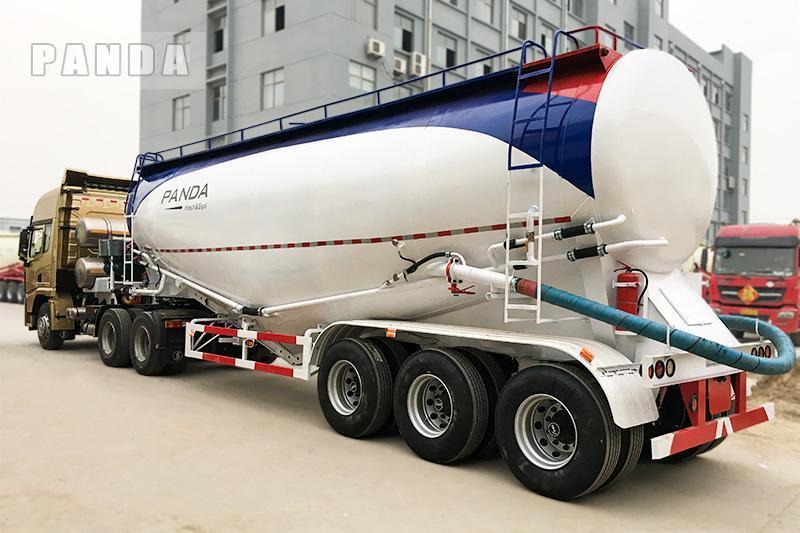
Dry bulk means dry solid material carried loose, without individual bags or packages. The trailer carries the tank, and a tractor unit pulls it.
During unloading, a hose connects the tank to a suitable bulk inlet at the receiving site. This is useful when the site has enough storage space and can vent the incoming air. If the destination has no compatible inlet or needs cargo unloaded into an open pile, check another unloading method before choosing a pneumatic trailer. The closed hose route helps reduce open powder handling, but the seals, hose and receiving system must suit the cargo.
What Can a Pneumatic Trailer Carry?
Pneumatic trailers can carry suitable industrial powders, food powders and some granular materials. Cement, fly ash and lime are industrial examples; flour needs a trailer designed for food transport. Some trailer designs handle plastic pellets. Match the tank and unloading system to the material’s flow and cleanliness needs.
| Your cargo | Start with | Why | What to verify |
|---|---|---|---|
| Industrial powders: cement, fly ash or lime powder | A pneumatic tanker built for the specified powder | Moisture and flow behavior affect how powder reaches the outlet | The exact material, its condition and the model’s approved cargo list |
| Food powders: flour or another approved food powder | A tanker built for food transport | Food contact surfaces, previous cargo and cleaning affect whether the tanker is fit for food use | Materials that touch the food, allowed cargo changes, and cleaning and drying needs |
| Granules: plastic pellets on suitable designs | A model approved for that granular cargo | A powder tanker’s air and outlet setup may not suit the pellets | Particle form, loading method and the model’s unloading system |
| Grain or aggregate delivered to a gravity-discharge receiver | A suitable gravity hopper or commodity trailer | Cargo can leave through the bottom outlet under its own weight; pneumatic conveying is not required | Cargo size, receiving equipment and the selected trailer’s approved application |
Panda Mech lists plastic pellets and powders as possible pneumatic tanker cargo. This does not approve every model or every plastic grade. For pellet transport, check the exact material and the selected model’s loading and discharge setup.
An enclosed tank does not make a trailer suitable for every dry material. Wet, sticky, corrosive, highly abrasive, reactive or potentially combustible powders need a separate cargo and site risk assessment before you choose a tanker. If the chosen model cannot transport and unload the material safely, use equipment approved for that cargo instead. Send us the exact material and its condition so we can check the suitable trailer route.
For food cargo, confirm that the tank, seals, valves and hoses are suitable for the product. Check the previous and next loads, including allergen restrictions, and whether a dedicated tanker is needed. If the previous load or the required cleaning and drying cannot be verified, do not approve a change to the next food powder. Washing a standard cement tanker does not prove that it is fit to carry flour. If the powder presents a combustible-dust risk, follow the applicable site safety requirements.
After wet washing: Confirm the tank is dry for the next approved food load. Follow the cargo-specific cleaning and drying requirements.
At Panda Mech, our pneumatic dry bulk trailer range covers cement, fly ash and listed mineral powders. Flour needs a separate tanker setup. Our flour tankers have aluminum and stainless-steel tank options. Confirm the exact grade and any required food-contact documents for the order.
What Are the Main Components of a Pneumatic Tank Trailer?
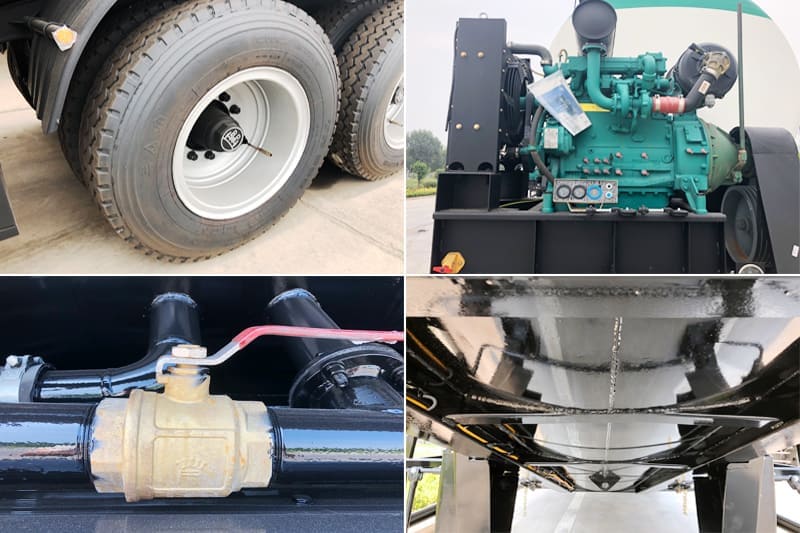
The main parts include the cargo tank, loading openings, air system, valves for cargo flow, discharge line, and the axles, wheels, suspension and brakes (running gear). Air helps suitable powder flow near outlets; this is called aeration. A pressure gauge shows pressure. A vent valve releases air, while a relief valve protects against excess pressure.
The Heil dry bulk trailer manual explains which parts supply air, control cargo flow, show pressure and protect against excess pressure.
| Component | What it does | Main difference |
|---|---|---|
| Tank body and lower outlet sections (discharge hoppers) | The tank holds the cargo. The lower hoppers guide it toward the outlets. | Several hoppers can share one cargo chamber. Counting outlets does not show how many separate chambers the tank has. |
| Access openings (manholes) and loading openings | Let you fill the tank through the openings specified for the model | Top filling uses the tank’s top openings. A loading line is optional, so check whether it is fitted. |
| Air source and air piping | The air source supplies unloading air, and the pipes distribute it. | The machine that supplies air is the compressor or blower. A separate engine or the tractor can supply the power to run it. |
| Aeration equipment | Uses air to help suitable powder reach an outlet | Some granules flow easily (free-flowing cargo) and use a different air setup from powders that need aeration. |
| Cargo flow valves (product valves), discharge pipe and hose | The valves control the cargo’s path; the discharge pipe and hose connect it to the receiving line. | The cargo path carries material. The air supply brings in the air that helps move it. |
| Pressure gauge | Shows the pressure at its measuring point | A gauge gives a pressure reading; a control valve adjusts flow. |
| Valve for releasing tank air (vent or blowdown valve) | Releases air from the tank under the approved procedure | Planned venting uses this valve. Automatic protection against excess pressure comes from the pressure relief valve. |
| Pressure relief valve | Protects against excess pressure | This is a safety device, not a valve for routine flow adjustment. |
| Supporting structure (chassis) and running gear | Support the tank and carry it on the road | The chassis and running gear carry the tank. The tank itself holds the cargo. |
Pressure safety: A pneumatic tanker is pressurized during unloading. Follow the operating procedure approved for your model. Never open a manhole, remove a pressure-side fitting or disconnect a discharge hose until the air supply is stopped and the tank is fully depressurized and confirmed safe. Never change a pressure-relief setting to make unloading faster.
Pressure values are not interchangeable: A gauge shows pressure at its measuring point; it does not set the approved unloading target. Use the operating pressure or range specified for the actual trailer model. Design pressure, test pressure and the relief-valve setting have different purposes. Do not use them as normal unloading targets.

How Does Air Move the Cargo?
For powders that need aeration, air helps the material flow toward an outlet before it travels through the discharge line. This behavior is called fluidization: air makes the powder flow more easily while it stays solid. The receiving silo is the site’s fixed storage vessel, separate from the trailer.
Many conventional pneumatic tankers are filled through top loading openings while the tank is not pressurized. The steps below explain how material leaves the tank using air. They do not mean every trailer can draw material into the tank by vacuum; that needs a suitable self-loading system.
- The air source supplies the tank and its air lines.
- Air passing through the aeration system helps suitable powder reach the outlet.
- The pressure difference and the air carrying the material (conveying air) move cargo through the hose to the receiving silo.

If the powder becomes damp or caked and the discharge hose is long, bent or restricted, material flow may stay weak even when tank pressure rises. Poor silo venting can make this worse by raising backpressure. Before deciding that the air supply needs changing, check the cargo condition, aeration, hose connection and diameter, discharge distance, pipe bends, silo inlet height and venting. Some free-flowing granules use a different air arrangement from powders that need aeration.
Check the receiving site before confirming the unloading setup. Before approving the tanker-to-silo match, ask the receiving-site operator for the inlet connection type and size, available silo space, and vent or filter limits. Compare these details with the selected trailer’s approved discharge connection and unloading requirements. If the information cannot be confirmed, treat site compatibility as unverified.
For a fuller explanation of the tank, air system and receiving side, see how a cement tanker works.
Where Does the Unloading Air Come From?
Unloading air can come from a unit with its own engine, a system powered by the tractor, or a suitable external plant supply. The tractor can supply mechanical power to the air equipment through a power take-off, or PTO. The setup determines where the compressor or blower sits and what drives it.
An independent unit pairs its own engine with the air equipment. If your tractor has no compatible PTO, do not plan on using a PTO-driven compressor with that tractor. Check whether the approved trailer can use an independent engine-driven unit or suitable external plant air instead. If using plant air, confirm its available airflow, approved pressure range and connection match the trailer’s unloading requirements.
Pro tip: Check where the unloading air comes from before comparing equipment lists. A trailer using plant air has different onboard equipment needs from one carrying its own engine and compressor.
What Other Names Are Used for Pneumatic Trailers?
Common names for pneumatic trailers include pneumatic tank trailer, dry bulk tanker, silo trailer and cement bulker. Pneumatic means the trailer uses air to unload; dry bulk describes the cargo. The name alone does not tell you how the trailer loads or which materials it can carry.
| Name | What it describes | What to know |
|---|---|---|
| Pneumatic trailer / pneumatic tank trailer | Air used to unload dry bulk solids | The equipment category explained here |
| Dry bulk tanker | Loose dry solids carried inside a tank | Can refer to a pneumatic tanker; the name alone does not confirm air unloading |
| Silo trailer / silo semi-trailer | A mobile tank trailer for bulk material | The trailer, separate from the fixed receiving silo |
| Cement tanker / cement bulker | Transport of dry bulk cement | A dry bulk tanker named for the cement it carries |
“Trailer” identifies the towed vehicle. “Truck” may describe a tank mounted on a powered vehicle or refer to the whole vehicle in everyday speech. “Pneumatic trucking” describes the transport activity.
Common mistakes
- Treating every dry bulk trailer as a pneumatic trailer can lead to the wrong unloading equipment. Timpte hopper trailers are one example of dry bulk equipment; check for gravity unloading, where cargo falls under its own weight, or compressed-air discharge through a hose.
- Assuming tanker always means liquid tanker. This mixes up cargo forms and leads to the wrong equipment comparison. Specify “liquid tank trailer” when discussing liquids and “dry bulk tanker” when discussing loose solids.
- Calling a cement bulker a concrete mixer. A cement bulker transports dry cement powder; a concrete mixer handles wet concrete. Confusing them means choosing equipment for the wrong material. Start by identifying the cargo’s form.
Use our buyer guide to turn your cargo details into a trailer checklist.
Start with your cargo, destination country, target tonnes per trip and number of trailers. If known, add your tractor, unloading hose distance and receiving silo height. Our guide explains how these details affect the tank volume, running gear and air system before you compare configurations.
Common Questions About Pneumatic Trailers
Do Multiple Hoppers Mean Separate Cargo Compartments?
No, several discharge hoppers can serve one shared cargo chamber. The Spitzer SF 2763/4 Z specification lists 4 manholes, 4 outlet systems and 1 chamber. Panda Mech also offers a project-built cement-and-fly-ash option with fully isolated compartments and separate discharge paths. Counting outlets alone cannot prove that separation. Check the approved partition and discharge drawings for the selected model.

Can Every Pneumatic Trailer Load Itself by Vacuum?
No, vacuum self-loading needs a trailer designed and equipped for that function. A documented vacuum-loading system lets a suitable trailer load by suction. Pneumatic unloading alone does not mean it can do this. Top openings and loading lines show where cargo enters. Check the model’s loading instructions to confirm vacuum self-loading.

Do Pneumatic Trailers Always Unload Without Tipping?
No. Dry bulk tanker designs include tipping and non-tipping versions. Spitzer’s series overview identifies non-tipping SF designs and tipping SK designs. Pneumatic describes how air moves cargo, not whether the tank tilts. If a selected model tips for unloading, confirm site clearance and ground conditions, then follow that model’s approved unloading procedure.
Does a Larger Tank Carry More Tonnes?
No. A larger tank provides more space, but it does not automatically let you carry more cargo legally. Bulk density means the weight of loose material per unit volume. For the same cargo weight, a lighter powder needs more tank space than a denser powder.
The cargo weight you can carry also depends on the trailer’s empty weight and rated capacity, the tractor and fifth-wheel ratings, and local gross-weight and axle-load limits. Heil’s small cube and large cube categories group tanks by cargo type; large cube designs suit low-density cargo. Confirm the actual cargo density and the planned route limits before comparing tank sizes.

Frannie
Hello, I’m Frannie, a CNC machinery specialist with 15 years of experience in the woodworking CNC industry. I help furniture factories, cabinet makers, woodworking workshops, and production businesses choose CNC machines that match their production needs, factory size, budget, and efficiency goals.
My work focuses on solving real production problems, including replacing outdated equipment, improving machining efficiency, reducing labor costs, and upgrading to smarter CNC solutions. I also support customers with machine installation guidance, operation training, video support, and on-site training when needed, helping them use their machines more confidently and effectively.
