
Plan night cement tanker unloading around a ready receiving site, a driver who stays at the controls, and enough time to finish and leave safely. Agree on the cement grade, silo, available receiving capacity, delivery window, lighting and night contact before dispatch. If any of these is unresolved, move the booking or correct the site conditions before unloading.
Darkness changes how people find the fill point, spot leaks and respond to alarms. It also makes a missed handover harder to recover. We recommend settling these details in daylight, then using a short, site-specific handover for each night delivery.
What must be agreed before the tanker leaves?
Dispatch needs a confirmed receiving plan, not just an open gate and a delivery address. The person who can open the gate may not be authorized to select a silo or approve filling.
Put the following information on the delivery instruction shared by the driver, dispatcher and receiving contact:
| Agree on | Record before dispatch |
|---|---|
| Product and destination | Cement grade, delivery quantity, silo number and the matching fill-point identification. |
| Receiving space | The site’s current available receiving quantity, who authorized it, and any other delivery booked into that silo. |
| Night access | Gate arrangements, truck route, parking position, exit and any required traffic assistance. |
| People and response | Named receiving contact, backup contact, communication method and emergency access. |
| Operating window | Arrival slot, permitted equipment hours, expected bay occupancy and what happens if the truck is late. |
At a staffed plant, hand the booking to the incoming shift. For an approved remote-reception site, send the driver the current written instructions and arrange a positive check-in with the authorized contact. A key box or gate code alone leaves too many decisions to the driver.
Before the first night delivery, walk the route with the receiving team in daylight. Revisit it after changes to silos, traffic routes or temporary works. Holcim’s safe-site delivery guidance provides a useful operating reference for access, nighttime lighting and attended cement discharge.
How do you make the unloading bay usable after dark?
Make the correct fill point, controls, hose route and escape path clear from the positions people will actually use. A brightly lit yard can still leave the coupling or pressure gauge in shadow.
Identify the silo by its fixed markings
Match the dispatch ticket’s cement grade and silo number with the permanent identification at the fill connection. Have the receiving contact resolve conflicting or unreadable markings before connecting. Directions such as “the left pipe” are easy to misread when approaching from another direction.
Get the available receiving quantity from the site’s inventory or level system and its approved filling method. Account for stock already inside and other committed loads. A silo’s nominal cubic-meter capacity is not its current capacity to accept tons of cement. An inactive high-level alarm also does not show how much space remains.
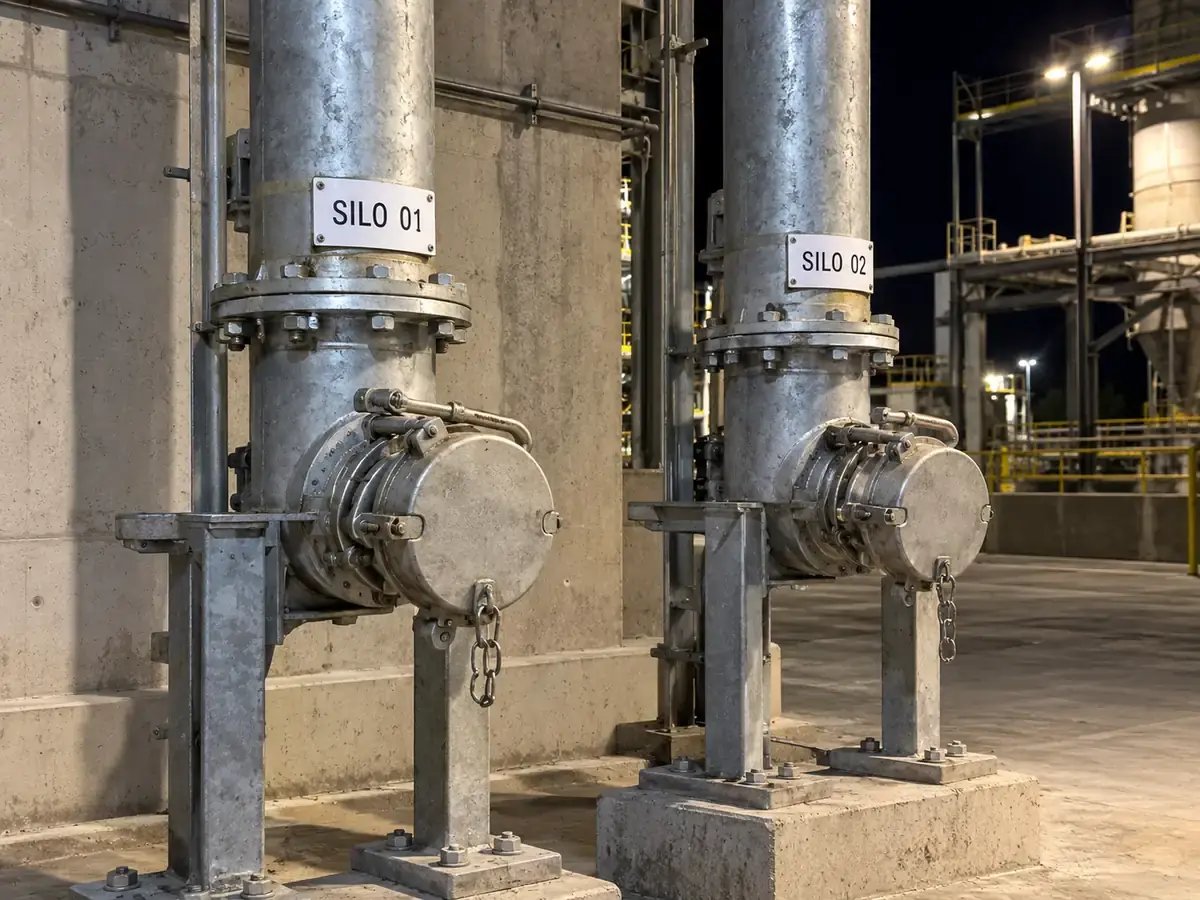
Light the task and keep the hose clear of traffic
Position work lights so the driver can read the gauge and valve labels without holding a phone. Light the coupling, hose path and ground underfoot. Keep lamps and power leads away from truck movements and the walking route. Repeat the walk in darkness: look from the cab, the control position and the fill point.
HSE’s workplace transport lighting guidance recommends lighting loading areas and pedestrian routes, with lights positioned to reduce glare and shadows. Use the site’s applicable lighting specification for measurements; there is no single lamp wattage that makes every unloading bay suitable.
Prefer a drive-through position. Where reversing remains necessary, use the site’s planned procedure and trained assistance where required. If the driver loses sight of an assigned signaller, stop the maneuver. Keep other people and vehicles out of the maneuvering area. This follows HSE’s reversing guidance.
Who needs to supervise the delivery and receive alarms?
The tanker operator must remain at the unloading controls, able to monitor the transfer and respond to the receiving silo’s warnings. CCTV or a remote contact can support that operator; neither takes over the hands-on job.
For a new site, a changed filling arrangement or an unfamiliar driver, arrange an authorized person on site for the handover and necessary support. If a regular site uses remote reception, its approved lone-working plan must define permitted tasks, contact intervals, emergency response and when unloading must stop. Test the communication method at the unloading position, not only at the gate.
HSE’s lone-working guidance explains the need for task limits, monitoring and tested contact arrangements. Decide staffing from the actual site risks. Avoid assuming that every delivery needs the same headcount, or that an experienced driver can fill an unprepared site alone.
Prove the warning reaches the operator
Before filling, have authorized personnel carry out the receiving system’s specified pre-delivery functional test. A lamp-test button may only prove that a light and sounder work. It may leave the level sensor, pressure sensor or shutoff function untested. The MPA silo protection guide explains this distinction in its ground-level testing section.
Also verify that the driver can detect the warnings in the actual operating position, with normal equipment noise and required hearing protection. HSE notes that unsuitable hearing protection can impair communication and warning detection. Improve the signal arrangement or communication equipment where needed; do not solve the problem by removing required protection.
How much time should the night unloading slot allow?
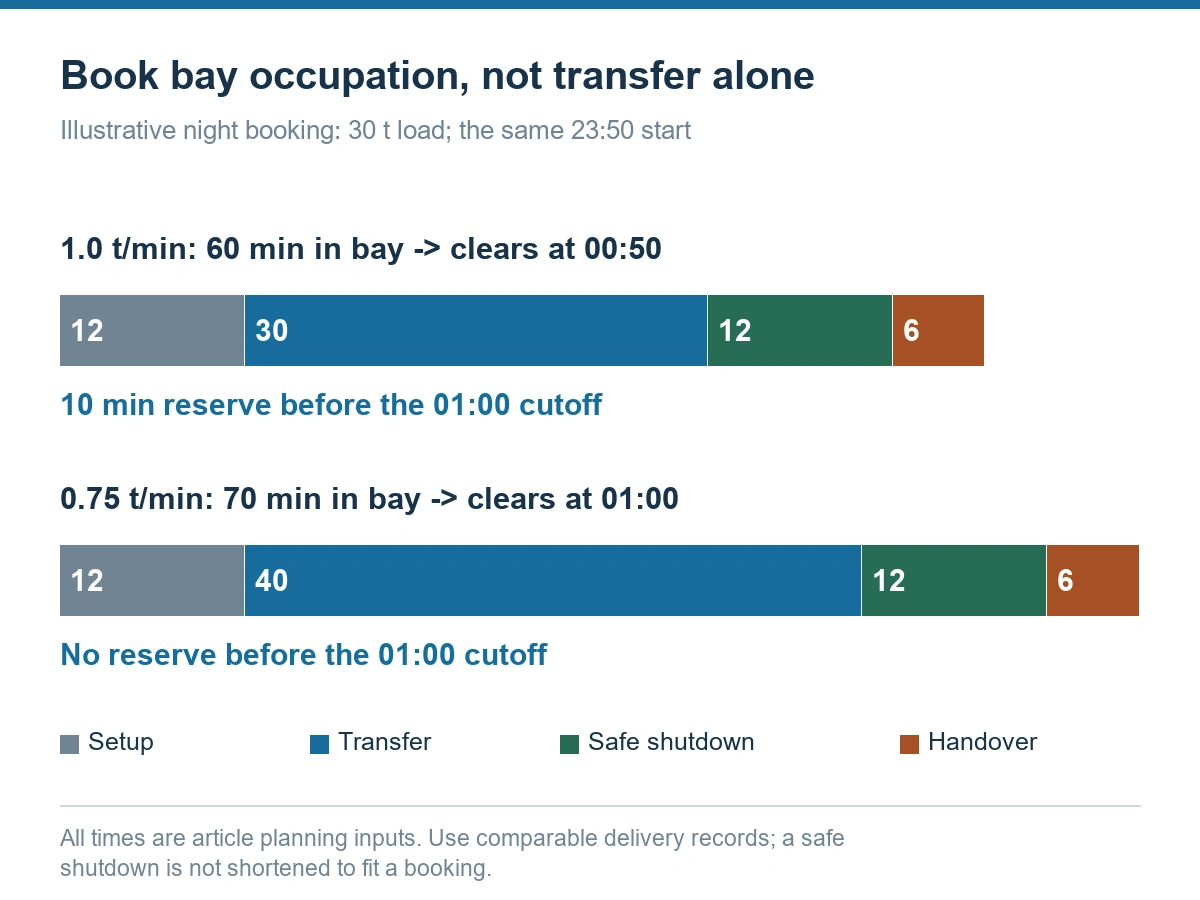
Book the complete bay occupation, including setup, transfer, safe shutdown and departure handover. Dividing cargo weight by a discharge rate covers only the transfer portion.
Start with time records from comparable deliveries: same cargo, similar load, hose route, receiving silo and air-source arrangement. Record when the truck occupies the bay, transfer starts and ends, the system becomes safe to disconnect, and the bay is clear. Keep waiting outside the bay separate from bay occupation, but include it when planning the driver’s shift.
Example night booking: Suppose a 30-ton load uses a planning transfer rate of 1.0 t/min. Allow 12 minutes for positioning and setup, 12 minutes for line completion and safe shutdown, and 6 minutes for handover and leaving the bay.
Transfer: 30 ÷ 1.0 = 30 minutes.
Bay occupation: 12 + 30 + 12 + 6 = 60 minutes.
A 23:50 start clears the bay at 00:50. With a 01:00 site cutoff, that leaves 10 minutes of reserve. If the planning rate falls to 0.75 t/min, transfer takes 40 minutes and occupation becomes 70 minutes. The same start then reaches 01:00 with no reserve. Start at 23:40 to keep the original reserve, or arrange another slot.
These are planning inputs for the example. Replace them with your delivery records. Our cement tanker unloading time guide explains why the complete cycle changes with the tanker, line and silo.
Agree on permitted noisy operating hours with the site before booking. Use maintained silencers and an air-source configuration suitable for the duty. An acoustic enclosure needs engineered ventilation and service access. Do not cover cooling openings, disable warning devices or run below the approved conveying settings just to reduce noise.
Allow for the return journey and rest as well. HSE’s driver-health guidance identifies night shifts and long working hours as fatigue risks. A delayed truck may need a new slot or relief driver, even when the unloading bay is ready.
What should the driver watch for while unloading?
Watch the pressure trend, transfer behavior, connections and silo warnings throughout the delivery. Stay in the designated control position with a clear path to stop the equipment.
Before starting, complete the product and silo handover, receiving-space authorization, protection test and hose inspection. Use the tanker model’s operating sequence and approved pressure limits. Keep the pressurized hose outside pedestrian and vehicle routes.

The NRMCA cement tanker safety bulletin emphasizes marked fill pipes, adequate silo space and an operator who can see or hear the high-level alarm. Most cement storage silos are not pressure vessels; a normal tanker gauge reading does not establish a safe silo pressure.
| What changes | Immediate action and restart condition |
|---|---|
| Lighting fails or essential contact is lost | Use the planned safe-stop procedure. Restore lighting or contact and repeat the affected readiness checks before restarting. |
| Level/pressure alarm or dust escaping from the silo | Stop the transfer using the agreed shutdown procedure and notify the receiving contact. Have the cause resolved and the site authorize restart; do not bypass or repeatedly reset the alarm. |
| Pressure rises while flow weakens | Stop and isolate safely. Record the stage, pressure trend and silo conditions for investigation. Do not raise pressure or loosen a coupling to clear the line. |
| Product or silo identification no longer agrees | Stop transfer. Have the authorized receiving person resolve the destination and any affected product before another connection is made. |
| Driver becomes too tired to monitor safely | Stop safely and contact dispatch for relief or a revised delivery. A quiet yard does not make fatigue manageable. |
Near the end of transfer, avoid an uncontrolled rush of residual tanker air into the silo. The MPA guide identifies this as an overpressure mechanism. Complete the tanker procedure rather than using the silo as a convenient vent.
When is the tanker ready to leave?
The job is complete when the system is safe, connections are secured and the delivery is handed over—not when the last cement stops flowing.
Finish the approved shutdown, isolation and controlled depressurization sequence. Establish that the tank and any line to be opened are depressurized before disconnecting. Do not rely on the tank gauge alone to rule out pressure trapped in an isolated hose. Never loosen a fitting to test for pressure.
A Safequarry incident alert on residual tanker pressure describes a truck returning to load while still partly pressurized. Leave time to reach the required safe state; do not leave the site with residual tank pressure.
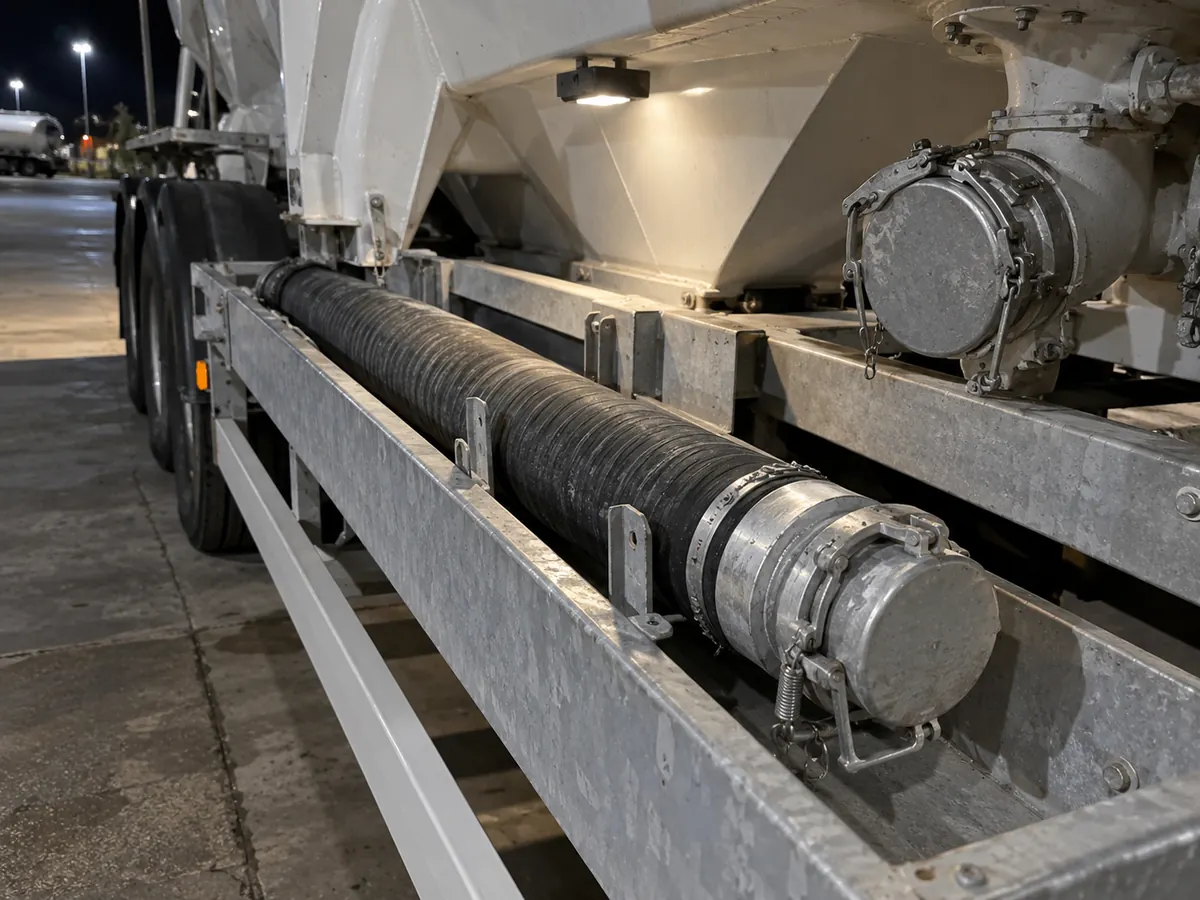
Secure the fill connection, cap and stow the hose, collect temporary traffic equipment when safe, and record delivered quantity, silo, completion time and any abnormal event. Keep delivery weight records separate from tank-empty indications. Tell the next shift about interrupted loads and unresolved faults before another booking uses the same silo.
Reliable night cement tanker unloading starts with a prepared receiving site and ends with a complete handover. Fix gaps in access, reception or protection before trying to shorten the transfer.
If you are selecting a trailer for regular night deliveries, review our 3 axle cement tanker trailer with your payload, tractor and receiving conditions. Send your discharge distance, silo height, pipe size, air-source arrangement and delivery window through our contact page. We can discuss the tanker configuration around those conditions.
Frequently asked questions
What if the gate is open but the night contact does not answer?
Wait in the agreed safe holding position and contact dispatch or the named backup. Do not infer permission to fill from an open gate, a previous delivery or an unlocked inlet. Start only after the receiving authorization and required site support are restored.
Can two tankers unload into the same silo at night?
Do not connect both unless the receiving installation was specifically designed and authorized for simultaneous filling. Otherwise, book sequential slots and update available silo space after the first delivery. A shared fill line also needs a defined changeover before the next truck connects.
What if the permitted unloading window ends before the tanker is empty?
Use the agreed safe shutdown, record the quantity delivered and remaining, and arrange the next authorized slot. Establish this contingency before dispatch. Do not increase pressure or rush depressurization to meet the cutoff.
Should unloading continue if fog, rain or a storm reduces visibility?
Stop when conditions prevent safe access, warning detection or control of the unloading area, or when the site weather procedure requires it. Restore the affected conditions and obtain restart authorization. Do not climb the tanker or silo to investigate during a storm.
Does a digital tanker pressure display make remote nighttime unloading safe?
A digital display can make tanker pressure easier to read. Safe remote reception still needs correct silo identification, receiving capacity, effective silo protection, communication and a present tanker operator. Specify those functions separately when discussing sensors or remote monitoring.

ZAC
Hello, I’m ZAC, a cement trailer and semi-trailer specialist with over 20 years of industry experience. My technical approach starts with real operating conditions, including how cargo characteristics, road conditions, and loading and unloading methods affect trailer performance. I place particular emphasis on structural reliability, component compatibility, and ease of maintenance. I look at both everyday performance and how reliably a trailer operates over time, as well as how easily it can be inspected and serviced.


