
Unattended bulk cement delivery can be arranged without the customer’s receiving staff present, but a trained driver must remain at the unloading operation. The site, cement supplier and carrier must agree to that arrangement, and the driver needs reliable silo identification, enough receiving space, working protection systems and a way to get help.
If “unattended” means connecting the hose and leaving the tanker to discharge by itself, the answer is no for an ordinary pneumatic tanker delivery. Remote stock readings and cameras do not remove the need to control the fill.
What does unattended bulk cement delivery actually mean?
It normally means the customer is absent while the driver carries out the delivery. It does not mean that nobody watches the transfer.
| Delivery arrangement | Who is at the unloading point? | Practical decision |
|---|---|---|
| Customer-attended delivery | Driver and receiving representative | Use when the site or supplier requires a receiver, or the driver needs assistance. |
| Driver-only delivery | Trained, site-authorized driver | Consider only after agreeing the receiving checks, protection, access and emergency arrangements. |
| Unmonitored discharge | Nobody controlling the operation locally | Do not use this arrangement for an ordinary road tanker unload. |
The Australian CCAA bulk cement delivery guide, section 11, discusses deliveries to unattended plants, including controlled access and paperwork. The UK MPA silo protection guide, page 30, tells drivers to keep the fill attended. These address different things: who receives the load and who controls unloading.
A supplier may still require a customer representative. Get agreement before dispatch; an open gate or available key is not enough.
What must be ready before a driver-only delivery?
Prepare a release for the specific product, load and silo before the customer’s staff leave. The driver should be able to match that release to the physical fill point without guessing.
The receiving plant should provide:
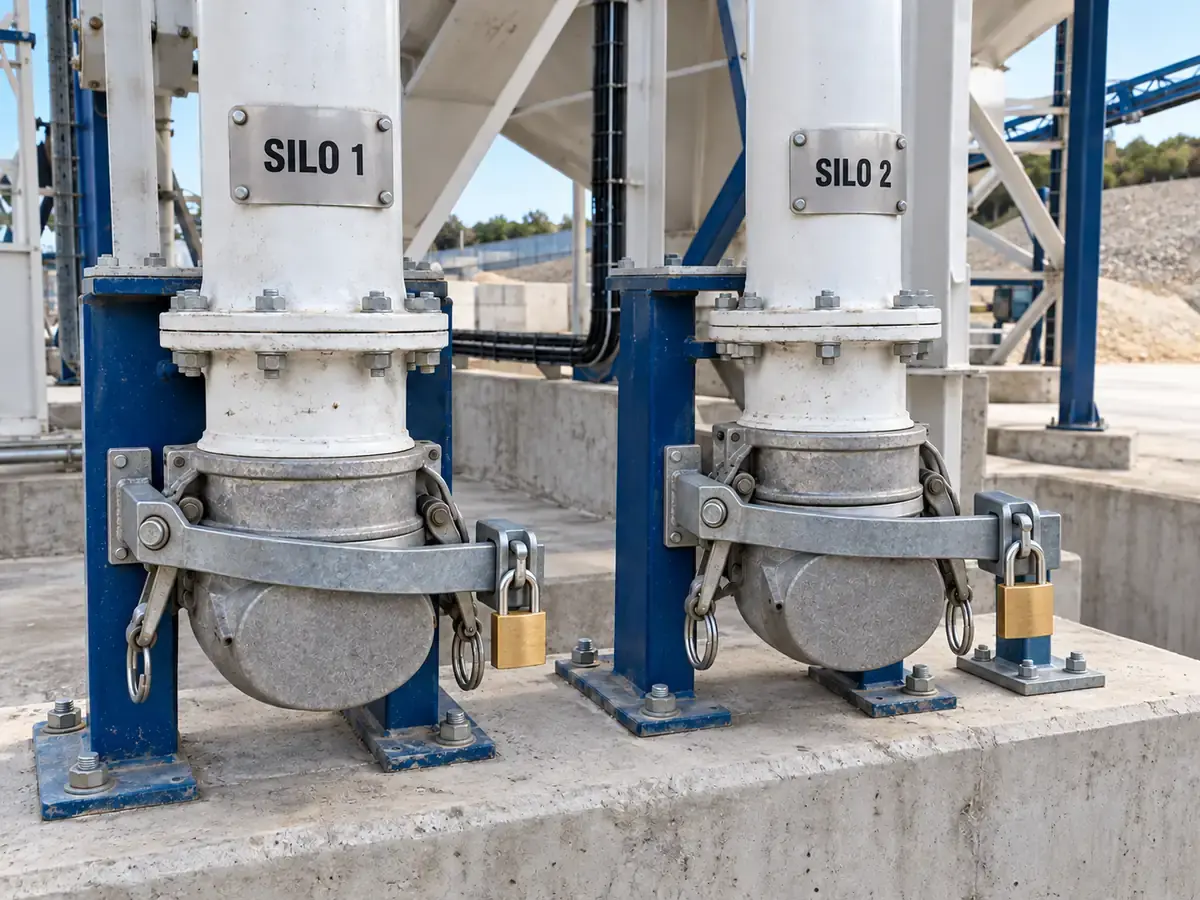
- Delivery identity: order reference, cement grade, vehicle/load identification, intended silo number and matching fill-pipe label.
- Receiving quantity: approved amount, latest stock reading and its time, plus any other deliveries already assigned to that silo.
- Controlled access: a key or electronic permission for the intended inlet, a current site map and clear entry and exit instructions.
- Ready equipment: available filter cleaning and venting, current protection-system status and an accessible pre-fill test facility.
- People and contact: a driver who knows the site, an answering contact, check-in arrangements and a plan if the driver needs help.
Keep labels, keys and electronic silo assignments consistent. When a plant changes a silo from one cement grade to another, update the physical signs and the control-system mapping together. A key that opens the pipe does not identify the powder already inside it.
For a first delivery, walk the driver through the actual site with a receiving representative present. Check the parking position, hose path, lighting, alarm position and emergency access. The carrier’s lone-working assessment should determine whether later deliveries can be driver-only. HSE guidance on lone-worker supervision gives a useful model for training, keeping in touch and checking that the worker has finished safely.
Which silo protections must work without site staff?
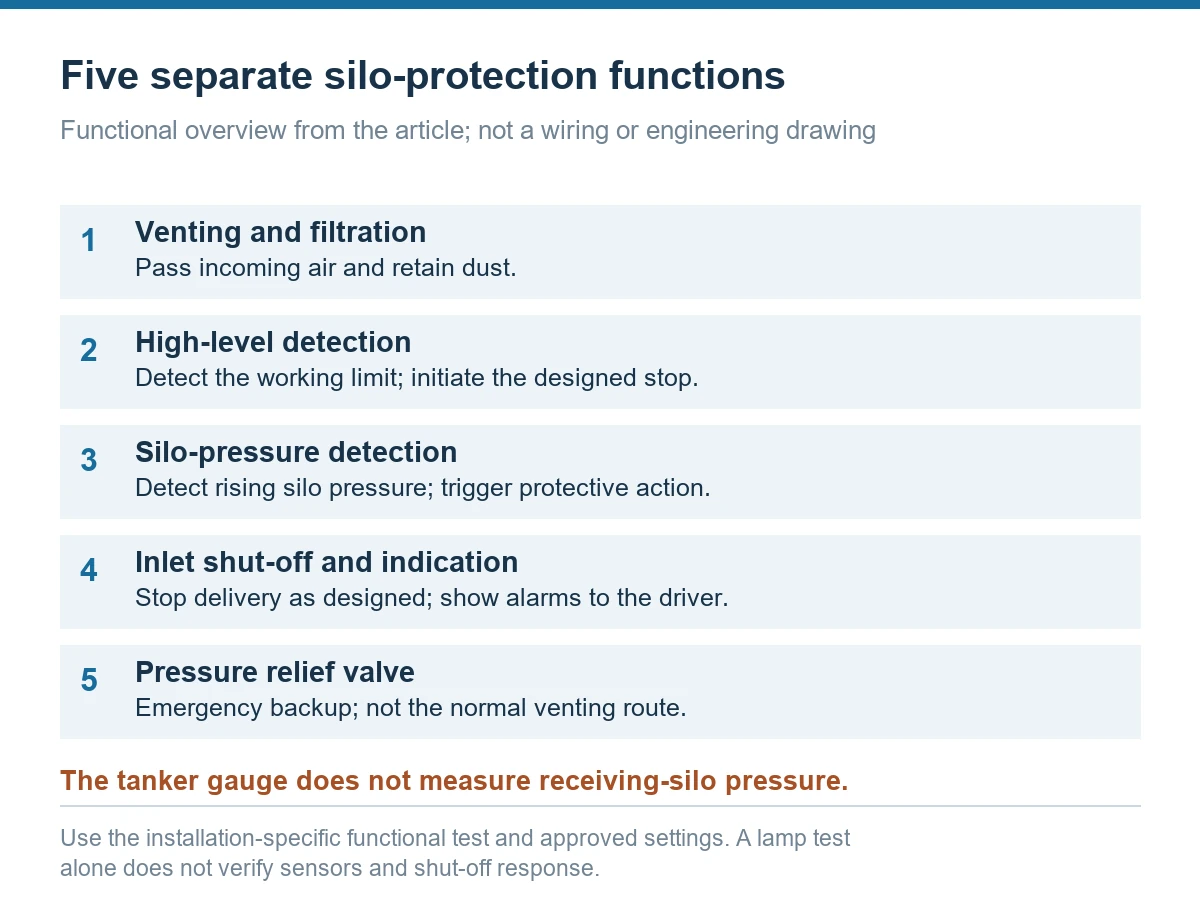
The receiving silo needs working controls for both overfilling and excess pressure, with alarms the driver can detect at the fill point. A stock display alone does not provide that protection.
Cement enters with conveying air. The filter must let that air escape while retaining dust. A restricted filter can raise silo pressure even when there is still space for cement. That is why “the silo is not full” does not answer a pressure alarm.
The protection arrangement should cover these separate jobs:
| Function | What it needs to do |
|---|---|
| Venting and filtration | Pass the incoming air under the agreed delivery conditions; keep the cleaning system available. |
| High-level detection | Detect the upper working level and initiate the designed stop sequence. |
| Silo pressure detection | Detect rising pressure in the silo and trigger the protective action. |
| Inlet shut-off and local indication | Stop incoming delivery as designed and show the driver the alarm or fault. |
| Pressure relief valve | Provide emergency backup if other protection fails. |
The tanker gauge reads tanker pressure. It cannot replace pressure detection at the receiving silo. The pressure relief valve is also an emergency backup, not the normal way to vent an unload.
Use the protection equipment’s ground-level functional test before filling. The test needs to exercise the relevant sensors, alarm and shut-off response; illuminating the panel lamps alone is insufficient. Have the silo-protection specialist define the pressure settings, timing and safe response to power or instrument faults for that installation. Our pneumatic unloading system guide explains how the tanker, line and receiving silo work together.
How do you confirm there is room for the load?
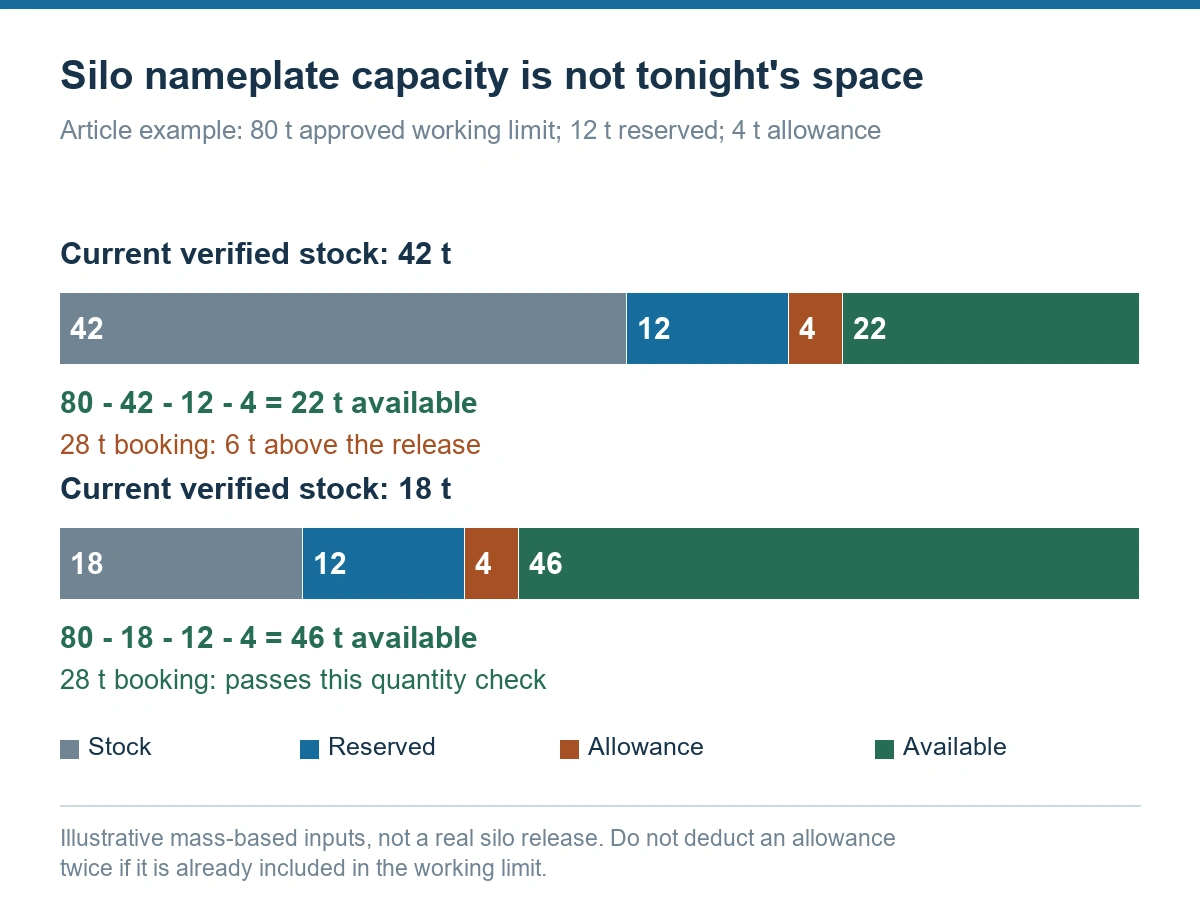
Use the silo’s approved working inventory limit and a current stock figure, then account for other booked loads. The tonnage painted on a silo is not its available receiving space tonight.
Use the working limit established for the actual cement and its receiving condition. If the plant measures level or volume, use its approved conversion to mass. Freshly aerated and settled powder can occupy different volumes, so an assumed density can give a misleading answer.
For a mass-based check:
Available receiving mass = approved working inventory limit − current stock − earlier reserved deliveries − any additional uncertainty allowance.
Do not deduct headroom or uncertainty twice if the working limit already includes them. Give each reservation a load reference and arrival order so two dispatchers cannot promise the same space.
For example, suppose the approved working limit is 80 metric tonnes, current stock is 42 tonnes, an earlier booked delivery reserves 12 tonnes, and the plant assigns an additional 4-tonne uncertainty allowance. The available amount is:
80 − 42 − 12 − 4 = 22 tonnes.
A proposed 28-tonne load does not fit that release. Reduce the agreed quantity, change the delivery time or have the plant authorize another suitable silo. Do not arrive expecting the high-level alarm to decide how much to accept.
If a new verified stock figure is 18 tonnes, the same calculation gives 46 tonnes. The 28-tonne load then fits the quantity check. These are example inputs; the plant sets its own working limit and allowance. Do not credit forecast overnight cement use until it has actually occurred and the stock record has been updated.
How should a driver-only delivery be carried out?
Keep the driver in control from arrival through disconnection, with a clear handover before and after the transfer. Use the tanker and silo procedures for the actual valve sequence and operating settings.
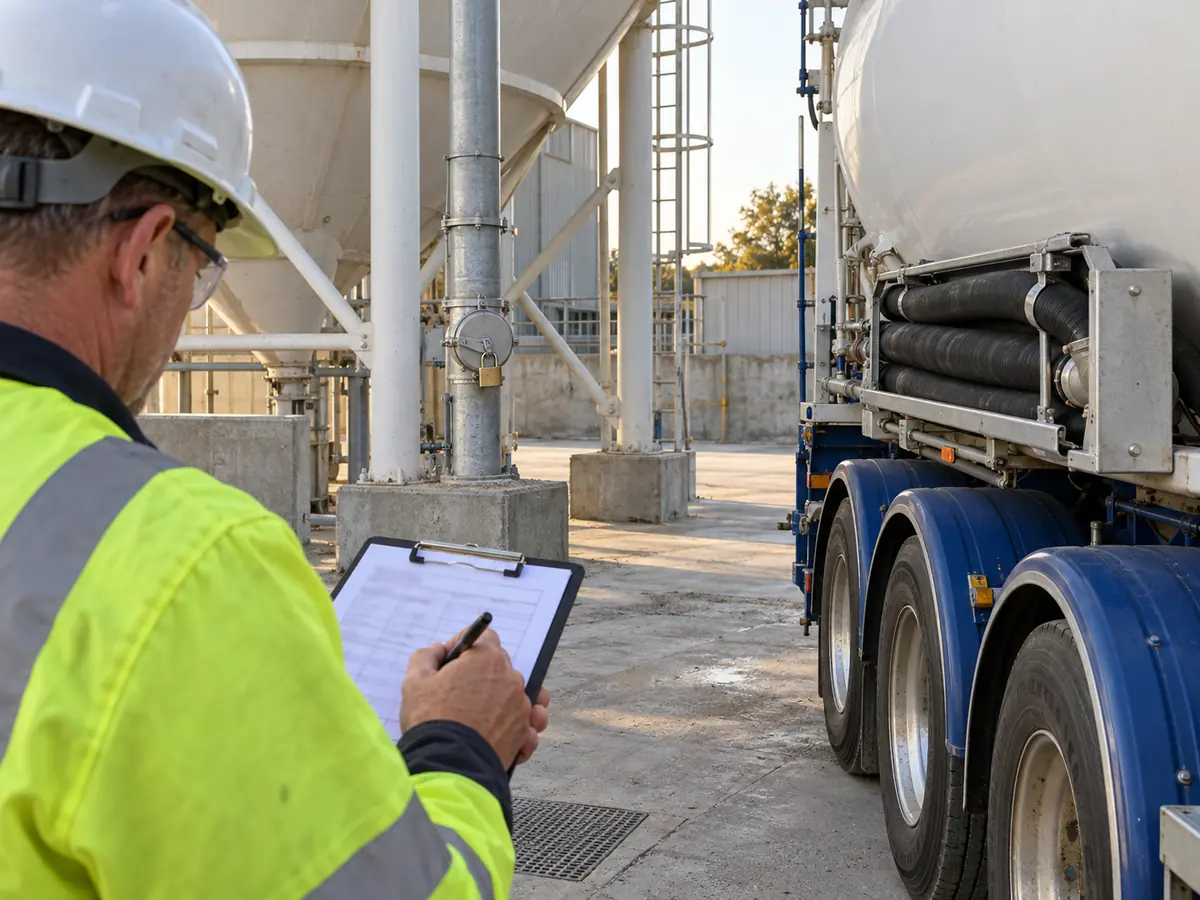
- Check in and identify the load. Report arrival through the agreed channel. Match the load document, grade, silo number and physical fill point. Resolve any mismatch before connecting.
- Complete the receiving checks. Read the current release and stock status. Perform the required protection-system test. A failed or unavailable check means the delivery stays on hold.
- Position and connect safely. Immobilize the vehicle, keep other traffic clear and inspect the hose, seals and compatible couplings before pressurizing. Use the specified hose restraints and keep the control position accessible.
- Attend the transfer. Stay at the designated safe operating position where alarms, gauges and the discharge system can be monitored and the stop control reached. Do not leave to complete unrelated work while cement is flowing.
- Control the end of discharge. The nearly empty tanker can send a large surge of air toward the silo. Control the final stage and release residual tank pressure through the tanker’s designated safe venting arrangement, rather than dumping it into the silo. Before uncoupling, establish zero pressure in the tanker and discharge line using the equipment procedure.
- Secure and record. Refit and lock the fill-point cap, stow the hose and record completion. Include the silo, product, quantity basis, times, alarms and any material remaining on the vehicle. Check out so the contact knows the driver has left safely.
Before production resumes, reconcile opening stock, documented deliveries and recorded consumption. Investigate an unexplained difference or a possible wrong-silo delivery before using the affected stock. A signed receipt alone will not reveal where the cement went.
When should the driver stop or refuse the delivery?
Hold the load whenever identity, receiving space, protection or safe communication is uncertain. Stop an active transfer when an alarm or abnormal condition develops.
| What the driver finds | What to do next |
|---|---|
| Grade, silo label or release does not match | Do not start. Obtain a corrected release and matching physical identification. |
| Stock data is stale or another truck used the reserved space | Recalculate and obtain a new quantity release before filling. |
| Protection test fails or an interlock is bypassed | Keep the delivery on hold until the fault is repaired and the required functional test passes. |
| Pressure alarm, dust escape or abnormal hose movement | Use the equipment’s stop and isolation procedure; keep people clear and report the event. Do not loosen a pressurized coupling. |
| Agreed contact or emergency communication is unavailable | Hold driver-only unloading until the communication arrangement is restored or suitable site attendance is arranged. |
After a trip, do not keep resetting the panel to finish the load. Identify and correct the cause, repeat the affected checks and obtain authorization to resume. Reconfirm remaining silo space and the quantity still on the tanker. Moving the hose to another inlet requires a new product-and-silo release.
Plan the receiving site before choosing the tanker
The practical choice is a controlled driver-only delivery when the site and carrier accept it; otherwise, keep a receiving representative present. Unattended bulk cement delivery should never become unmonitored unloading.
A three-axle layout addresses transport and load distribution. The receiving arrangements determine whether a driver can deliver without customer staff. When considering our 3 axle cement tanker trailer, bring the silo inlet height, hose length and diameter, bends, connection type and protection-system details into the configuration discussion.
Send us your destination, cargo, target payload, tractor and unloading-site information through our contact page. We can review the tanker and pneumatic configuration against those conditions. Start with the details in the message field; use [email protected] for drawings or site photos when continuing the discussion.
Questions about unattended cement deliveries
Can CCTV let the driver leave the unloading point?
No. For an ordinary road tanker unload, CCTV does not replace the driver’s local control. It can help a remote contact see the site, but the driver still needs to detect alarms and operate the stop controls from the designated safe position.
What if there is no reliable mobile phone signal?
Use a tested alternative contact system before allowing driver-only unloading. This could be a suitable radio or an accessible fixed call point, with an agreed response to missed contact. If the driver cannot reliably raise help, keep a receiving representative present or reschedule.
What if the order changes to another cement grade after dispatch?
Hold the delivery until the load identity and receiving assignment have been resolved. Establish what is actually on the vehicle and what is already in the proposed silo. Update the release, physical labels and electronic assignment as needed before authorizing connection.
Can the audible alarm be disabled for a night delivery?
Do not simply mute a required warning to meet a delivery window. The plant must provide an effective, approved warning arrangement that the driver can detect under those conditions. If noise restrictions and the required warning cannot both be satisfied, move the delivery to an attended or permitted time.
Does a keypad code replace the product check?
No. Access permission must still match the load and physical silo. A valid code can open a wrongly assigned inlet if the software mapping is outdated. Compare the order, product, silo identifier and fill-pipe label before starting.
How is delivery recorded without a customer signature?
Agree the paperwork and quantity method before dispatch. Record the driver, load reference, cement grade, actual silo, start and finish times, delivered quantity and any retained load. Use the agreed weighing method for a partial unload, then reconcile the record with silo stock. Do not record the full dispatched weight as delivered when cement remains on the vehicle.

ZAC
Hello, I’m ZAC, a cement trailer and semi-trailer specialist with over 20 years of industry experience. My technical approach starts with real operating conditions, including how cargo characteristics, road conditions, and loading and unloading methods affect trailer performance. I place particular emphasis on structural reliability, component compatibility, and ease of maintenance. I look at both everyday performance and how reliably a trailer operates over time, as well as how easily it can be inspected and serviced.


