
Cement tanker cost per ton is the complete operating cost of one delivery cycle divided by the tonnes actually delivered. Cost per ton-kilometer divides the same trip cost by delivered tonnes multiplied by the loaded transport distance. For a bulk cement route, include the empty return, the time spent at loading and receiving sites, and fuel consumed by pneumatic unloading. Otherwise, a low-looking rate can still lose money.
The calculator in this guide estimates cost per trip, cost per delivered ton, cost per ton-kilometer, and a selling price for a target margin. It also shows what a diesel price change does to the result. Start with the worked 30-ton example, then replace every input with your own route and fleet records.
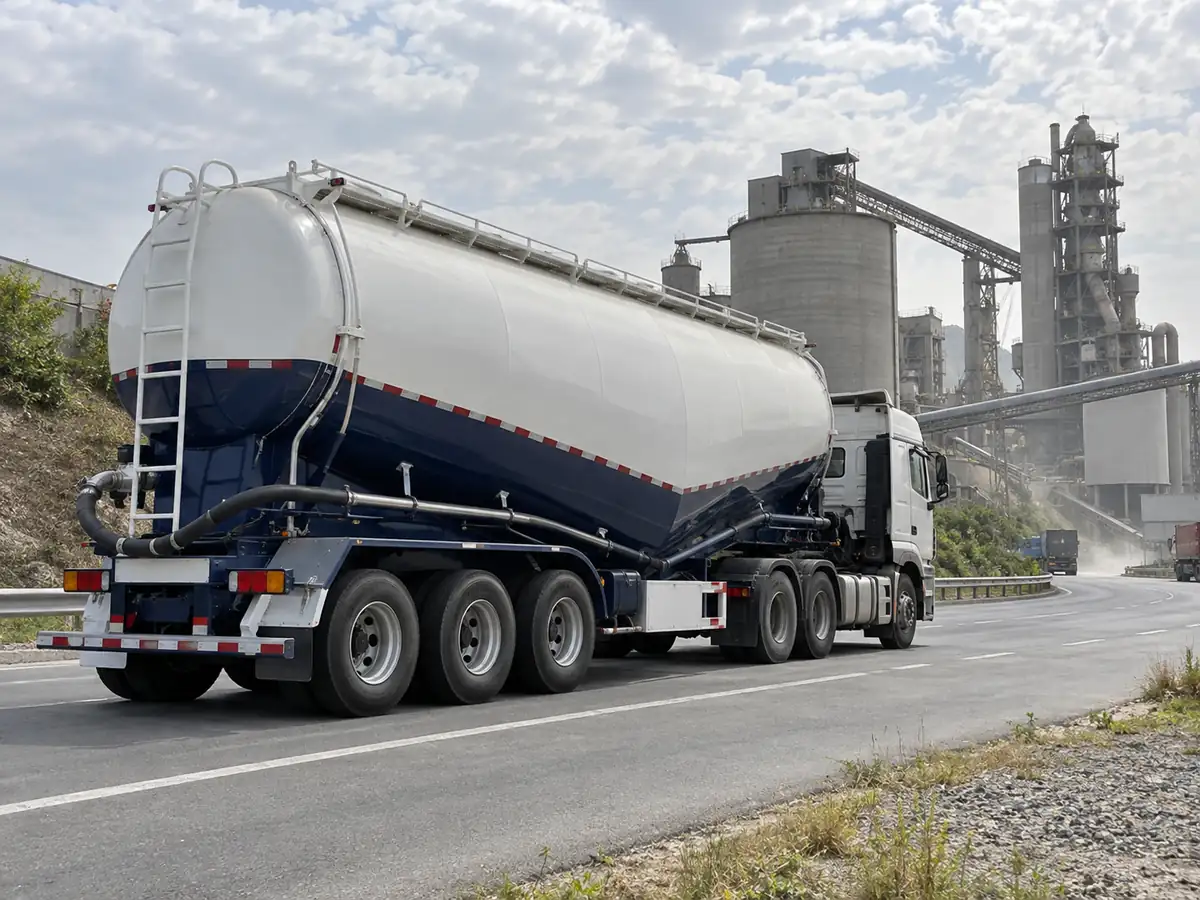
How Do You Calculate Cement Tanker Cost per Ton and Ton-Kilometer?
Use the total cost of the complete trip as the numerator. Divide by delivered tonnes for cost per ton, or by delivered tonnes multiplied by loaded kilometers for cost per ton-kilometer. This keeps the cost of the empty leg in the calculation without treating the empty leg as freight delivered.
Cost per trip = fuel + driver time + servicing/tires + allocated fixed vehicle cost + tolls + other trip costs
Cost per ton = cost per trip ÷ tonnes delivered
Cost per ton-km = cost per trip ÷ (tonnes delivered × loaded kilometers)
A tonne-kilometer (often written ton-km or t-km) represents one metric tonne of freight moved one kilometer. This matches the basic road-freight performance method described in Eurostat’s road freight metadata. Here “ton” means a metric tonne (1,000 kg), not a US short ton.
| Measure | Use it to decide | Keep consistent |
|---|---|---|
| Cost per trip | What one full delivery cycle costs the operator | Include paid return distance and non-driving time |
| Cost per delivered ton | Plant supply contracts, fleet economics and tonne-based tenders | Use weighbridge tonnes received, not the trailer’s advertised payload class |
| Cost per ton-km | Compare routes of different loaded distances | Use tonnes × loaded delivery kilometers as the denominator |
| Quote per ton | What a carrier must charge to achieve a stated margin | Quote is not the same as operating cost |
If a trip has several delivery stops, calculate the ton-kilometers of each loaded leg using the tonnes still on the truck for that leg, then add them. Multiplying the first loaded weight by the entire route would overstate the freight work after some cement has been unloaded.
Which Costs Belong in a Full Cement Tanker Trip?
Count the entire cycle from loading to the vehicle’s next available working position. A pneumatic tanker is earning no new delivery revenue while it waits for silo access or returns empty, but the vehicle, driver and unloading system still create costs.
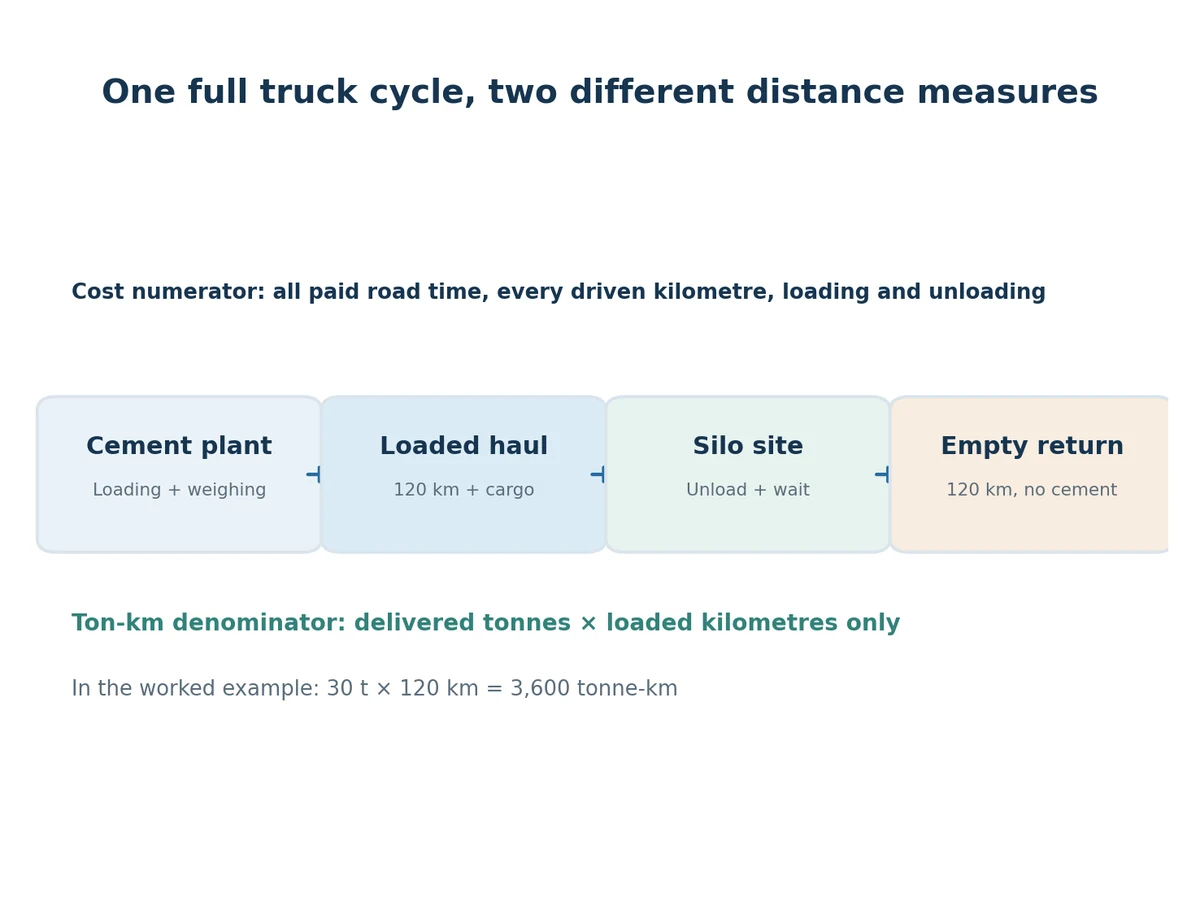
Separate distance-based, time-based and trip-specific costs
| Cost item | Practical input | Where to obtain it |
|---|---|---|
| Loaded driving diesel | Loaded km × loaded L/100 km ÷ 100 | Telematics, fuel cards or a controlled route sample |
| Empty-leg diesel | Empty km × empty L/100 km ÷ 100 | Return-route GPS and tank-to-tank fuel logs |
| Pneumatic unloading fuel | Liters consumed by the discharge engine or allocated tractor fuel | Engine hour/fuel meter or observed consumption over unloading cycles |
| Driver and vehicle time | Drive hours plus loading, unloading and waiting hours | Dispatch timestamps, time sheets and GPS |
| Maintenance and tires | Cost per total kilometer driven | Fleet work orders and tire records divided by fleet km |
| Fixed vehicle/overhead | Documented share for one trip | Depreciation or lease, insurance, license, overhead and realistic utilization |
| Tolls and extras | Actual tolls, permits, parking and other route charges | Trip receipts or tariff schedules |
For the model below, driver pay is time-based, maintenance is distance-based, and truck/insurance overhead is entered as a fixed cost allocated to the trip. Do not enter the same driver’s salary again in fixed cost if you already charge driver hours, or include tolls in both the maintenance rate and a toll field.
How should you allocate fixed costs?
Start with monthly tractor, trailer, insurance, licensing, administrative and other committed expenses. Divide by the realistic number of completed trips in that month, or allocate the cost by working hours when trips have very different durations. If the fleet handles only ten deliveries rather than fifteen, the fixed amount per trip increases; it does not disappear. A full-cost quote should recognize that utilization risk.
The American Transportation Research Institute’s operational-cost program separates fuel, vehicle payments, maintenance, insurance, tires, tolls and driver-related costs. Its 2026 report gives a 2025 US trucking average of $2.336 per mile; that is a broad US benchmark, not a cement tanker tariff or a substitute for local diesel, payload and route data.
Use the Cement Tanker Transport Cost Calculator
Enter the actual loaded distance, empty return kilometers, delivered payload, fuel use, running costs and site time. Results update when an input changes. All example numbers are hypothetical US-dollar inputs, not current freight rates. Choose a currency for your own figures; changing the currency label does not convert exchange rates.
Calculated operating cost and quote
| Check the calculation | Value |
|---|---|
| Loaded plus empty km | |
| Delivered tonne-km | |
| Fuel cost | |
| Driver cost | |
| Service and tires | |
| Fixed, tolls and other |
Diesel-price sensitivity
New diesel price: . Revised trip cost: ; revised cost per ton: . Difference from the base trip: .
The selling-price output assumes the requested profit margin is a share of the selling price: price = cost ÷ (1 − margin). It is a costing target, not a market freight quotation.
Keep units consistent: kilometers, liters per 100 kilometers, metric tonnes and one chosen currency. If a trip receives a paid return load, first set a fair allocation of return costs instead of assuming a free journey. For a fuel index where available, the US Energy Information Administration publishes dated US diesel prices; routes outside the US should use their local invoices or agreed market index.
Worked Example: A 30-Ton Cement Delivery Over 120 km
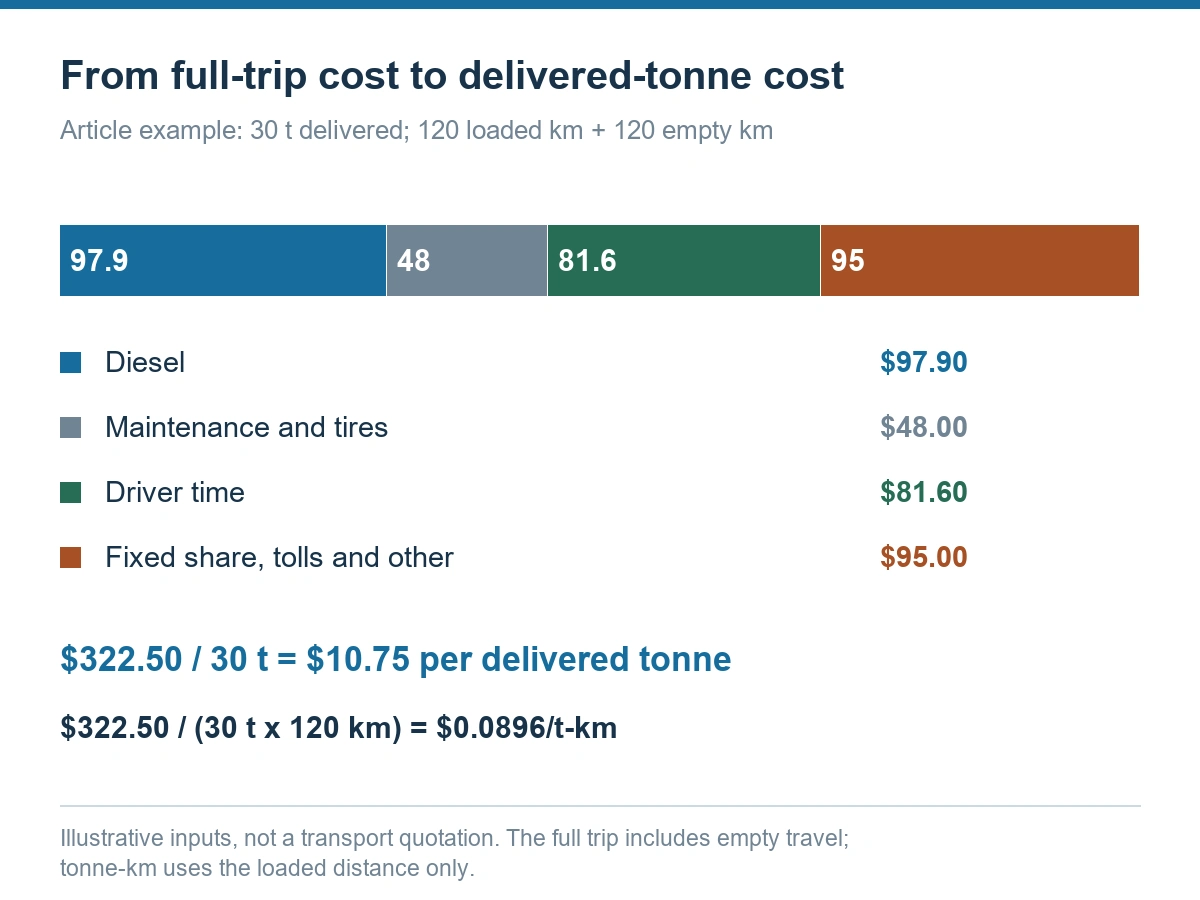
Using the example inputs in the calculator, one 30-ton delivery costs $322.50 per trip, or $10.75 per delivered ton and about $0.0896 per ton-km. This is a transparent arithmetic example; its fuel price and hourly charges are chosen to demonstrate the method rather than represent any country.
| Input or cost | Calculation | Result |
|---|---|---|
| Loaded + empty kilometers | 120 km + 120 km | 240 km |
| Loaded diesel | 120 × 40/100 | 48 L |
| Empty diesel | 120 × 30/100 | 36 L |
| Discharge diesel | Observed or budgeted separately | 5 L |
| Diesel cost | (48 + 36 + 5) × $1.10/L | $97.90 |
| Maintenance and tires | 240 × $0.20/km | $48.00 |
| Driver cost | (240/50 + 2.0 h) × $12/h | $81.60 |
| Fixed share + tolls + other | $65 + $18 + $12 | $95.00 |
| Total operating cost | $97.90 + $48 + $81.60 + $95 | $322.50 |
Divide $322.50 by 30 tonnes to get $10.75/t. The delivery moves 30 × 120 = 3,600 tonne-km, so $322.50 ÷ 3,600 = $0.0896/t-km when rounded to four decimal places. At a 15% margin on selling price, the target quote is $322.50 ÷ 0.85 = $379.41 per trip (about $12.65/t). Do not confuse 15% margin with adding 15% markup to cost.
To verify this example with your fleet, replace 30 with the actual weighbridge tonnes, 120 with dispatch/GPS loaded distance, 89 liters with measured route-plus-unloading diesel, and the other entries with fleet expense records. Re-run the calculator after each change rather than preserving the example result.
How Does Empty Return Distance Change the Result?
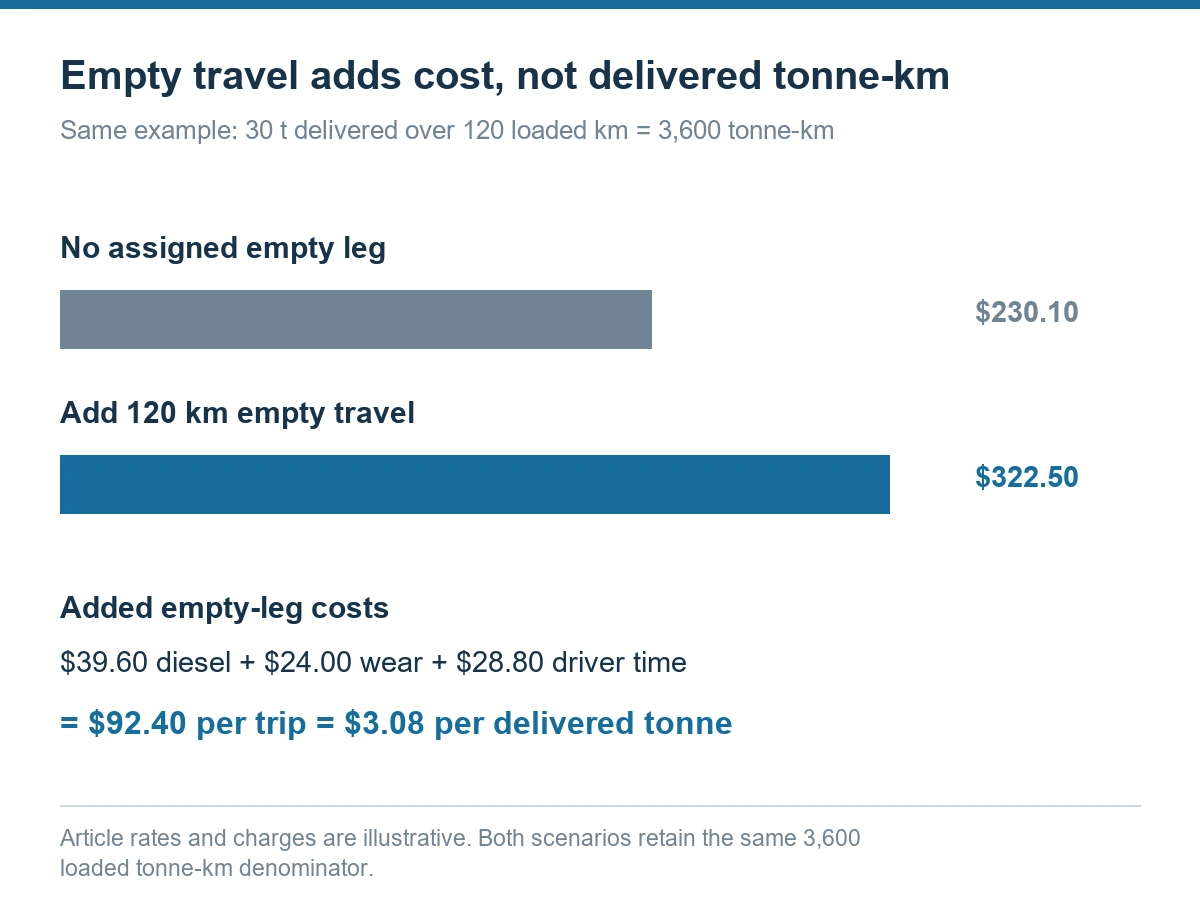
An empty return increases the cost per delivered ton even though it adds no tonne-kilometers. Using the same 120 km loaded haul, 30-ton payload and example rates, assigning 120 km of empty travel raises modeled cost from $230.10 to $322.50 per trip.
The difference is $92.40: 36 L × $1.10 = $39.60 of diesel, 120 km × $0.20 = $24.00 for wear, and 120/50 h × $12 = $28.80 in driver time. Other example charges stay unchanged. At 30 tonnes, the additional return leg adds $3.08 per delivered ton.
What if the tanker finds a paying backhaul?
Do not simply delete all return costs. A return assignment may need repositioning, an extra loading stop, cleaning, a suitable cargo and longer cycle time. Decide which costs belong to each shipment from the actual route and commercial agreement. For a dedicated cement tanker, a compatible return load may be hard to find; treat backhaul income separately from the cost of serving the first customer so the margin remains visible.
If the vehicle does not return to the plant but drives to its next loading point, enter that real empty repositioning distance instead. For multi-stop cement delivery, recalculate tonne-km by leg as the load drops, while keeping the full route’s operating expenses in the cost numerator.
Why Does Actual Payload Matter More Than the Tanker’s Rated Tonnage?
A lower delivered load spreads the same cycle costs across fewer tonnes. At a constant $322.50 trip cost, 30 tonnes gives $10.75/t, while 24 tonnes gives about $13.44/t. The smaller shipment costs roughly 25% more per delivered tonne before allowing for any reduced fuel use from lighter loading.
The controlling payload is the smallest practical limit created by the route’s legal gross and axle weights, the vehicle’s available payload after tare, usable tank volume at the powder’s loaded bulk density, and customer order size. Keep density in metric tonnes per cubic meter when converting a volume-based limit. For illustration, 40 m³ at 1.10 t/m³ would hold 44 tonnes on a simple volume-times-density basis before legal and operational restrictions; that is not permission to load 44 tonnes on every route.
Panda Mech’s 50-ton cement tanker trailer is a 40 m³, three-axle product payload class. The manufacturer states that allowable road payload still depends on tractor weight, axle rules and final equipment configuration. Do not use “50 ton” as the delivered-tonne input unless the actual route and cargo support that load. A higher nominal class does not by itself deliver a lower cost per tonne.
Comparing two tanker sizes on the same route
First confirm the legally achievable cargo weight of both combinations, then compare their measured trip fuel, tare, tire cost, unloading time and complete cycle count. A larger tanker is helpful when it delivers more legal tonnes without wiping out the advantage through slower unloading, extra axle cost or site restrictions. When both units can deliver only the same legal payload, the smaller full-cost combination may be more economical.
How Much Does Diesel Price or Site Delay Move Cement Tanker Cost?
Fuel sensitivity equals the total liters consumed for the cycle multiplied by the change in price per liter; site delays increase the paid hours and can reduce the number of trips completed per month. These are different mechanisms, so model them separately.
In the worked route, total diesel use is 89 L. If diesel rises by $0.20/L, the trip increases by 89 × $0.20 = $17.80, or about $0.59/t. If diesel instead rises 20% from the assumed $1.10/L to $1.32/L, the cost increases by $19.58 per trip and becomes $342.08 total, or approximately $11.40/t. The calculator tests any percentage change you enter.
When does unloading time change the result most?
At the example driver cost of $12/hour, one additional paid hour adds at least $12 per cycle when driver labor is charged by time. If a blocked receiving silo also keeps the compressor running or incurs site detention, add the actual extra fuel and agreed charges. Repeated delays can lower monthly trips, raising the allocated fixed cost per trip as well.
Keep two timestamps at the delivery site: arrival-to-start-of-discharge and start-to-end-of-discharge. Long queues call for scheduling and receiving-capacity work; slow pneumatic discharge calls for checks of the air package, line routing, silo backpressure and filter condition. The financial result only becomes actionable when the delay’s cause is identified.
How Should a Carrier Quote and Verify Cement Transport Costs?
Build the first rate from recorded costs, then compare it with invoices and completed deliveries on the same route. An attractive price per ton is only useful if the carrier can actually achieve the payload, timing and number of cycles assumed in that rate.
- Select a clear route and delivery condition. Record where loading starts, the receiving silo, possible empty repositioning and whether unloading fuel belongs to the tractor or a separate engine.
- Take actual source records. Use weighbridge tickets for delivered weight, GPS for loaded/empty km, fuel and compressor logs for liters, driver times for hours, and maintenance/insurance accounts for cost allocations.
- Calculate a cycle for several normal trips. Compare similar loaded routes and note unusual delays separately. Use a sample that includes busy and quiet days rather than one unusually fast trip.
- Set the selling rate. Divide expected full trip cost by (1 − target margin). Check contract treatment of tolls, waiting, fuel surcharge, taxes and return repositioning before sending the quote.
- Reconcile after delivery. Compare the quoted tons, actual received tons, actual fuel, elapsed hours and cost per delivered tonne. A repeated gap shows whether pricing or operating conditions need changing.
Common mistakes that distort cement tanker quotes
| Mistake | Better approach |
|---|---|
| Dividing trip cost by a nominal 50-ton label | Use actual, legal and achievable delivered tonnes from the route |
| Pricing only the loaded kilometers | Cost the empty return and any repositioning, but keep it out of loaded tonne-km |
| Using road diesel only | Measure any independent diesel consumed while unloading |
| Treating waiting as free | Record paid driver/site time and the effect on completed cycles |
| Adding a 15% markup when 15% margin is required | Use cost ÷ 0.85 for a 15% margin on selling price |
| Copying a national average price to a local route | Use actual route rates, local fuel and the current contract cost scope |
A cement plant comparing bids should request the same delivered tonnage, route, unloading obligations and detention terms from each carrier. A fleet manager should compare the full trip and the cost per delivered tonne, not just a lower diesel rate. An engineering contractor should confirm vehicle access, a workable discharge connection and receiving-silo scheduling before setting a fixed delivery rate.
Key Takeaways for Cement Tanker Cost per Ton
Calculate the whole delivery cycle, divide it by tonnes actually received, and use loaded tonne-kilometers for the distance-normalized comparison. The worked 30-ton, 120-km example produces $322.50 per trip, $10.75/t and $0.0896/t-km. Those figures change when empty kilometers, site hours, legal payload, diesel use or fixed-cost utilization change.
Use the calculator to compare your real routes and different equipment configurations, then check the estimate against completed-trip records. For a new tanker order, Panda Mech can discuss the combination of cargo, legal route payload and pneumatic unloading requirements that shapes the transport economics.
Start with the actual route, delivered tonnage and receiving silo conditions, then compare the running gear and unloading package against the work.
Review the 50-ton tanker configurationFrequently Asked Questions About Cement Tanker Transport Cost
Does cost per ton-kilometer include the empty return distance?
Include empty-return expenses in the trip cost, but not the tonne-kilometer denominator. The denominator represents delivered tonnes multiplied by their loaded road distance.
What if the carrier has a paying return load?
Allocate the shared route costs to the actual shipments and account for return revenue separately. Include the extra loading, cleaning, repositioning and delay costs the backhaul creates.
Should I use the 50-ton tanker rating as the calculator payload?
No. Enter the tonnes actually delivered or a feasible planning load. Legal gross and axle limits, tractor and trailer tare, tank volume, cargo density and the order all affect available payload.
Is cost per ton the same as the price quoted to a customer?
No. Cost covers the operator’s expenses; a freight quotation also reflects the required profit margin and contract charges. For a 15% margin on price, divide full cost by 0.85.
How should I calculate cost when a tanker serves two silos?
Keep every trip expense in the cost total, but calculate tonne-kilometers separately for each loaded leg. After the first discharge, use the smaller remaining load over the next leg.
Does unloading use fuel if the truck is parked?
Yes, pneumatic unloading can use a separate diesel engine or the tractor’s power source. Record the fuel associated with the actual discharge method and include it once in the trip.
What happens when the receiving silo delays unloading?
Additional paid driver hours increase trip cost and may reduce monthly trip capacity. Add any extra discharge fuel or agreed detention fee, then review the receiving schedule and system constraints.
How can I test a diesel price increase in the calculator?
Enter the change as a percentage in the fuel-price field. The model multiplies loaded, empty and unloading liters by the new price and shows the revised trip and per-ton results; changing currency labels does not convert exchange rates.

ZAC
Hello, I’m ZAC, a cement trailer and semi-trailer specialist with over 20 years of industry experience. My technical approach starts with real operating conditions, including how cargo characteristics, road conditions, and loading and unloading methods affect trailer performance. I place particular emphasis on structural reliability, component compatibility, and ease of maintenance. I look at both everyday performance and how reliably a trailer operates over time, as well as how easily it can be inspected and serviced.


