
A cement tanker axle load calculation starts with the loaded trailer’s center of gravity, its kingpin-to-axle-group distance, and the empty trailer’s weight split. Use moments to calculate how much weight goes to the kingpin and trailer axle group. Then transfer the kingpin load to the tractor steer and drive axles. Finally, compare each actual axle/group reading with the limits for the route and equipment.
In the worked example, a trailer with an 8.0 t empty mass carries 30.0 t of cement. Its trailer axle group takes 28.8 t, while the kingpin transfers 9.2 t to the tractor. This creates a group-overload problem even though the combined vehicle weighs just 47.0 t. We will calculate every step and then show why a simple cargo-center adjustment may not fix both axle groups.
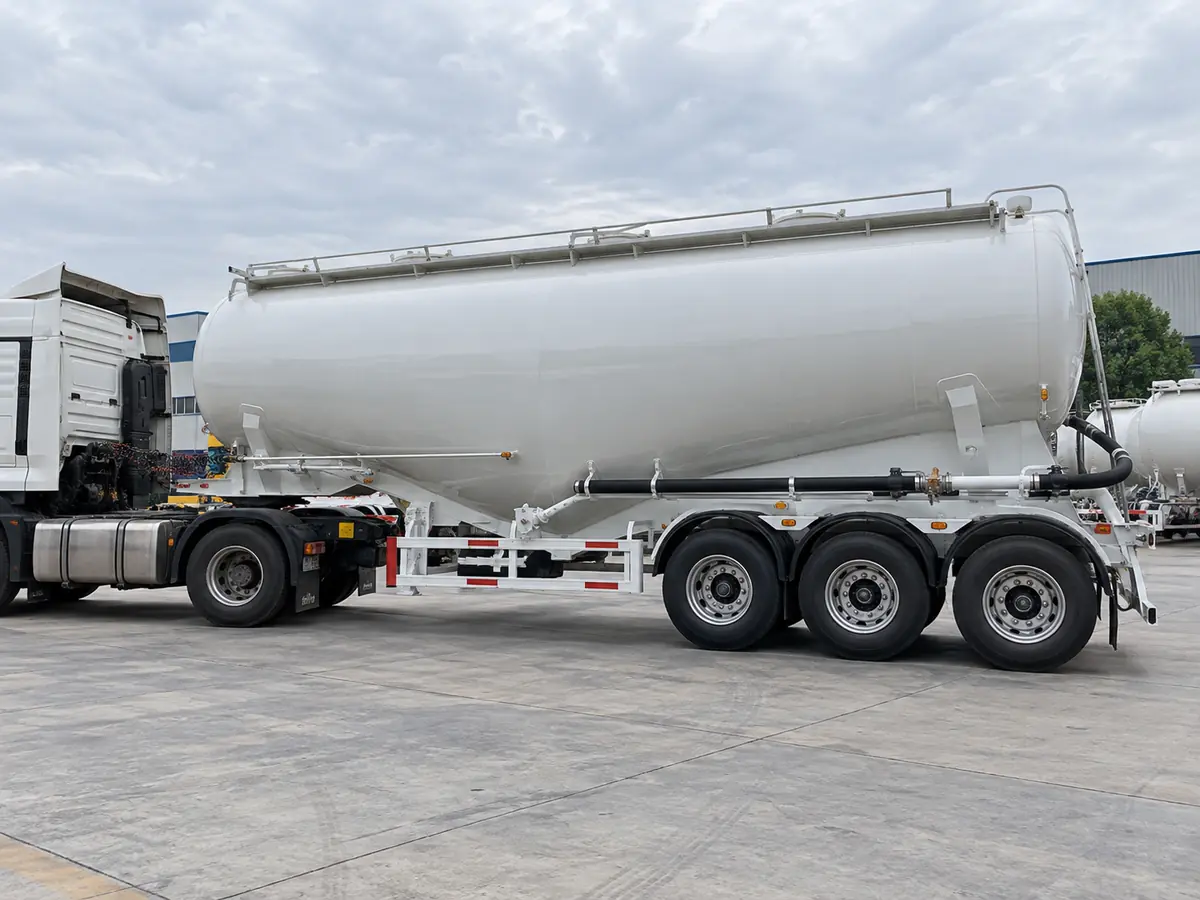
What Does an Axle Load Calculation Need?
Start with a weight-and-distance record for the exact tractor, trailer, and loading condition. A model name or axle count does not tell you where the weight acts. The needed measurements can come from an approved dimension drawing, empty-vehicle scale readings, and the cargo loading model.
| Input | Worked value | Where to get it |
|---|---|---|
| Empty trailer load at kingpin, K₀ | 3.2 t | Unladen support reaction from weighing or verified design |
| Empty trailer load at rear axle group, R₀ | 4.8 t | Unladen trailer axle-group reaction |
| Cement cargo, P | 30.0 t | Loading record or difference between loaded and tare mass |
| Kingpin to effective tridem center, L | 8.0 m | Trailer geometry and suspension layout drawing |
| Kingpin to cargo center, x | 6.4 m | Tank geometry plus actual modeled fill distribution |
| Tractor empty steer / drive group | 5.2 t / 3.8 t | Tractor-alone axle scale readings in the same fuel/equipment state |
| Tractor wheelbase / fifth-wheel lead | 3.6 m / 0.3 m | Tractor dimension sheet; lead is ahead of the drive-group center |
All numbers in this table describe one illustrative vehicle, not a published Panda Mech model. For a real bulk cement tank, the cargo center depends on tank shape, fill state and the location of powder inside it. Keep all distances measured rearward from the kingpin for the trailer calculation.
How Do You Calculate Kingpin and Trailer Axle-Group Loads?
Balance the cargo moment about the kingpin, then add the empty trailer’s support reactions. For the trailer, the kingpin and the effective center of the axle group act as two supports.
Kingpin load K = K₀ + P × (L − x) ÷ L
The formula works because the two support reactions must add up to the trailer’s loaded weight: R + K = R₀ + K₀ + P. It is the same static-balance method used in published semitrailer axle-load models, where a three-axle group is replaced by an equivalent support for the initial group-load calculation.
Worked Step 1: Find the Cargo’s Rear Reaction
The cargo adds 30.0 × 6.4 ÷ 8.0 = 24.0 t to the rear axle group. Add its empty axle-group share: 4.8 + 24.0 = 28.8 t.
Worked Step 2: Find the Kingpin Reaction
The cargo sends the remaining 30.0 − 24.0 = 6.0 t to the kingpin. Add the empty kingpin share: 3.2 + 6.0 = 9.2 t.
Worked Step 3: Check Total Trailer Mass
28.8 + 9.2 = 38.0 t, which matches the empty trailer plus cement: 8.0 + 30.0 = 38.0 t. This mass-balance check catches many arithmetic and unit mistakes. It does not yet tell you whether either axle group is within its permitted load.
Engineering basis: Krebs and Ehmke, Axle Weights in Combined Vehicle Routing and Container Loading Problems, §§4.2–4.4, which models axle groups as resultant supports and uses force and moment equilibrium.
How Does Kingpin Load Reach the Tractor Axles?
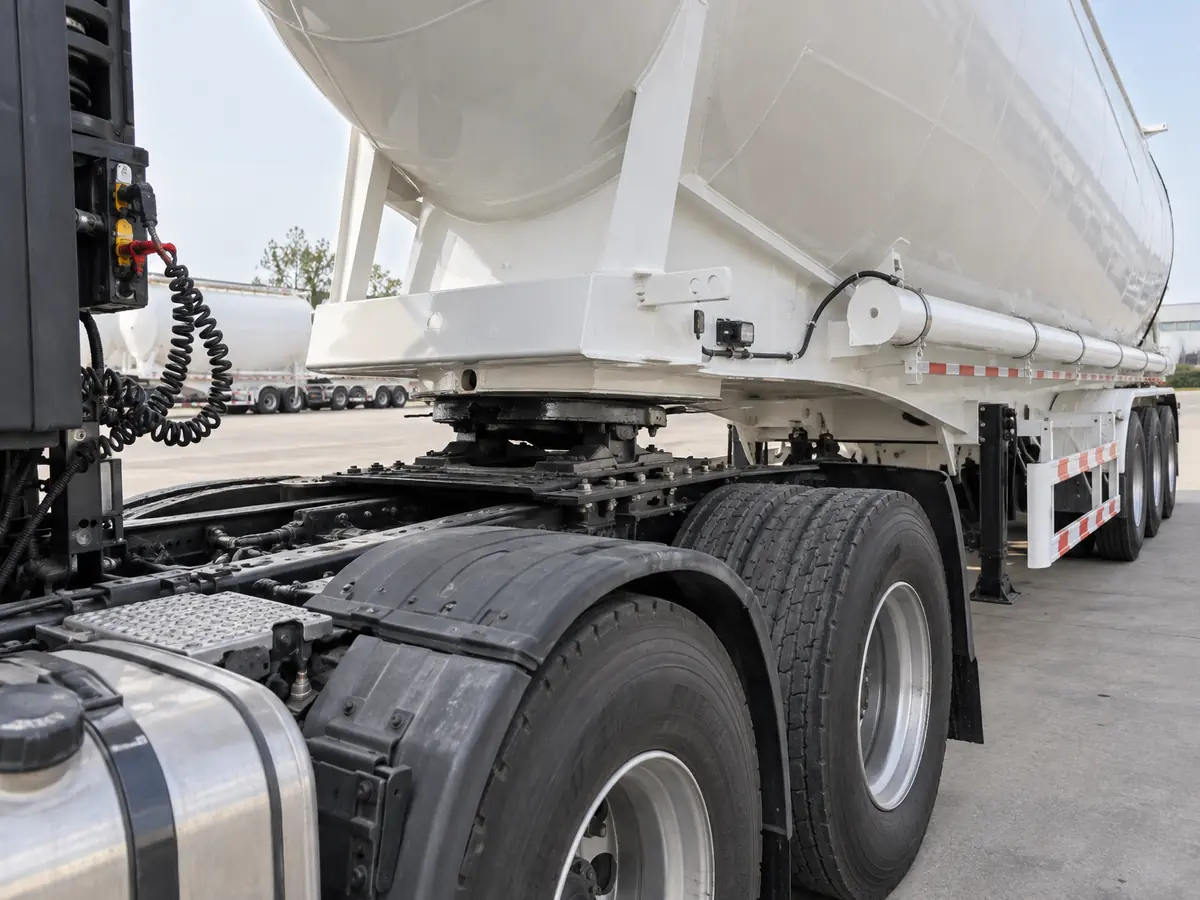
The photo shows the coupling where the trailer transfers load to the tractor. Measure fifth-wheel lead and wheelbase on the actual working combination before applying the calculation below.
The 9.2 t kingpin reaction becomes an extra load on the tractor. Its split depends on fifth-wheel position relative to the tractor axles. Here the fifth wheel is 0.3 m ahead of the drive-group center and the tractor wheelbase is 3.6 m.
Added drive load = K − added steer load
Added steer load = 9.2 × 0.3 ÷ 3.6 = 0.767 t. Added drive-group load = 9.2 − 0.767 = 8.433 t. Add the tractor’s own unladen axle-group loads:
| Support | Empty | Added by trailer | Loaded reading |
|---|---|---|---|
| Tractor steer axle | 5.200 t | 0.767 t | 5.967 t |
| Tractor drive group | 3.800 t | 8.433 t | 12.233 t |
| Trailer three-axle group | 4.800 t* | 24.000 t | 28.800 t |
| Complete combination | 17.000 t | 30.000 t | 47.000 t |
*The empty trailer also has 3.2 t at the kingpin; this transfers to the tractor when coupled and is already included in the two tractor loaded readings. For this reason, do not add the 9.2 t kingpin reaction to the 47.0 t vehicle total a second time.
Moving a tractor fifth wheel changes the steer/drive split; it normally does not change the trailer kingpin versus trailer-group split if the trailer support points and cargo position stay fixed. The tractor’s axle ratings and actual fifth-wheel position still need their own checks.
Why Can a Tridem Group Overload Below the Gross Weight Limit?
Because group limits and total vehicle weight limits are separate tests. Suppose this example has a hypothetical 50.0 t combination gross limit, a 27.0 t trailer-tridem limit and a 13.5 t tractor-drive-group limit. Those are teaching thresholds, not legal limits for any named country.
The original 47.0 t combination is below the example gross limit, yet the trailer group carries 28.8 t: 1.8 t above the illustrative 27.0 t group limit. Simply saying “30 tons over three axles is 10 tons per axle” misses the trailer tare and load transferred through the kingpin.
What If the Cargo Center Moves Forward?
Try a different calculated cargo center, 5.9 m behind the kingpin, with the same 30.0 t cargo and trailer. The trailer group drops to 4.8 + 30 × 5.9 ÷ 8.0 = 26.925 t. The kingpin rises to 11.075 t, so the tractor drive group becomes 3.8 + 11.075 × (3.3 ÷ 3.6) = 13.952 t.
One overload has shifted to a different axle group. The change clears the hypothetical trailer-group limit but exceeds the hypothetical drive-group limit by about 0.452 t. A fixed pneumatic tank does not let a driver simply move cement around like pallet freight: the cargo-center change must come from an approved design or loading model.
A Payload Change That Clears Both Example Group Limits
Keep the cargo center at 6.0 m and reduce the modeled cargo to 29.5 t. Trailer group = 4.8 + 29.5 × 6 ÷ 8 = 26.925 t. Kingpin = 3.2 + 29.5 × 2 ÷ 8 = 10.575 t. Tractor drive group = 3.8 + 10.575 × 3.3 ÷ 3.6 = 13.494 t. The total becomes 46.5 t. Both group figures are just inside these example limits, but the steer axle, individual axles, equipment ratings and route still need checking.
| Modeled case | Payload | Cargo x | Tridem group | Tractor drive | What changes? |
|---|---|---|---|---|---|
| Original load | 30.0 t | 6.4 m | 28.800 t | 12.233 t | Tridem above example 27.0 t limit |
| Forward-CG test | 30.0 t | 5.9 m | 26.925 t | 13.952 t | Drive group above example 13.5 t limit |
| Smaller payload test | 29.5 t | 6.0 m | 26.925 t | 13.494 t | Both example group figures within limits |
There is no cargo-center position that meets both group limits with the original 30.0 t payload and these assumed tractor/trailer weights. The two limits require at most 27.0 t at the trailer group and at most about 10.582 t through the kingpin; together they support at most about 37.582 t of loaded trailer mass. The planned loaded trailer is 38.0 t. That is why reducing the payload or changing the vehicle configuration is more effective than chasing a new center of gravity alone.
What Changes the Load Split in Service?
Trailer tare, filling pattern, support geometry and suspension load sharing all affect the result. The worked formulas predict the two main trailer reactions on level ground. A final axle check also needs the real running gear and loading state.
- Tank geometry and powder position: A partly filled tank, separate hoppers or an uneven loading sequence can place the powder’s mass center somewhere other than the vessel midpoint. Use the approved design and fill model.
- Equipment and tare changes: A different compressor, spare-wheel mount, suspension, axle position or fuel state changes the empty reactions. Repeat the calculation if these change.
- Tridem load sharing: A calculated 28.8 t axle-group total gives an arithmetic average of 9.6 t across three axles. That is not three verified 9.6 t axle readings. Unequal suspension reactions and tire loading need actual axle-level checks.
- Moving support geometry: A trailer axle assembly moved forward or backward changes L and therefore both trailer support reactions. A changed tractor fifth-wheel setting instead changes the split carried by the tractor axles.
- During partial discharge: If the remaining powder’s center changes substantially, recalculate the loaded state used for the operation and travel plan. Avoid treating an initial full-tank CG as valid for every later fill condition.
Axle and suspension component ratings can also differ from the legal road allowances. For a country-specific route, check the axle spacing and group definitions as well as total weight. For example, the U.S. Federal Highway Administration’s Bridge Formula guidance explains why the length of a group of axles matters on U.S. Interstate routes. Do not apply U.S. numbers to another country.
How Do You Confirm Axle Weights on a Weighbridge?
Use a loaded scale record to verify steer, drive and trailer axle-group readings, not only the gross mass. Take the readings in the vehicle configuration, fuel state and load condition that matter for dispatch.
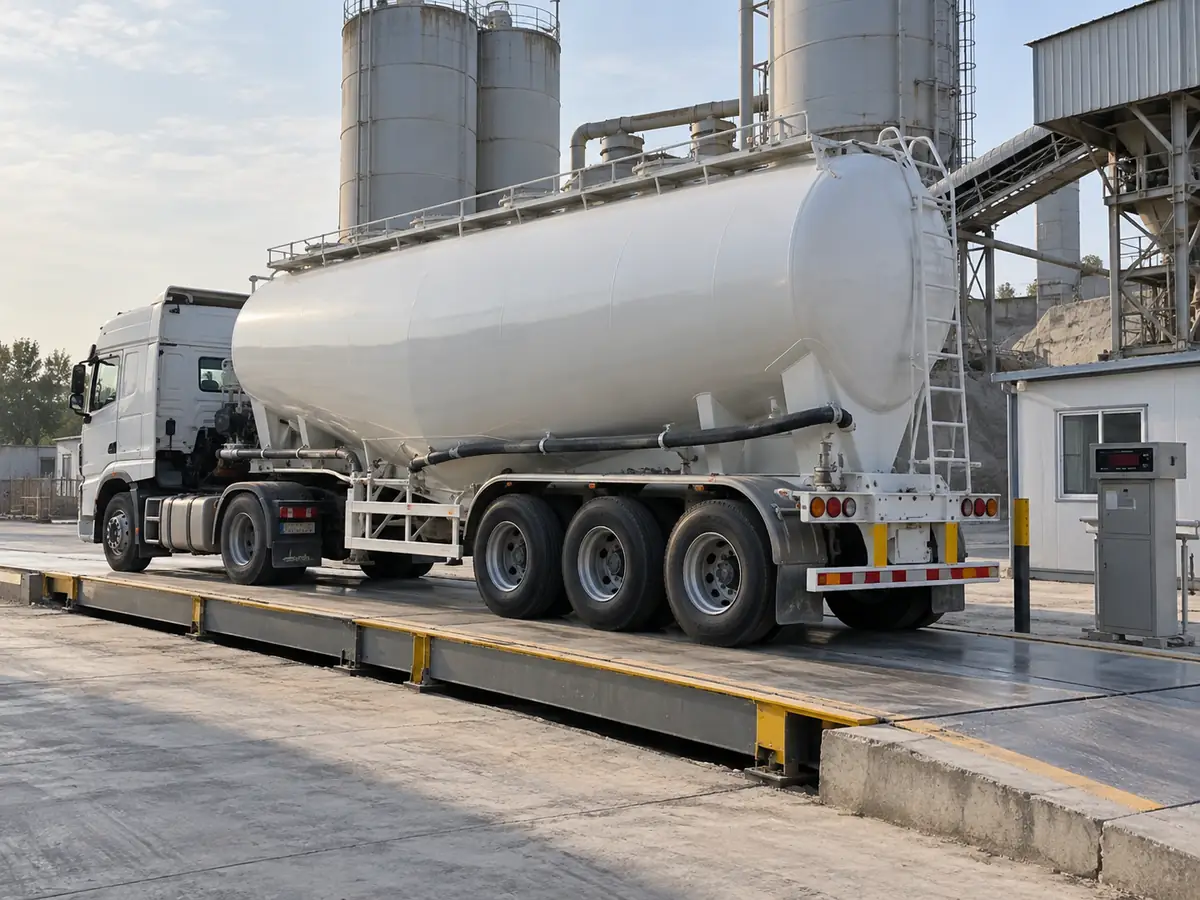
- Record the empty combination or approved tare split. Write down steer, drive and trailer group reactions separately. If the tractor or tanker is changed, obtain its matching tare values.
- Weigh the loaded combination by axle group. Request steer axle, tractor drive group, trailer axle group and the total. Where needed, weigh individual axles or wheel positions using equipment suitable for that purpose.
- Compare each value with its own constraint. Check the applicable route’s gross, axle and axle-group limits, spacing or bridge rules, and the rated capacity of the axles, tires, suspension, coupling and tractor.
- Correct the actual cause, then reweigh. If the rear trailer group is high while drives have room, recalculate the support split and review the manufacturer-approved options. If the drive group is high, a rearward shift may only move the problem back to the trailer. Reduce cargo or change the suitable combination when no permitted load split exists.
If the ticket provides only one gross number, obtain axle-group readings before using it to approve a loading plan. Keep the scale ticket with the vehicle configuration and cargo details; it is the field check that the arithmetic needs.
Cement Tanker Axle Load Calculator
Enter your actual empty axle-group reactions and geometry to repeat the static calculation. The preset values reproduce the worked example. Change the cargo mass or cargo-center distance to see whether a problem moves from the trailer group to the tractor drive group.
Calculate a Static Axle-Group Load Split
Trailer group exceeds the example limit by 1.800 t.
This is a static two-support estimate, not a certified weighbridge result. The limits in the last two input fields are examples until you replace them with route-specific values; individual axles, steering, tire/equipment ratings and all other limits still need checking.
What Data Should You Send Before Ordering?
Send the route, tractor details, loading target, empty weight split, and available dimension drawing. An axle load calculation is most useful before the tank body, axle position and tractor pairing are fixed.
- Destination country and roads or borders used, including known gross and axle-group restrictions.
- Tractor wheelbase, tire/axle ratings, unladen steer/drive readings and fifth-wheel position.
- Target cement tonnes per trip and actual powder bulk density, plus any special filling or discharge sequence.
- Trailer tare estimate or empty axle/kingpin readings, kingpin-to-axle-group spacing and approved tank layout.
- Loaded weighbridge readings if you are replacing an existing vehicle or troubleshooting a group overload.
Matching this calculation to a new three-axle cement tanker? Panda Mech’s 3-axle cement tanker configuration page covers its model family and the main axle/suspension choices. Start there, then share the route and tractor inputs to review a model-specific configuration.
Review 3-Axle Tanker ConfigurationsCement Tanker Axle Load Calculation: Final Check
Calculate the trailer group and kingpin reactions first; then calculate steer and drive axle-group reactions on the tractor. In this example, 30.0 t of cement gives 28.8 t on the trailer group and a 9.2 t kingpin load, producing a 47.0 t loaded combination. The numbers reconcile, but that does not remove the separate axle-group constraints. A proper cement tanker axle load calculation ends when the proposed loading condition is checked against axle/group, equipment and route limits, and the resulting plan is confirmed with suitable scale readings.
Axle Load FAQ
Can a cement tanker pass the total-weight check but fail an axle-group check?
Yes. Total vehicle mass and axle-group mass are separate limits. In the worked example, the 47.0 t combination is below a hypothetical 50.0 t gross limit, while the 28.8 t trailer group exceeds a hypothetical 27.0 t group limit.
Can I divide the tridem-group weight by three to check each axle?
Only as a rough average. A 28.8 t tridem group averages 9.6 t per axle, but suspension setup, tire pressure and load sharing may make actual individual axle readings different. Use suitable scales for an axle-level check.
Does moving the tractor fifth wheel reduce weight on the trailer tridem?
A tractor fifth-wheel adjustment mainly changes the split between the tractor steer and drive axles. With trailer geometry and cargo position unchanged, it does not solve an overloaded trailer axle group. Moving a trailer axle assembly is a different change and needs a new trailer load calculation.
What if my bulk cement tanker has a fixed tank and I cannot shift the cargo?
Treat the cargo center of gravity as a design and loading input, not an adjustable setting. Check approved tank geometry and actual loading conditions. If the planned axle loads exceed a limit, reduce payload or review tractor and trailer configuration with the manufacturer.
How do I find the cargo center of gravity for a partly filled powder tanker?
Start with the approved tank drawing and the manufacturer’s loading model for the actual fill condition. Do not assume that half the tank length is the cargo center. Where fill distribution changes, compare the relevant loading and discharge states.
Is an axle rating the same as the legal axle limit?
No. Hardware ratings for axles, suspension, tires, and the kingpin are not interchangeable with road-law limits. The permitted load also depends on the route, axle spacing, axle group and any applicable bridge-weight rule.
What scale readings should I request?
Request the loaded steer-axle, tractor-drive-group and trailer-axle-group readings, plus total weight. If individual-axle or wheel-position checks are required, use a suitable weighing method that provides those readings; a total-only ticket is not enough.

ZAC
Hello, I’m ZAC, a cement trailer and semi-trailer specialist with over 20 years of industry experience. My technical approach starts with real operating conditions, including how cargo characteristics, road conditions, and loading and unloading methods affect trailer performance. I place particular emphasis on structural reliability, component compatibility, and ease of maintenance. I look at both everyday performance and how reliably a trailer operates over time, as well as how easily it can be inspected and serviced.


