
For reliable cement tanker rainy season transport, approve the route and the receiving site as one delivery plan—not just a line on a map. Check official closures and flood warnings, verify bridge and vehicle limits, inspect weak shoulders and drainage crossings, confirm the plant entrance can take a loaded tanker, and set a clear stop-or-reroute rule before dispatch. Never drive through floodwater or use an unverified detour to protect an ETA.
What makes a rainy-season route unsafe for a cement tanker?
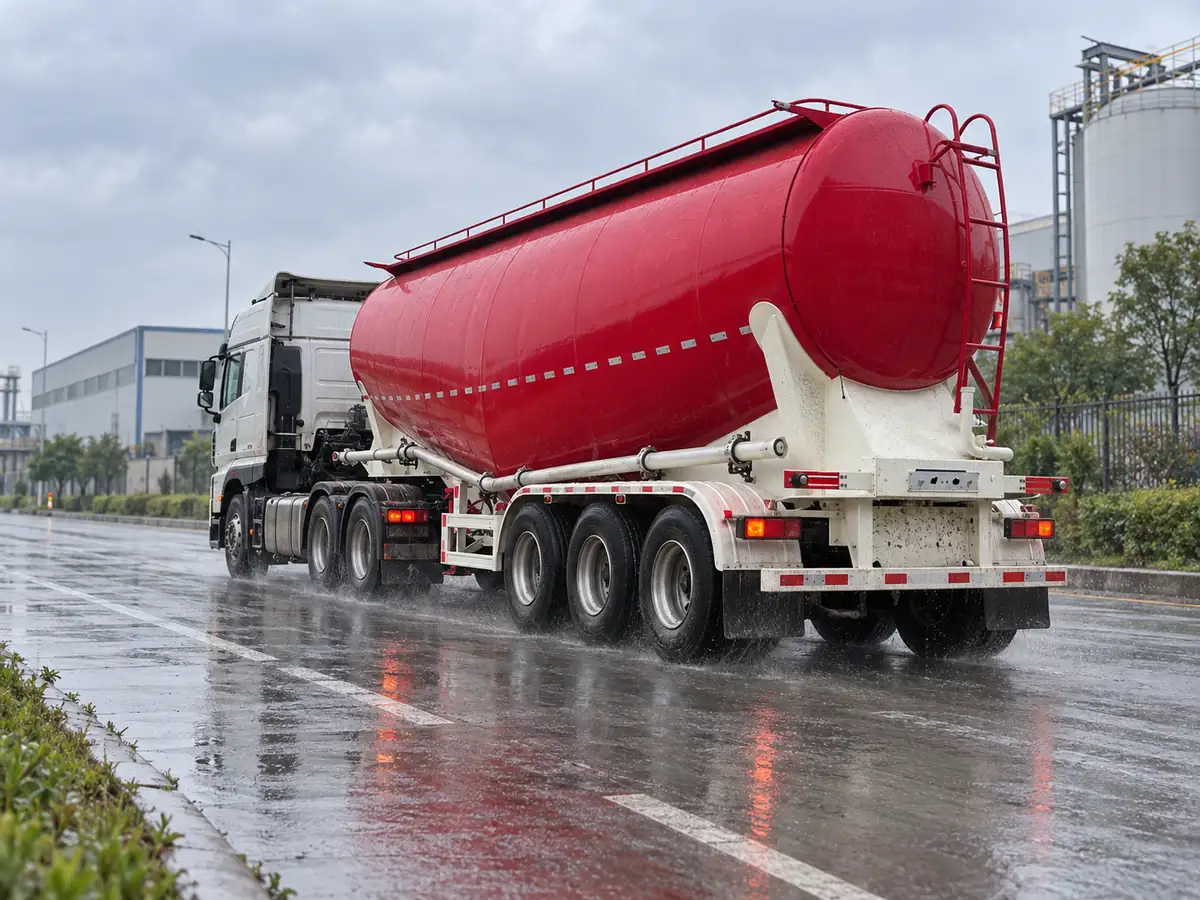
A route becomes unsafe when rain changes the road, the vehicle’s stopping margin, or access to the delivery point—and the change has not been checked. Rainfall alone is not a useful go/no-go measure for every road. The same storm can leave a drained main road passable while a low crossing, unsealed shoulder, steep approach, or plant access lane becomes unusable.
For a loaded pneumatic tanker, review the whole journey in sections. A road can be open to ordinary traffic but still be unsuitable for a particular heavy-vehicle combination, axle loading, height, turning path, or delivery schedule. The driver also needs a safe place to stop if the route deteriorates after departure.
| Risk point | What rain can change | What the fleet should verify |
|---|---|---|
| Low crossings and floodways | Water may hide road damage, debris, or a washed-out surface. | Current closure status and local authority instructions. If water covers the road, do not attempt the crossing. |
| Shoulders, verges, and unsealed roads | Soft ground, edge collapse, ruts, or reduced traction can make passing and turning unsafe. | Surface condition, drainage, width, and whether the vehicle can stay on firm ground without entering a weak edge. |
| Bridges, slopes, and tight turns | Rain does not change the posted limit, but it can reduce traction and expose existing route constraints. | Vehicle mass and dimensions, posted restrictions, approach geometry, braking margin, and any permit or local access condition. |
| Plant entrance and unloading bay | Standing water, mud, queues, or a soft turning area can prevent a tanker from entering or positioning safely. | Receiving-site access, turning space, firm parking, drainage, unloading slot, and a safe waiting location. |
Wet roads also reduce tyre grip. The UK Highway Code says stopping distances in wet weather should be at least double those needed on dry roads; treat that as UK guidance, not a universal legal formula for every country or vehicle. The operational lesson is consistent: allow more space, reduce speed to conditions, and do not plan a route that leaves no safe stopping option. See the UK Highway Code guidance on adverse weather.
How should you survey a flood-prone delivery route?
Survey the route by segment and record evidence for every known weak point, then confirm the findings close to dispatch. A route survey is not simply checking the total distance or asking whether a truck has travelled there before. The road, drainage, bridge access, and plant entrance can change between seasons and after a storm.
Build the route record
- Start and destination: record the loading point, receiving silo or plant, approved gate, unloading position, and any safe staging area.
- Vehicle data: use the actual tractor-and-trailer combination, overall height and width, length, axle configuration, loaded mass, ground clearance, and turning needs. Do not use a generic “cement tanker” label as a substitute for the vehicle’s approved details.
- Road constraints: mark bridges, low-clearance structures, weight limits, steep grades, tight bends, narrow approaches, low points, culverts, river crossings, and unsealed sections.
- Rain-sensitive locations: record where water collects, drainage overflows, the shoulder softens, traffic queues form, or the road has previously been closed. Treat past experience as a clue, not proof that the road is open today.
- Authority and site contacts: note the official road-closure source, the responsible road manager where known, the plant receiving contact, and who can approve a delay or alternate delivery slot.
Verify the primary route and the alternative
Check current local weather warnings and official road status before release. Where heavy-vehicle route tools exist, select the correct vehicle class and review route conditions rather than relying on a car-navigation estimate. For example, Australia’s NHVR Route Planner maps approved routes for certain heavy-vehicle classes and says its networks are indicative; operators must confirm conditions with the relevant state road authority. This is an Australian example, not a global route tool.
For each alternative, verify the same constraints as the primary route: vehicle mass and dimensions, bridge or road restrictions, road surface, turning space, and the receiving site’s access. A shortcut that adds an unsealed road, a low bridge, or a flood-prone crossing is not a useful fallback just because it is shorter.
Can the tanker reach the loading and unloading points?
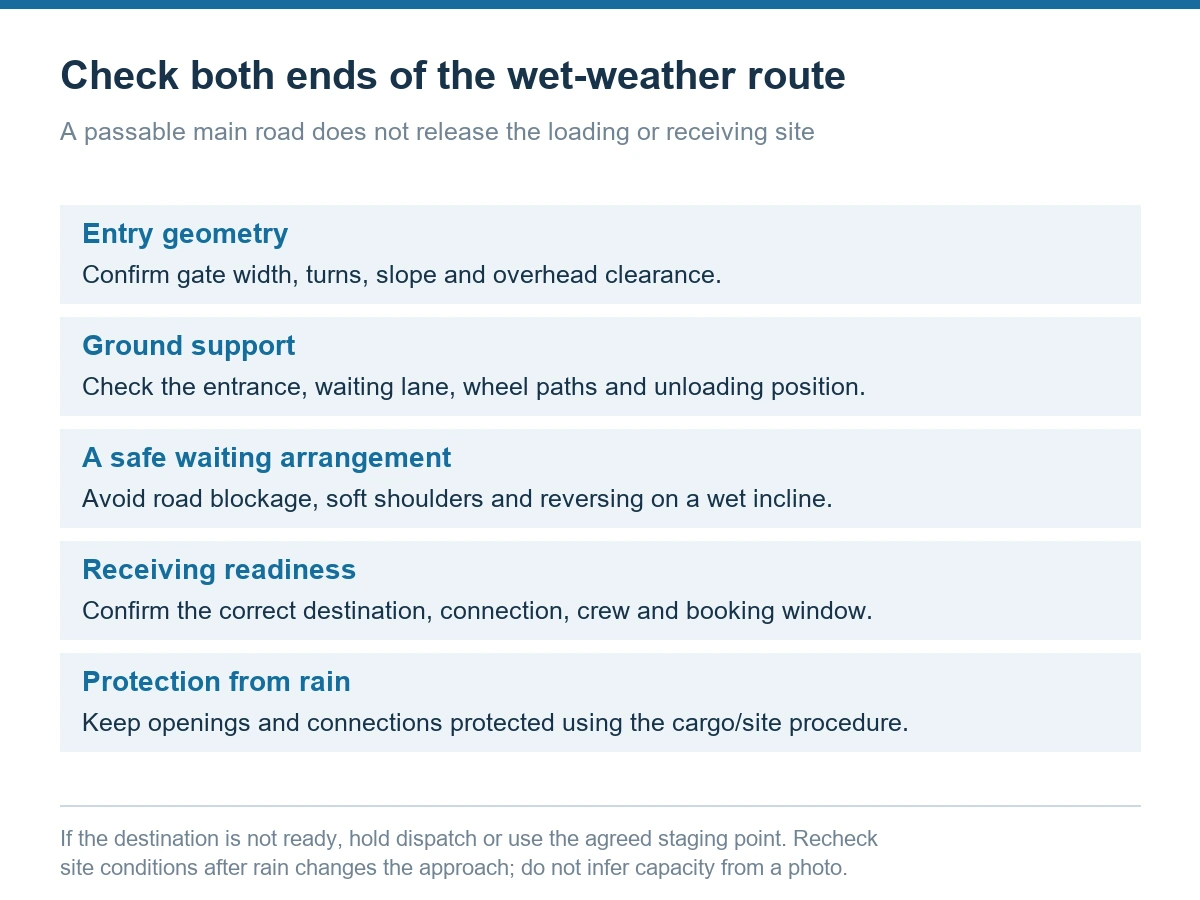
Route approval is incomplete until both ends of the trip can safely receive the actual loaded vehicle. A passable public road does not guarantee that a plant gate, stockpile access road, weighbridge queue, loading bay, or silo unloading position is usable after heavy rain.
Check the final approach, not just the main road
- Entry geometry: confirm the gate width, turning path, overhead clearance, slope, and any sharp turn between the public road and the loading or unloading position.
- Ground support: check whether the entrance, waiting lane, and turning area remain firm under a loaded vehicle. Avoid relying on a soft shoulder or an unverified temporary surface.
- Queue and parking: agree where the tanker can wait without blocking traffic, standing under trees or unstable slopes, or being forced to reverse on a wet incline.
- Receiving readiness: confirm the silo or destination is available, the correct connection point is ready, and the unloading crew can receive the vehicle within the planned window.
- Weather exposure: agree how the site will keep powder transfer equipment and connections protected from rain. Keep openings and transfer connections closed when not in use, following the equipment and cargo handling instructions.
If the receiving point is not ready, hold the dispatch or use an agreed staging point rather than sending the tanker into a queue that may spill onto a narrow or flood-prone road. If the road surface or approach has changed since the last delivery, ask the site to confirm the current condition with a recent inspection or clear photos and an accountable contact.
When selecting a trailer for a route, consider the full combination—not the nominal payload alone. Our 50-ton cement tanker trailer page is a starting point for discussing a configuration; the appropriate axle layout, tractor match, dimensions, and permitted load still depend on the actual vehicle specification, route rules, and site conditions.
How should dispatch decisions change as weather develops?
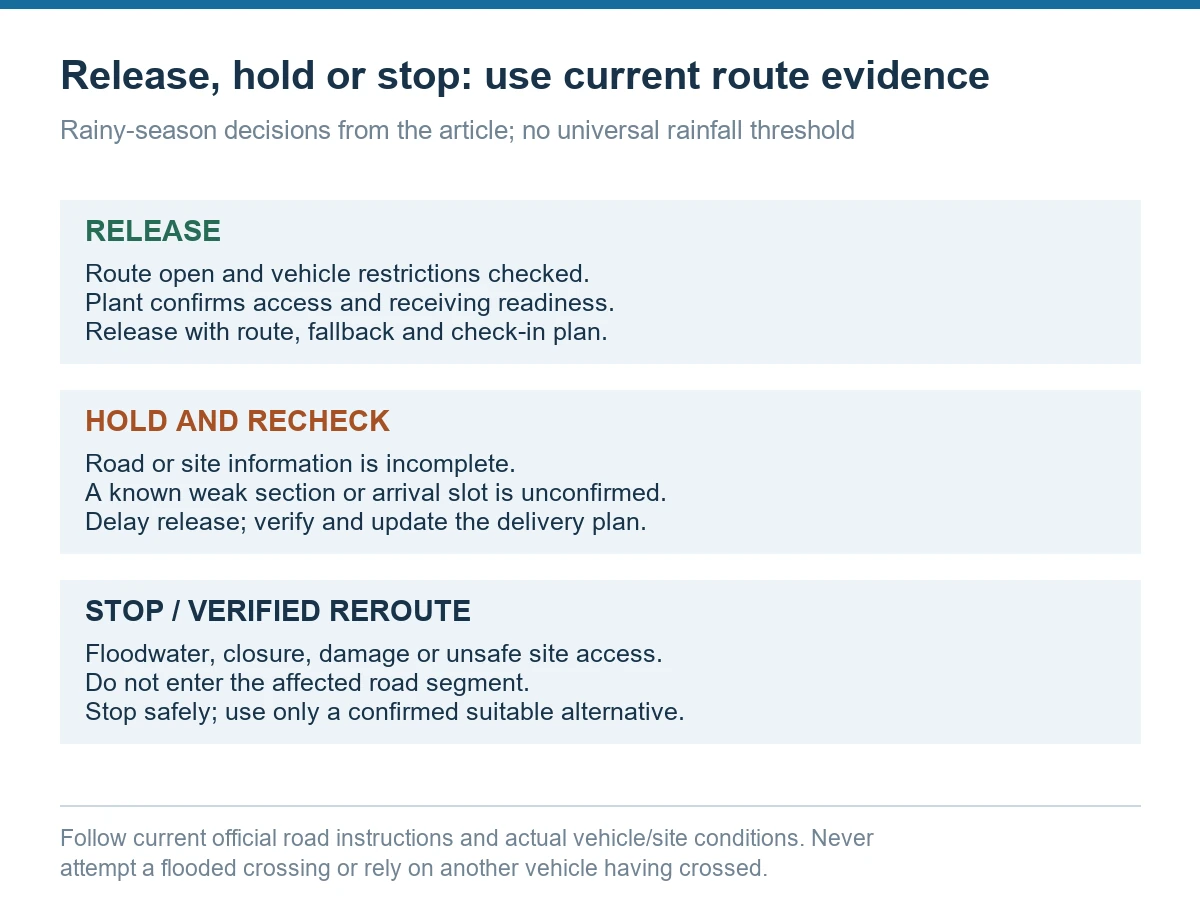
Use a simple release, hold, or stop decision based on current evidence—not a fixed rainfall number that ignores local drainage and road conditions. There is no single rainfall threshold that makes every road or tanker combination safe. Local warnings, road-authority instructions, flood reports, and the actual condition of each route segment matter more than a generic millimetre target.
| Dispatch status | Evidence | Action |
|---|---|---|
| Release | The intended route is open; applicable vehicle restrictions are understood; the plant confirms access and receiving readiness; no current warning or site report conflicts with the plan. | Release the vehicle with the primary route, confirmed fallback, check-in points, and the person authorised to change the plan. |
| Hold and recheck | Heavy rain is forecast or underway, information is incomplete, a known weak segment has not been inspected, or the receiving site has not confirmed access. | Delay release while dispatch verifies the relevant road and site status. Update the ETA and recheck the plan before committing the vehicle. |
| Stop or reroute | An official closure or warning applies; floodwater covers the road; a bridge, culvert, shoulder, or approach is damaged; the alternative route has not been verified; or the receiving point cannot safely accept the vehicle. | Do not enter the affected segment. Stop in a safe location, notify dispatch and the customer, and use only an officially confirmed, vehicle-suitable alternative or wait for clearance. |
Set decision points before the truck leaves
For each delivery, agree when the route will be checked again: during planning, immediately before release, at a suitable check-in before a known risk segment, and after any material weather or road-status change. Choose check-in points where the driver can stop safely; do not require a driver to use a phone while moving or to stop on an exposed shoulder.
Give dispatch authority to delay or cancel the trip without pressure to protect the original ETA. The driver should be able to stop when a road appears flooded, a closure is encountered, visibility becomes unsafe, or the actual road condition conflicts with the plan. The dispatcher then confirms the next safe action rather than instructing the driver to “try slowly.”
Keep the customer plan realistic
Notify the loading plant and receiving site when a route check changes the departure or arrival estimate. Give a revised delivery window, the reason for the change, the next update point, and any action needed at the receiving silo. If the delay will push the delivery beyond the site’s receiving hours, rebook the slot instead of arriving at a closed gate in worsening weather.
Where several tankers serve the same corridor, dispatch can stagger departures, pause vehicles upstream of a known weak segment, or hold loads at a safe yard. Do not let a queue build near a floodway, narrow bridge, steep approach, or low-lying waiting area.
What should drivers check before and after a wet-weather trip?
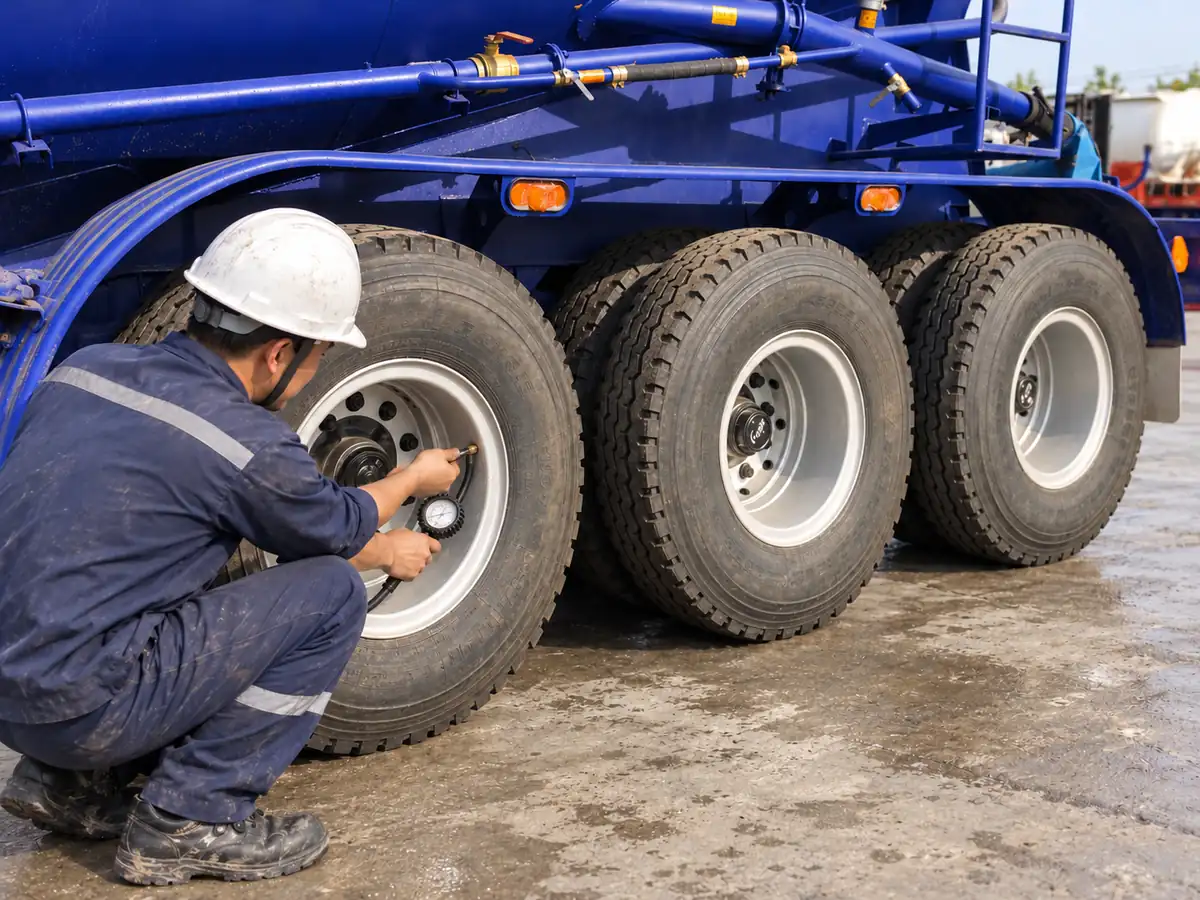
Check the items that affect grip, visibility, braking, vehicle condition, and safe stopping—and record any defect that could change the route decision. Rainy-season planning is not only a route-map task. A vehicle that is suitable on paper can still be unsafe if tyres, brakes, lights, wipers, or visibility are poor.
Before departure
- Inspect tyres, tread, visible damage, wheels, brakes, lights, indicators, windscreen, wipers, mirrors, and demisting equipment under the fleet’s normal inspection process.
- Confirm the correct tractor-and-trailer combination, load and axle limits, route documents, permits where required, and vehicle height/width details used for route approval.
- Check current official weather and road information, plus the receiving site’s access status and unloading slot.
- Review the primary route, verified alternative, safe holding location, contact chain, and the condition that requires the driver to stop.
- Confirm the tanker’s hatches, closures, seals, hoses, and transfer connections are secured for travel according to the vehicle and cargo instructions. Keep dry powder protected from rain during loading and unloading.
During the trip
- Reduce speed to the actual visibility, surface, traffic, and stopping distance. Leave more following space and avoid abrupt braking or steering on wet or loose surfaces.
- Do not enter floodwater, drive around a closure barrier, or assume a familiar crossing remains intact after a storm.
- Report new washouts, blocked access, unsafe queues, or a change in the receiving site’s condition from a safe stopping place.
- Do not take an unverified detour, even if navigation software suggests it. Dispatch must confirm that the route is suitable for the actual heavy vehicle.
After arrival or a weather-related stop
Record any route damage, tyre or brake concern, contact with standing water, abnormal vibration, or defect found during inspection. If a road or vehicle component may have been damaged, do not simply return it to service because the load was delivered. Follow the fleet’s inspection and repair process, and record the location and condition so the next trip plan can be updated.
A practical rainy-season fleet checklist
A useful checklist connects each decision to an owner and a record. Use this before the wet season, before a high-risk delivery, and after a closure or route condition changes.
- Route owner: primary route and alternate route reviewed for the actual vehicle and load.
- Road status: official warnings, closures, bridge restrictions, and local access conditions checked and time-stamped.
- Weak points: floodways, culverts, soft shoulders, steep approaches, narrow turns, and unsealed sections identified.
- Site access: loading and receiving points confirm entry, turning, parking, drainage, unloading readiness, and a safe waiting location.
- Driver briefing: route, check-in points, stop conditions, emergency contacts, and change authority understood.
- Customer communication: ETA window, delay contact, receiving slot, and next update point agreed.
- Vehicle readiness: tyres, brakes, lights, visibility equipment, closures, and transfer connections inspected.
- Trip record: changes, stops, defects, site reports, and actual route outcome captured for the next dispatch.
After each significant weather disruption, update the route record with what actually changed. A note such as “bridge approach flooded after overnight rain” is more useful than a general “bad road” label because it identifies the location, observed condition, and reason to recheck before the next delivery.
For dependable cement tanker rainy season transport, treat official route status, vehicle limits, current road conditions, and confirmed site access as one release decision. If any critical segment is closed or unverified, hold the tanker and update the delivery slot instead of accepting an unverified detour.
Planning a cement tanker route for a wet-season delivery?
Send us the destination, required payload, tractor and trailer details, route constraints, and receiving-site conditions. We can help review the tanker configuration against the transport job; final road access and operating permission must still be confirmed with the responsible local authorities and site operators.
Review the 50-ton cement tanker trailer or contact Panda Mech with your route and configuration requirements.
Frequently asked questions
Can a cement tanker travel through shallow floodwater?
No. Do not judge a flooded crossing by visible depth or by watching another vehicle cross. Water can hide road damage and flowing water can move vehicles. Stop at a safe location and wait for official clearance or use a confirmed alternate route.
Is a route suitable if ordinary trucks are still using it?
Not necessarily. Check the actual tanker-and-tractor combination, loaded mass, axle limits, height, width, turning needs, bridge restrictions, and the condition of the final site access. General traffic movement does not confirm that every heavy-vehicle configuration is permitted or safe.
How often should a rainy-season route be checked?
Check it during planning, before dispatch, and again when an official warning, closure notice, driver report, or receiving-site update could change the decision. A fixed schedule is only a baseline; a material change in conditions requires a fresh check.
What should a fleet do when the main route closes?
Stop at a safe location, notify dispatch and the customer, and verify a suitable alternate route against vehicle dimensions, loaded mass, road surface, bridge limits, and site access. If no safe, permitted alternative is confirmed, hold the delivery until the route reopens or a new plan is agreed.
Should the fleet use a smaller tanker during the rainy season?
Only if the actual route or site constraints make the current configuration unsuitable and a smaller vehicle solves those constraints without creating a different problem. Compare permitted mass, axle loads, height, ground clearance, turning space, payload needs, and unloading compatibility rather than choosing by nominal tonnage alone.
Does rain change the tanker’s legal payload?
Rain itself does not create a universal new payload figure. The permitted load still depends on the applicable local rules, actual vehicle and axle limits, and route restrictions. Road damage or temporary closures may change which route can be used, so confirm the current local requirements for the trip.

ZAC
Hello, I’m ZAC, a cement trailer and semi-trailer specialist with over 20 years of industry experience. My technical approach starts with real operating conditions, including how cargo characteristics, road conditions, and loading and unloading methods affect trailer performance. I place particular emphasis on structural reliability, component compatibility, and ease of maintenance. I look at both everyday performance and how reliably a trailer operates over time, as well as how easily it can be inspected and serviced.


