
Long-haul and short-haul cement tankers should not be configured from trip distance alone. For regular highway runs, start with the highest road-legal payload that the tractor, tank volume, axles, and route can support. For urban or construction-site deliveries, first make sure the complete truck can enter, turn, stand safely, and unload. Then choose the payload and pneumatic equipment that deliver the most cement over a working day.
A 40 m³ three-axle tanker may work for either job. A shorter route does not automatically need a small tanker, and a long route does not automatically justify the biggest one. The real difference is often whether each day is limited by driving distance or by site access, unloading, and waiting time.
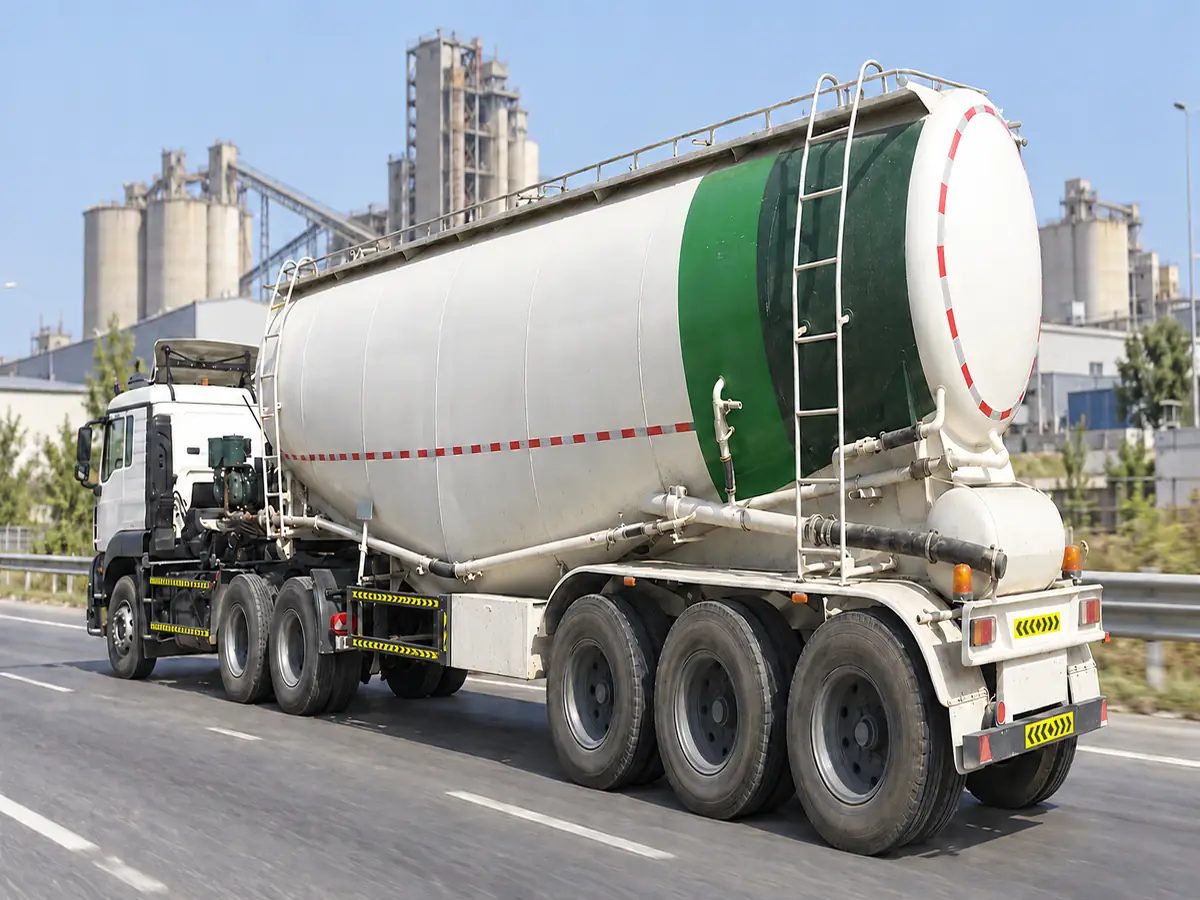
How Do Highway and Construction-Site Cement Tanker Requirements Differ?
Highway routes reward usable payload per trip and reliable running costs; construction-site routes reward access and complete deliveries per shift. Check the final unloading point as carefully as the road between the cement plant and the customer.
| What changes | Long-haul or intercity deliveries | Short-haul, urban or site deliveries |
|---|---|---|
| Main constraint | Route weight limits, driving distance, fleet uptime | Entrance size, turning room, queues, receiving-silo access |
| Payload direction | Maximize legal and usable tonnes per trip | Size to the receiving site and number of practical trips |
| Tractor priority | Stable road performance, suitable gearing, service network | Low-speed control, traction where needed, safe maneuvering |
| Trailer layout | Tank/axle combination that fits highway rules and route | Overall length, rear swing, ground clearance, approved access |
| Running gear | Tire life, brakes, axle loading, predictable maintenance | Turning wear, frequent braking, suspension and ground conditions |
| Air discharge | Reliable unloading at known silos with minimal downtime | Fast connection, accessible valves, dependable full-cycle unloading |
| Metric to compare | Cost per delivered tonne over the complete journey | Tonnes delivered per working shift and time at each site |
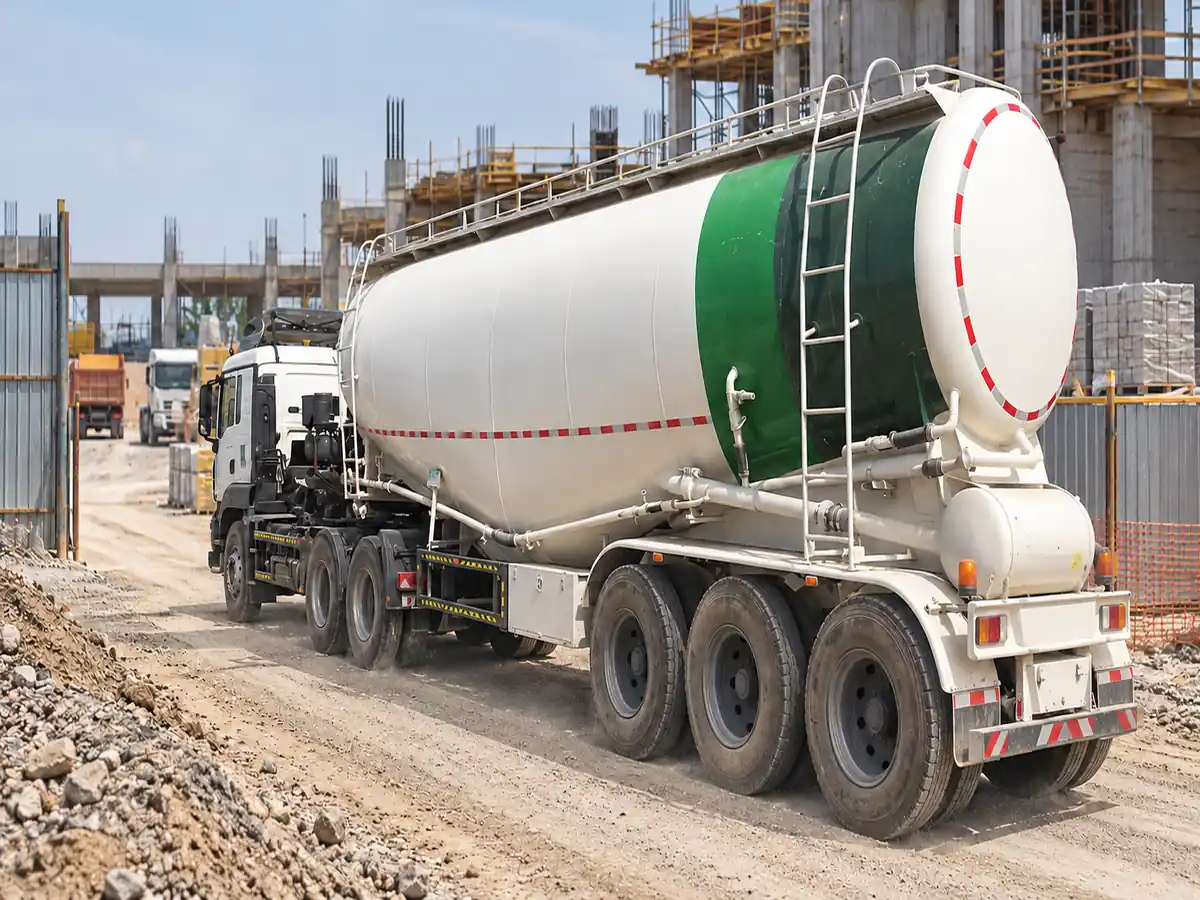
The journey may include both environments. If 95% of the trip is highway but the last 200 metres are a tight muddy site, the site may still determine the largest usable trailer. Do not specify a large highway tanker that cannot reach its unloading connection.
Which Tanker Capacity Fits a Long Route or a Short Route?
Choose capacity from the smallest of four limits: road-legal cargo weight, the tank’s usable volume at the cargo’s bulk density, the equipment’s rated payload, and what the site can receive. Model names such as “50 ton” describe a product class, not permission to carry 50 tonnes on every road.
Start with cargo density and actual legal weight
The basic relation is cargo mass (t) = usable volume (m³) × actual bulk density (t/m³). Usable volume may be less than geometric tank volume, so use a real fill plan, not an automatic 100% assumption. The permissible cargo is also limited by the complete combination’s gross weight and individual axle or axle-group loading.
Consider a worked example, not a measured customer load: a 40 m³ tank carries cement with a hypothetical bulk density of 0.90 t/m³. If the particular loading plan allows 90% of the tank’s nominal volume, the volume-based amount is 40 × 0.90 × 0.90 = 32.4 t. If the tractor-trailer combination and route permit only 28 t of cargo after tare and axle checks, 28 t is the usable planning payload, not 32.4 t or 50 t. Measure the real cement density and weigh the proposed combination before confirming the contract specification.
That check is not just about gross weight. Even if the total is within the route limit, the tractor drive axles, steering axle, kingpin, or trailer axle group can exceed their individual limits. On U.S. Interstate routes, for example, the Federal Highway Administration’s bridge formula guidance shows why axle spacing and group loads matter as well as gross weight. Apply the actual rules of your destination and road network, not the U.S. values to another country.
When a smaller tanker wins
A smaller tank or shorter combination can be the better short-haul choice when the site limits gross weight, headroom, axle loading, delivery batch size, or turning space. It may also reduce time lost repositioning at a narrow unloading bay. But a smaller tank does not automatically finish more trips: if the same truck can safely use a larger trailer and the site accepts full loads, the larger configuration may still carry more tonnes per shift.
When a larger tanker wins
For a highway shuttle between a cement plant and a receiving depot, higher legal payload can reduce the number of round trips needed for the same weekly demand. First check the density and usable volume; next check actual tractor and trailer tare and every axle group. An aluminum-tank option may reduce tare in some builds, but its price, repair support, tank/chassis construction, and actual legal-payload gain must be compared on the approved design—not assumed from the material name alone.
How Should You Match the Tractor to Each Cement Tanker Route?
Specify the tractor and tanker as one vehicle combination. Engine output alone does not tell you whether a loaded tanker can start on a grade, turn inside a gate, brake repeatedly, or drive the unloading compressor.
For highway-heavy work, compare the actual route grades, intended legal gross combination weight, gearbox and axle ratios, engine operating range, cooling, fuel capacity, and local service support. More horsepower is not a substitute for correct gearing, cooling, axle loading, or braking performance. Use the tractor manufacturer’s approved combination limits and a route representative of the actual job.
For short trips with a challenging final approach, check drive-axle traction, ground clearance, low-speed gear control, steering, wheelbase, fifth-wheel position, and the tractor’s ability to make the required turns. A tractor that performs well on pavement may struggle on wet, soft or steep site approaches. If off-road access is genuinely frequent, discuss the suitable drive configuration rather than selecting it just from kilometres traveled.
Check the coupling and all connections
Confirm kingpin and fifth-wheel specification, loaded coupling height, available articulation, clearance to the tractor cab, axle and brake connections, and electrical interfaces before a trailer is built. The position of the fifth wheel and the tanker’s loaded geometry affect how weight reaches the tractor axles. Record scale weights on the actual coupled combination and compare them with both component ratings and local limits.
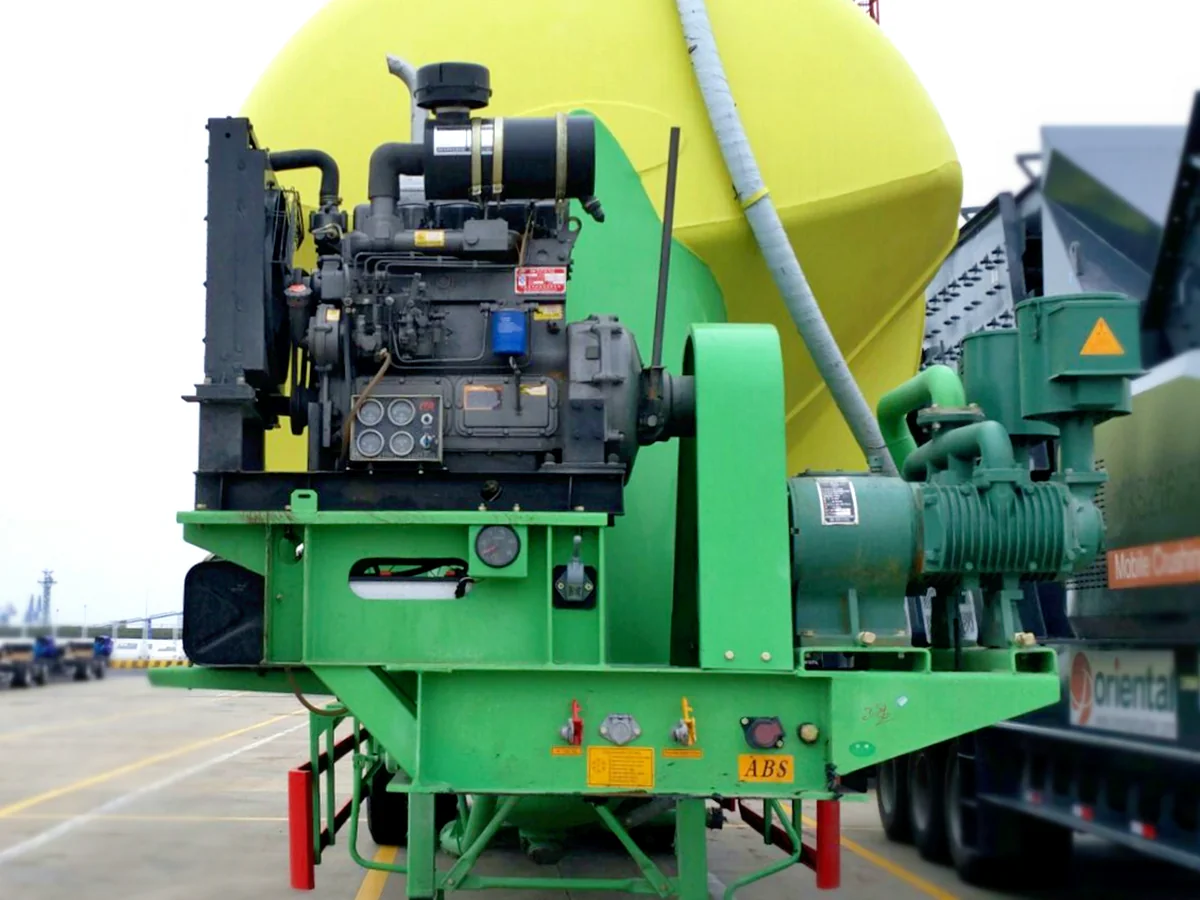
A tractor-powered compressor is an option only when the tractor has the correct power take-off (PTO), drive components, and rated operating setup. A dedicated trailer diesel engine and compressor can make the trailer less dependent on one tractor model, especially when a fleet exchanges tractors. Neither arrangement is automatically more economical: compare fuel use during discharge, maintenance, tractor availability and site restrictions.
Which Axles, Suspension, Tires, and Brakes Make Sense?
For highway work, emphasize legal axle distribution, tire suitability, steady running, and service life. For frequent site work, add low-speed turning wear, rough-road loads, and easy local repairs. The same three-axle arrangement can be suitable for both when the final weight and geometry checks pass.
Three axles versus two or four
An additional axle can share a load but adds hardware, tire wear, cost, and sometimes a larger turning footprint. A smaller two-axle tanker can be useful at restricted sites, while three-axle tankers cover many regular applications. Four axles may help meet a particular axle distribution requirement; they do not automatically make a heavier payload road legal or easier to turn. The final choice follows local weight rules, actual axle spacing, kingpin load, trailer tare, and the approved drawing.
Mechanical versus air suspension
Mechanical leaf-spring suspension gives a comparatively simple service arrangement in places where parts and repair skills are limited. Air suspension can be attractive for steady highway work and fleets already equipped to maintain air bags, valves, and lines. Neither should be chosen on the belief that it raises the certified axle rating. Match the selected system to surface quality, loaded and empty behavior, brake integration and maintenance capability.
Tire pressure, braking and repeated stops
Choose tire size and load index from the actual axle weights; then set cold tire pressure from the tire maker’s load-and-inflation guidance. Michelin’s commercial-tire instructions explicitly use loaded axle weights, tire size and single/dual fitment instead of one universal pressure. Review tire damage and heat exposure after repeated turns, curbs or rough access roads.
Specify the braking system for the destination’s requirements and the full combination. Daily urban stop-start duty and steep access routes require careful attention to heat, brake condition and the tractor’s retarding capability. Do not assume a trailer brake specification alone covers the tractor’s stopping performance.
Can the Complete Tanker Enter, Turn, and Unload at the Site?
Check the actual entrance and discharge position before you finalize trailer length. The useful dimension is the swept path: the space occupied by the tractor and trailer as they move through a turn, including the rear swing and off-tracking of the trailer wheels.
Request a site sketch or video showing the public-road turn, gate width, usable lane width, corner obstructions, overhead clearance, slope change, surface condition, unloading bay, and exit. Use the proposed tractor and trailer dimensions in a swept-path check; don’t judge access from tank length alone. Sacramento County’s published truck-turning requirements are one concrete example of why a design vehicle and actual turning movements must be modeled. Site requirements and legal standards differ by location.
At a temporary construction site, also establish a firm standing position and a safe route for hoses to the receiving silo. Avoid a layout that forces the driver to reverse blindly through workers or equipment. OSHA’s backover prevention guidance describes the hazards and practical measures, including traffic planning, spotters and visibility checks; apply local workplace rules in your market.
If the intended rig cannot safely reach the silo, there are several real alternatives: move the unloading point to an accessible edge of the site; improve the entry or turning area; select a shorter tractor/trailer configuration; or arrange transfer at a compliant depot. A longer discharge hose is not a free substitute because it adds resistance and can slow pneumatic unloading.
How Should You Configure Pneumatic Unloading for Each Route?
Match the compressor, aeration, discharge line, and receiving silo to the hardest regular unloading point—not just to the trip distance. A highway route to a large depot may have a fixed hose layout; a short urban route may visit several silos with different heights, pipes, filters and available space.
For repeated deliveries to one depot, standardize hose connections, compressor setup, valves, and the complete unloading routine. For multiple short-haul sites, check the longest practical hose, highest silo inlet, number of bends, available power, dust collection, and actual silo backpressure. Airflow (m³/min) is not cement discharge rate (t/min); they must be sized and checked separately.
Our 50-ton / 40 m³ three-axle cement tanker is specified at above 1.5 t/min under matched conditions. That is not a universal rate at every building site. A 22 t load at a planning discharge rate of 1.5 t/min would take about 14.7 minutes for the main powder movement alone. Hose connection, pressure building, final cleanout, depressurization and disconnection add time. See our cement tanker unloading time guide for the full-cycle distinction.
On short trips, reducing a repeated 10-minute hose or site delay can matter more than a small change in cruising speed. On a long trip, choosing a serviceable, reliable air package that avoids missed deliveries may matter more than chasing a quoted maximum rate.
How Do You Compare Productivity and Cost per Delivered Tonne?
Use complete round-trip time, not just road speed or nominal tank size. Record plant loading, travel out, site queue, positioning, hose setup, discharge, pack-up, return and any planned allowance. Then compare delivered tonnes, actual running costs and downtime.
A practical first calculation is: cycle minutes = loaded travel + empty return + loading + site waiting + positioning + complete unloading. Full cycles per available working period are the integer part of available operating minutes ÷ cycle minutes. Actual dispatch may produce fewer completed trips due to variability, breaks and customer receiving limits.
Worked example: a short urban cement route
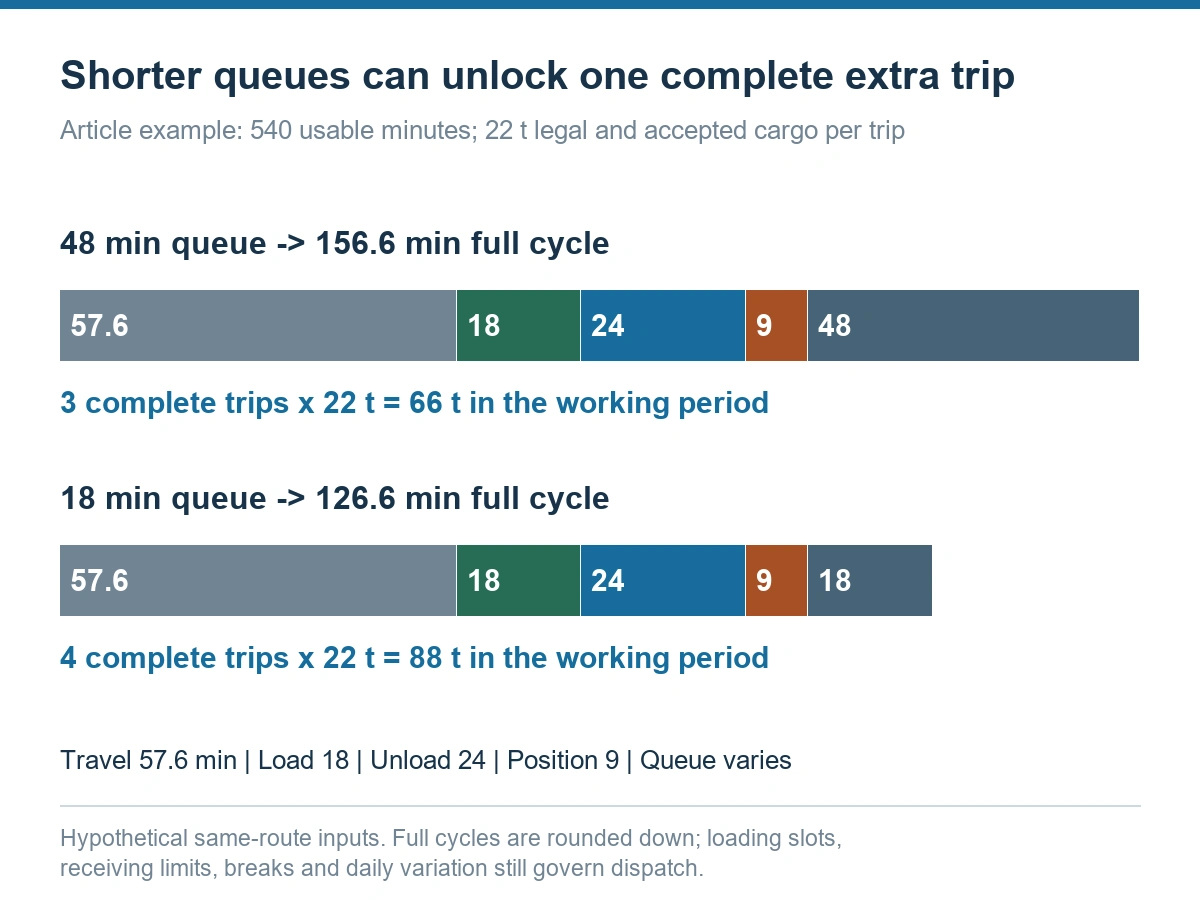
Assume one tractor and tanker has 540 minutes of usable operating time, after the operator’s other duties and breaks. The site is 12 km away each way, with a 25 km/h planning average in both directions. Loading takes 18 minutes, the complete discharge takes 24 minutes, and moving into and out of position takes 9 minutes. A legal and site-accepted load is assumed to be 22 t. These are hypothetical route inputs, not recorded Panda Mech customer performance.
| Part of one round trip | Busy site: long wait | Scheduled site: shorter wait |
|---|---|---|
| Loaded and return travel: 24 km ÷ 25 km/h | 57.6 min | 57.6 min |
| Loading | 18 min | 18 min |
| Complete unloading | 24 min | 24 min |
| Site positioning | 9 min | 9 min |
| Site queue | 48 min | 18 min |
| Total cycle | 156.6 min | 126.6 min |
| Complete trips in 540 min | 3 | 4 |
| Cement delivered at 22 t/trip | 66 t | 88 t |
Try Your Own Route Numbers
Enter your expected times and legal payload. Results are planning estimates; allow for daily delays and local driver-hour rules.
Cycle: 156.6 min. Complete trips: 3. Estimated delivered cement: 66 t.
The 30-minute reduction in repeated waiting makes a fourth full trip mathematically possible in this example, without increasing payload. It remains a planning result: the receiving silo must accept each load, and actual shift limits, traffic and schedule variation must allow four complete cycles.
What changes for an intercity route?
A 200 km one-way route has 400 km of round-trip travel. At an illustrative 55 km/h average, travel alone takes about 436 minutes. Saving 30 minutes at the silo may improve the schedule, but it is unlikely to create another 400 km round trip within the same working period. For this route, focus on legal tonnes per trip, fuel and tire cost, tractor utilization, reliability and planned service stops. Record the loaded and empty legs separately if their speeds differ.
For your fleet’s actual cost comparison, divide fuel + tires + maintenance + labour + depreciation/finance + waiting and site fees by tonnes delivered over the same period. Include days when the trailer is unavailable. Comparing purchase prices alone can favor a cheap setup that costs more to operate.
Which Panda Mech Cement Tanker Should You Start With?
Start with our 50-ton-class, 40 m³, three-axle tanker when the route supports its size and a useful legal load. Move to a smaller model when access or legal weights are tighter; consider a higher-capacity or lighter-tare configuration only when the measured gain is real.
Our published 50-ton model is 10,500 × 2,500 × 3,500 mm overall, with three trailer axles, 40 m³ of tank volume and the above-1.5 t/min matched-conditions unloading specification. Those dimensions make it a concrete first design to test against your tractor, roads and site. We can quote mechanical or air suspension choices, tire sizes and a matched engine/compressor package for the agreed build.
| Start with | When it is worth reviewing | What could change the recommendation |
|---|---|---|
| Smaller 30-ton / 25 m³ class | Restricted site, lower weekly demand, tighter legal weight | Gate geometry, axle rules, site batch size |
| 40-ton / 30 m³ class | Middle ground between capacity and access | Actual empty weight, route and delivery frequency |
| 50-ton / 40 m³ / 3-axle class | Regular high-volume deliveries on suitable routes | Legal payload, density, tractor match, turning simulation |
| Higher-capacity configuration | Large permitted loads and repeat depot deliveries | Gross/axle limits, bridge limits, tank volume, tractor duty |
Model classes are references, not a promise that every size is road legal in your country. Before manufacturing, we finalize the actual axle ratings, suspension, tire setup, tank dimensions, pneumatic package, and connection details on the quotation and approved drawing.
What Should You Send Before Ordering a Tanker for Either Route?
Send one actual route and one actual unloading site, not just “long haul” or “short haul.” We can use those details to compare your current tractor with a proposed tanker’s size, load and air system.
- Cargo and load: cement type, measured or expected bulk density, target tonnes and site batch size.
- Destination rules: country, applicable road/gross/axle limits, bridge or permit restrictions and planned highways.
- Trip pattern: one-way kilometres, number of daily deliveries, loaded and empty operating speeds, and loading/queue times.
- Tractor: make/model, drive configuration, own weight, approved gross combination weight, fifth-wheel height and coupling interfaces.
- Site access: entrance and gate dimensions, turn sketch, slope, ground condition, standing space and overhead obstacles.
- Receiving silo: silo height, connection, available hose route, line diameter/bends, filter or backpressure information.
- Maintenance: nearby service capability, preferred axle/brake/tire family and expected trailer operating life.
- Order: quantity, delivery country/port and any required technical documents.
If you already own a tanker, send its actual scale ticket, unladen weight, complete trip-time log and a video of the difficult site entry. These original records often reveal whether a new tanker needs more payload or simply better access and unloading turnaround.
Conclusion: Which Cement Tanker Configuration Is Better?
For long-haul cement delivery, prioritize a road-legal, well-matched tractor and trailer that moves the most useful tonnes reliably per journey. For short-haul urban or construction-site delivery, prioritize safe site access and the number of full loading-to-unloading cycles the fleet can finish. The 50-ton-class / 40 m³ three-axle tanker is a useful candidate for either duty if its real loaded dimensions, axle weights, and discharge conditions fit. Otherwise, change the size, tractor, running gear or unloading arrangement before ordering.
Need a route-matched tanker quote? Send us your planned load, tractor specifications, route and one difficult unloading location. We can compare the equipment before finalizing the drawing.
Request a Cement Tanker ConfigurationFrequently Asked Questions
Can the same cement tanker serve both highway and city construction routes?
Yes, when the tractor/trailer combination meets route weight limits, fits the tightest delivery entrance, and reaches the silo safely. Check the difficult final approach first. A trailer that is legal on the highway may still be too long for the delivery bay.
Does a short cement delivery route always require a two-axle tanker?
No. Axle count is selected from payload, axle loads, tractor fit and turning space. Three axles can work on a short route. Choose two only when the planned weight and access make that configuration suitable.
Is a 50-ton cement tanker legally allowed to carry 50 tonnes on highways?
Not automatically. The model name refers to a payload class. Actual legal cargo weight depends on tank capacity, cargo density, tractor and trailer tare, permitted gross combination weight, and each axle group on the actual route.
Should a short-haul tanker use a trailer-mounted compressor or a tractor PTO?
Use a PTO system when the tractor has a compatible, approved drive arrangement and the fleet wants that common setup. Consider a separate engine and compressor when tractors rotate between trailers or independent unloading is valuable. Compare the entire air system and service needs.
What if a large highway tanker cannot reach the site silo?
First consider moving the unloading point to accessible ground. Otherwise review a shorter configuration or an approved transfer arrangement. Do not simply add a long hose without checking discharge resistance, pressure, airflow and total unloading time.
Can air suspension raise the legal payload of a cement tanker?
No. Suspension design does not automatically increase axle or vehicle ratings or the legal gross weight. Compare the actual axle loads, trailer tare, tire capacity and destination rules before deciding between mechanical and air suspension.
What causes a short-route cement fleet to complete fewer trips than planned?
Plant queues, site waiting, slow hose connections, receiving-silo restrictions and turning or positioning delays often consume the saved driving time. Log each part of several complete cycles before changing the trailer size.

ZAC
Hello, I’m ZAC, a cement trailer and semi-trailer specialist with over 20 years of industry experience. My technical approach starts with real operating conditions, including how cargo characteristics, road conditions, and loading and unloading methods affect trailer performance. I place particular emphasis on structural reliability, component compatibility, and ease of maintenance. I look at both everyday performance and how reliably a trailer operates over time, as well as how easily it can be inspected and serviced.


