
Choose a pneumatic dry bulk trailer when you deliver fine dry powder, such as cement or fly ash, through a hose into an enclosed silo. Choose a hopper-bottom trailer when grain or another freely flowing commodity must fall through bottom gates into a pit, auger, or conveyor. Both carry loose, dry material, but they are not direct substitutes. The receiving point and unloading method usually decide which one works.
This pneumatic vs hopper bottom trailer comparison explains the equipment, cargo limits, capacity, operating work, and changes needed if a delivery site uses a different system.
What Are the Main Differences Between the Two Trailers?
The main difference is what happens at delivery: a pneumatic tanker moves suitable powder with compressed air through a sealed line, while a hopper-bottom trailer lets flowing material drop from bottom doors. Both have lower sloping sections, but those shapes alone do not tell you how they unload.
| What to compare | Pneumatic dry bulk tanker | Hopper-bottom trailer |
|---|---|---|
| Best starting cargo | Dry cement, fly ash, suitable fine mineral powders | Grain, feed and other free-flowing bulk commodities |
| Discharge route | Pressurized product line and flexible hose | Gravity through sliding bottom gates |
| Receiving equipment | Compatible silo inlet, vent/filter and transfer line | Ground pit, receiving hopper, auger or conveyor |
| Operating equipment | Compressor or blower, air controls, valves and hose | Hopper gates and mechanical door controls; downstream receiving equipment |
| Cargo enclosure | Enclosed tank and connection when properly sealed | Typically top loaded, with a roll tarp during transport |
| Main site limitation | Available air supply, pipeline resistance and silo venting | Space and clearance above a compatible gravity receiver |
| What changes costs | Air system, power/fuel, hoses, seals and filtering | Gates, tarp and wear parts, plus receiving equipment |
For a cement plant that accepts powder at a high silo fill pipe, start with a pneumatic tanker. For a grain elevator with a drive-over pit, start with a hopper-bottom trailer. A lower purchase quote for the wrong discharge method has little value if the truck cannot empty at the destination.
How Does Each Trailer Unload Its Cargo?
A pneumatic trailer uses air to move cargo through a pipe; a hopper-bottom trailer uses gravity to release cargo directly below the vehicle. Their receiving sites, operating sequence, and common delays are therefore different.
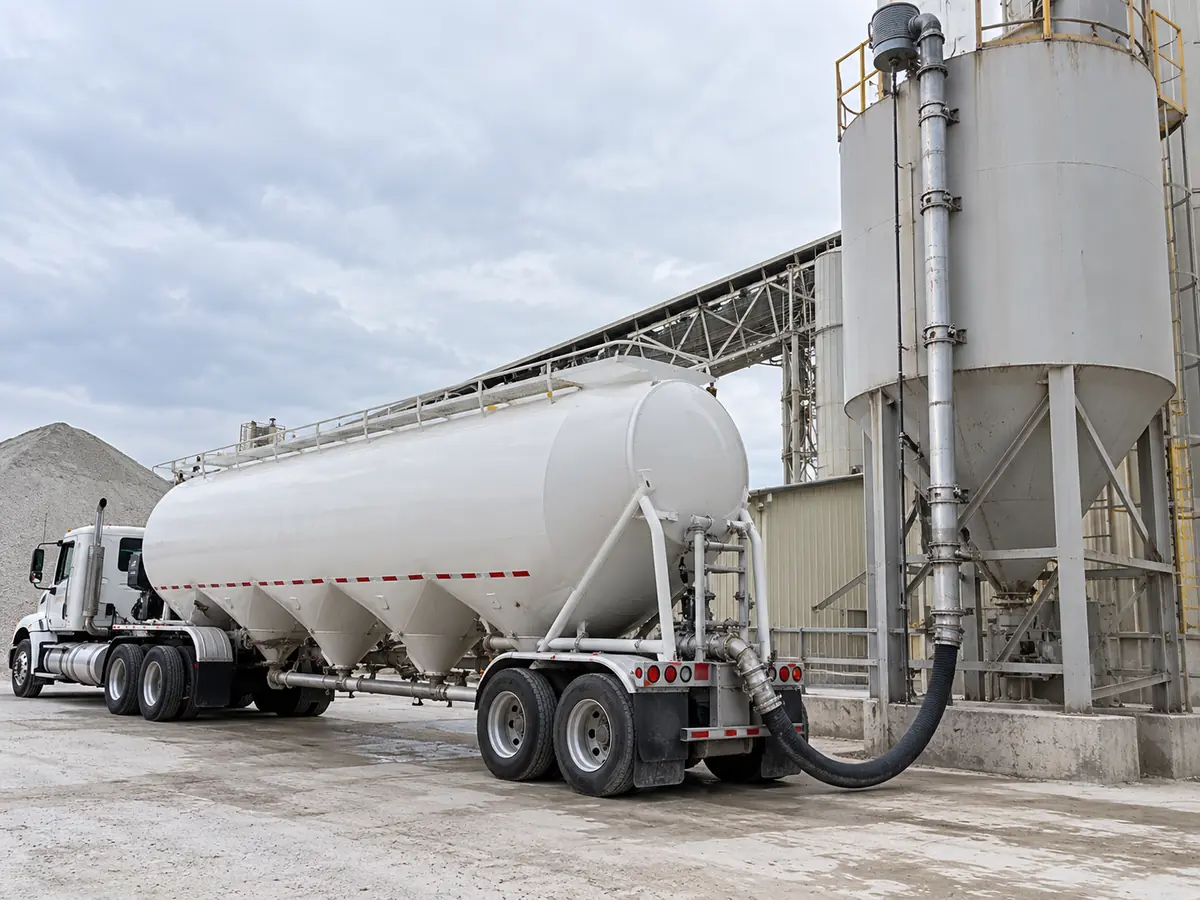
How a pneumatic tanker delivers powder to a silo
At the delivery site, the operator connects the product hose between the tanker outlet and the silo fill connection. The air supply moves suitable powder through the discharge line, while tank aerators help loosen material near its outlets. The silo must also have room for the load and a suitable vent/filter for the air entering with the powder.
A compressor or blower can be powered by a dedicated engine, the tractor’s power take-off (PTO), or a suitable external air source, depending on the trailer and site. Airflow, pressure, hose length, bends, lift height, material moisture, and receiving backpressure all affect the real discharge rate. The Heil dry bulk trailer operating manual explains the separate aeration, discharge, pressure and hose functions.
Before disconnecting a pressurized product line, the operator must follow the trailer maker’s shutdown and depressurization procedure. A hose that still holds pressure is a serious hazard.
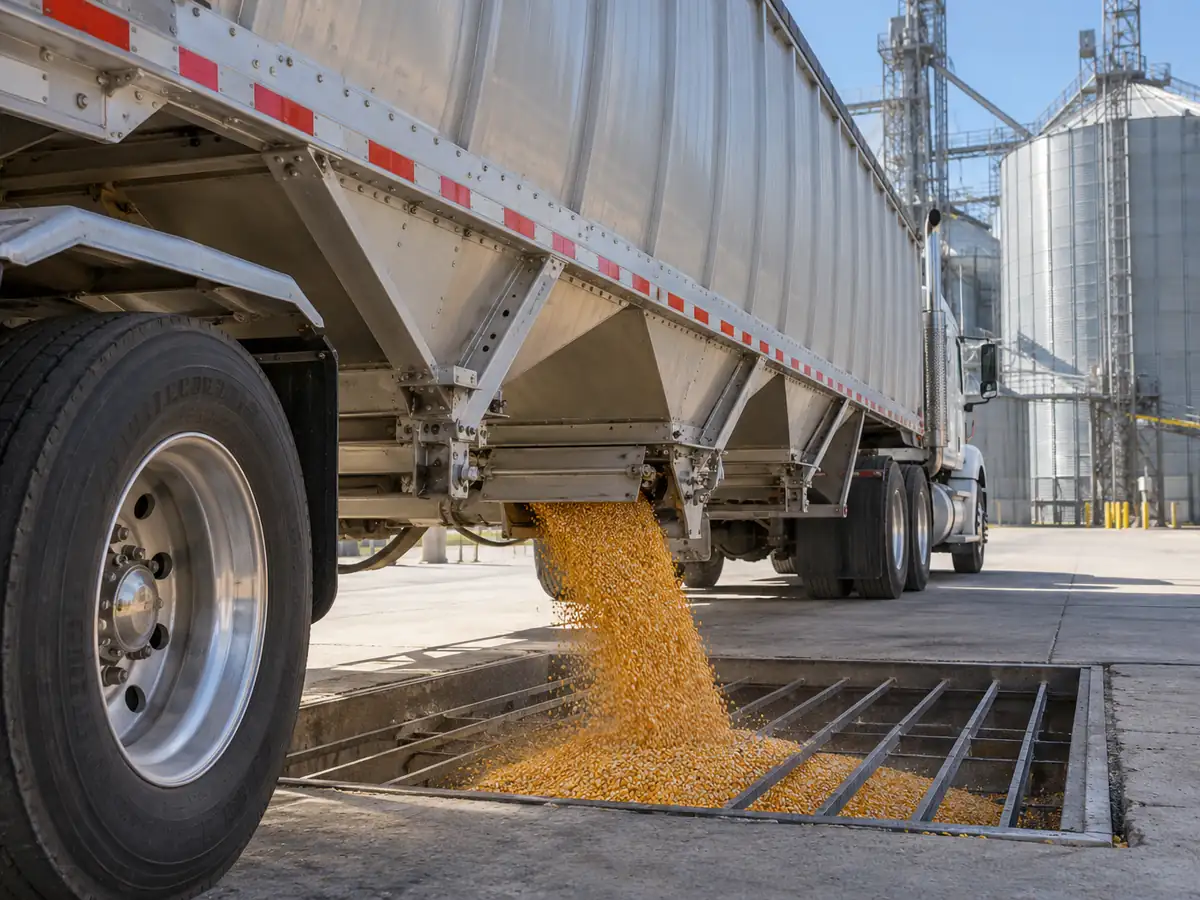
How a hopper-bottom trailer empties into a pit
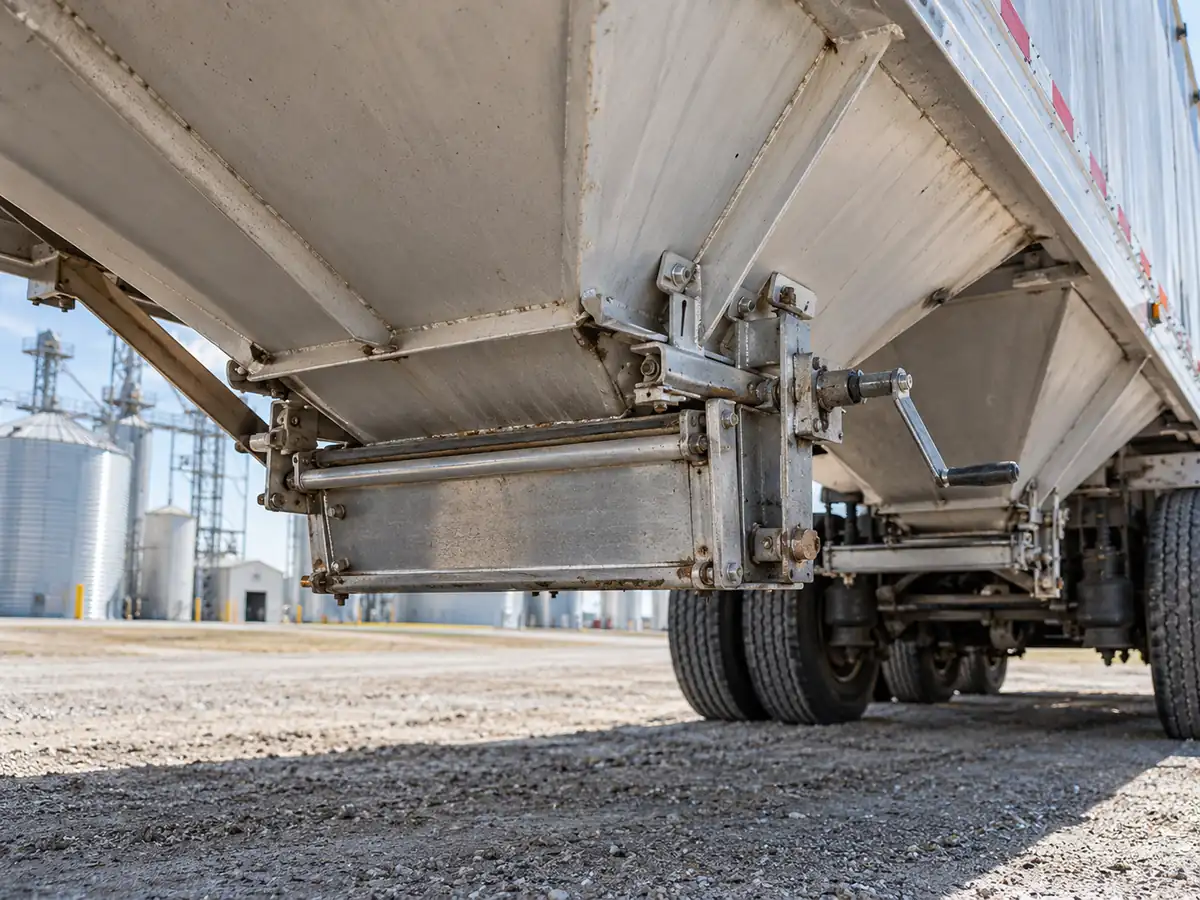
The driver positions the bottom hoppers directly over a receiving pit, conveyor or auger, then opens the correct slide gate to control the falling product. Suitable grain flows under its own weight. The receiver moves the grain onward to bins or processing equipment; the trailer does not need a product-discharge compressor for this standard method.
This arrangement requires a receiving point below the gate. The grain must flow through the opening, and the site needs enough ground clearance and a safe vehicle position. A narrow auger hopper may need careful alignment; a drive-over pit may simplify access. Demco’s grain trailer guidance describes bottom gates positioned over pits, augers and conveyors.
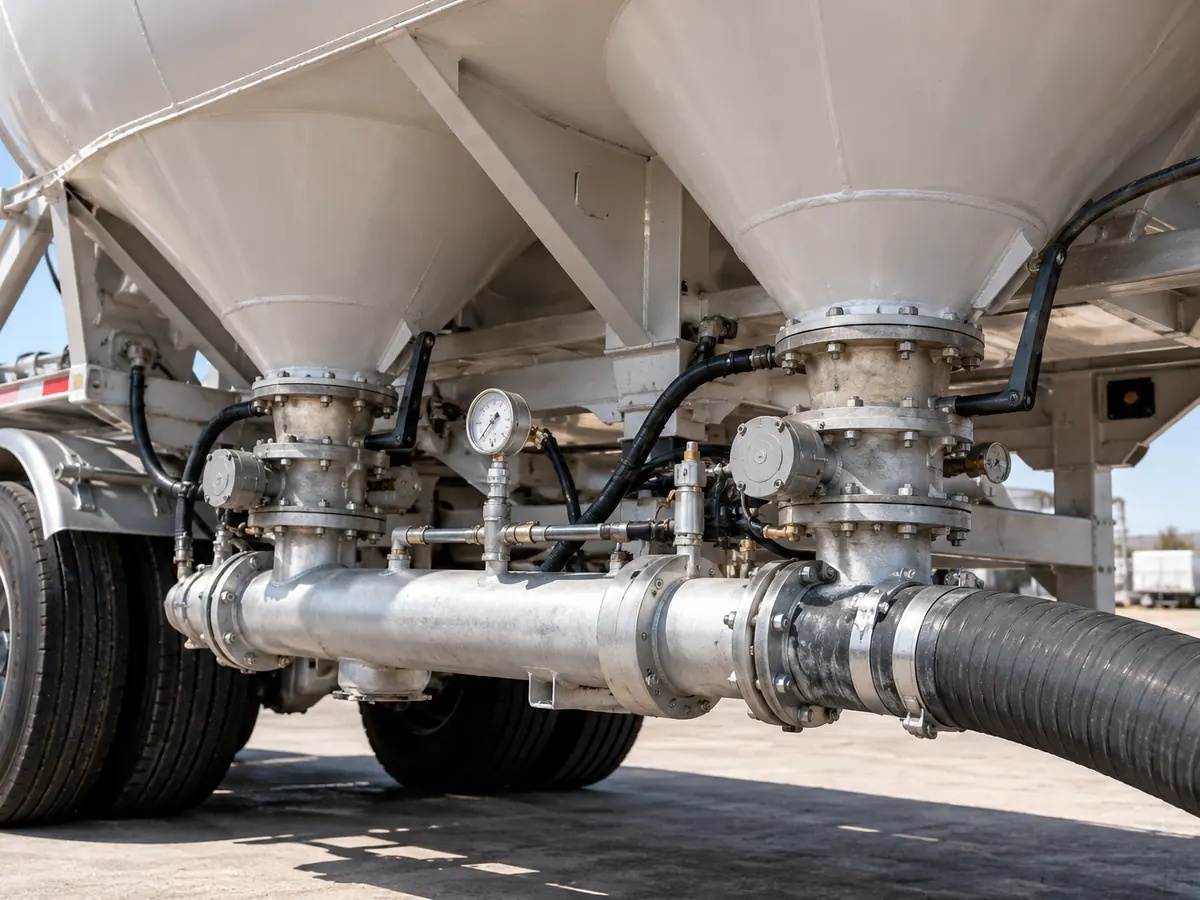
Why a pneumatic tanker still has hoppers
The word hopper can describe the cone-shaped outlet inside a pneumatic tanker. That does not turn the vehicle into a grain hopper-bottom trailer. A pneumatic tanker may have several lower cones, aerators and valves that feed one common air-powered discharge line. A gravity hopper-bottom trailer instead has bottom gates that let cargo fall straight into an external receiver.
Likewise, three versus four pneumatic outlet cones does not by itself decide the trailer’s usable cargo volume or what commodities it can safely carry. Compare actual tank capacity, cargo properties, discharge equipment and loading clearance.
Which Dry Bulk Cargoes Suit Each Trailer?
Start with the real material and the way the receiving site accepts it, not with a broad label such as dry bulk. Fine powders often need sealed pneumatic delivery, while many whole grains can flow by gravity. Some materials can move through several types of equipment, but only with the right configuration.
| Cargo and receiving task | Better starting choice | Reason and condition |
|---|---|---|
| Bulk cement delivered into a closed batching-plant silo | Pneumatic powder tanker | Air conveys cement into the fill line; match moisture, aeration and silo venting |
| Dry fly ash or lime powder into a compatible industrial silo | Pneumatic powder tanker | Powder flow and air-system requirements can differ from cement |
| Wheat, corn or similar flowing grain into a drive-over pit | Hopper-bottom grain trailer | Bottom discharge fits the receiver; check gate opening and product condition |
| Free-flowing animal feed or granular material to an auger | Suitable hopper-bottom or commodity trailer | Check particle size, bridging, gate geometry and contamination requirements |
| Plastic pellets or other specialized granules into a closed system | Cargo-specific design | A pneumatic granular system may work; an ordinary cement tanker is not automatically suitable |
| Food-grade flour into sanitary storage | Dedicated food-powder pneumatic tanker | Material contact, cleaning, hose history and contamination control matter |
| Wet or sticky material that does not discharge reliably | Reassess the equipment | Neither standard dry-powder aeration nor grain-style gravity gates solve all bridging problems |
Grain, feed and coarse granules
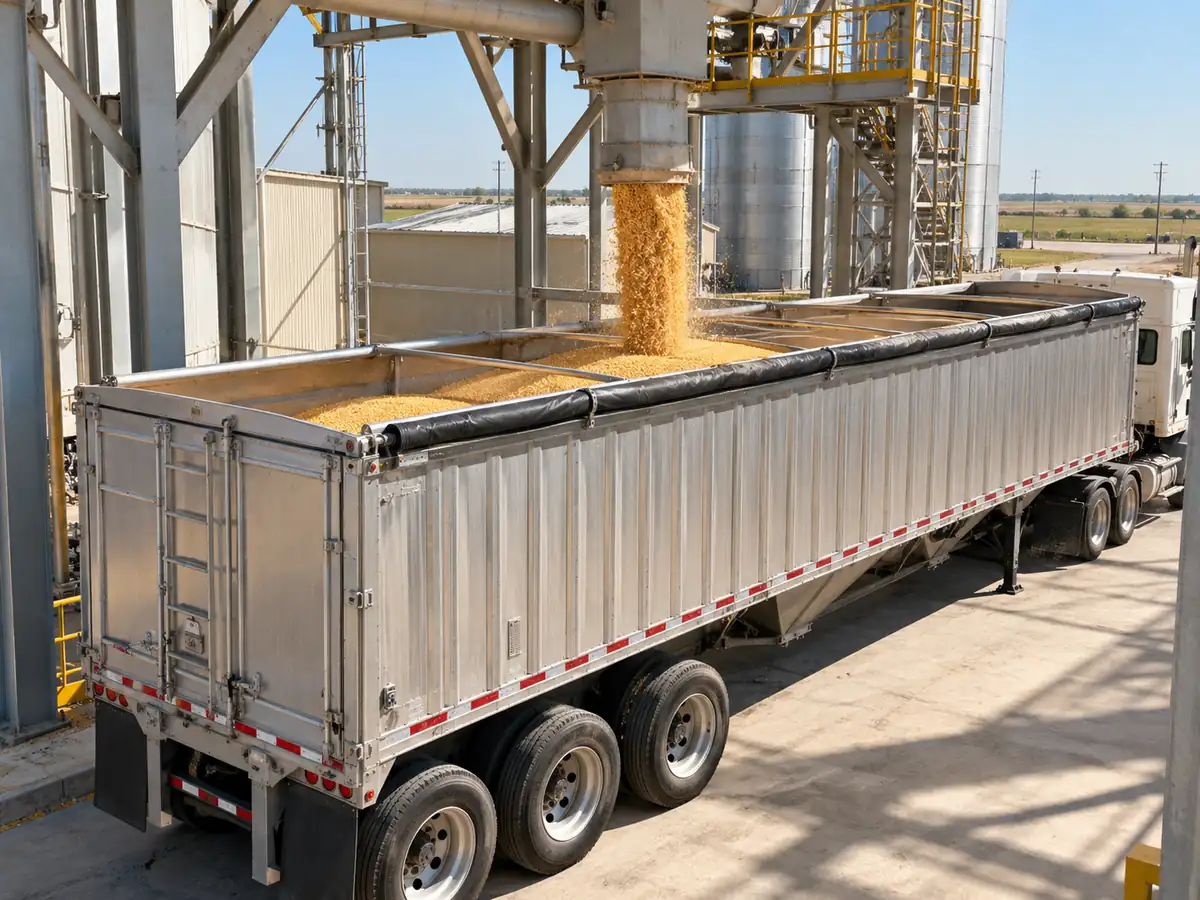
A hopper-bottom grain trailer commonly loads through its open upper section and travels with a cover or rolling tarp. It works particularly well where grain unloading is part of the site’s routine. Grain with high moisture, lumps or foreign material can still bridge, block a gate or change the unloading behavior; the trailer is not a guarantee that every bulk solid will flow.
If your fleet carries more than one product, review the previous load and cleaning arrangement before accepting the next. A change from industrial cement to food powder, for example, is not solved just by washing an industrial tank. For our cement and mineral-powder products, see the Panda Mech pneumatic dry bulk trailer range.
How Do You Compare Payload and Tank Volume?
Use two separate checks: the cargo must fit within usable volume, and the loaded vehicle must stay within the road and axle limits. Volume alone does not tell you tonnes. The actual bulk density of your material connects the two.
Required cargo volume (m³) = target cargo mass (metric tonnes) ÷ bulk density (tonnes/m³)
For example, suppose you plan to carry 24 metric tonnes. Use these two illustrative, assumed density values only to see how the calculation works:
| Assumed cargo density | Calculation | Theoretical cargo space |
|---|---|---|
| 1.20 t/m³ | 24 ÷ 1.20 | 20 m³ |
| 0.75 t/m³ | 24 ÷ 0.75 | 32 m³ |
The lighter bulk material needs 12 m³ more space for the same 24-tonne load in this example. Neither density is a guaranteed value for cement, grain or any named product. Obtain an actual sample or trustworthy cargo specification and confirm usable tank volume, any filling restrictions and weight distribution.
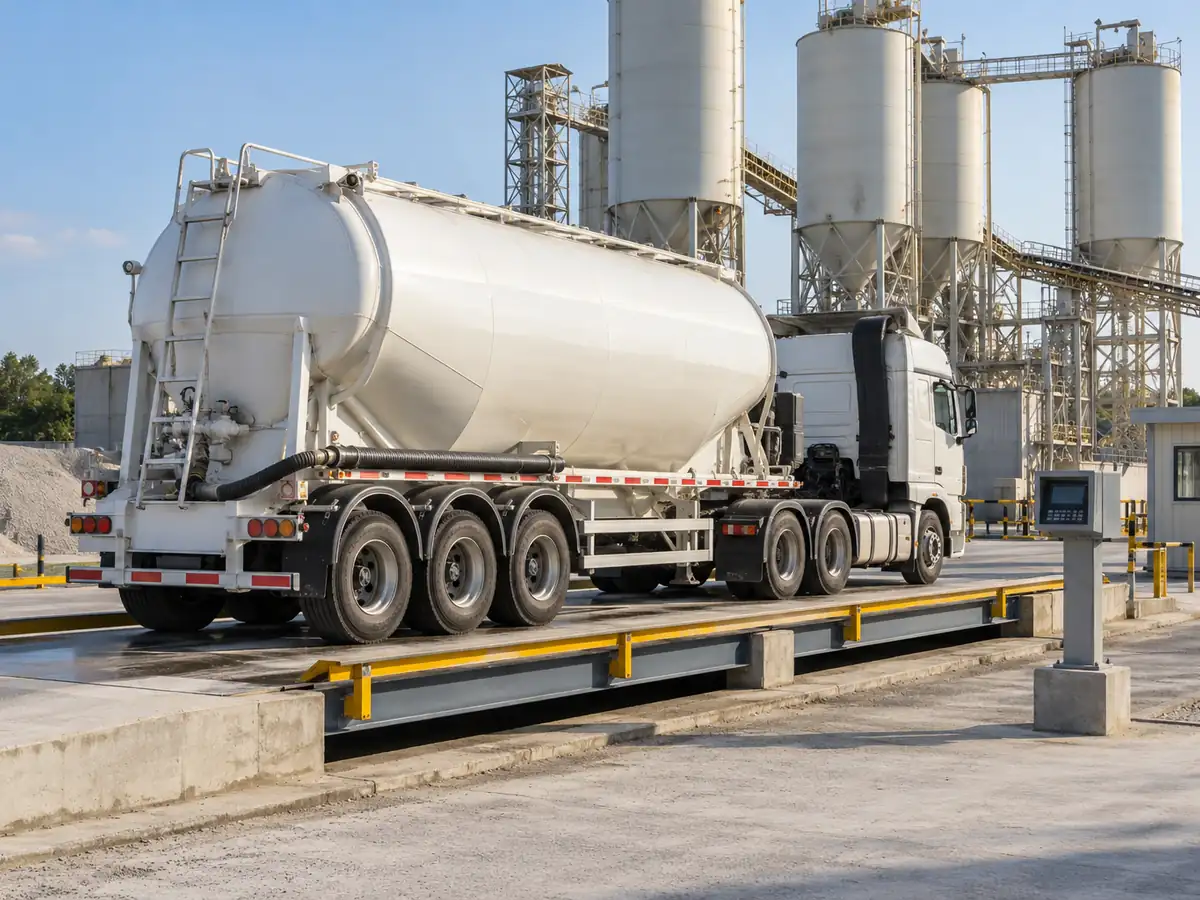
Next calculate your legal cargo allowance from the permitted gross combination weight minus tractor weight, trailer tare and any other applicable carried weight; then check individual axle groups and fifth-wheel loading. A trailer advertised as a 50-ton class cannot automatically carry 50 tonnes on every public road. A hopper trailer’s bushel or cubic-foot rating likewise is not a permitted road payload.
For context, our 50 ton cement tanker trailer lists a 40 m³ tank and three axles. Those are the reference model specifications. The final legal loading allowance follows the destination rules and tractor combination, not the product name.
Which Trailer Is Easier and Cheaper to Operate?
A hopper-bottom trailer generally avoids a dedicated product-discharge air system, but a pneumatic tanker can deliver straight to a compatible enclosed silo that a gravity trailer cannot reach on its own. The lower operating cost is whichever system completes your actual deliveries with less total equipment, waiting, handling and lost cargo.
Compare the complete delivery cycle, not one advertised unloading rate
Track time from entering the loading site to leaving it, and from arriving at delivery to the trailer being ready to depart. Separate waiting, positioning, connection, actual material flow, disconnection and paperwork. The unloading rate in tonnes per minute covers only part of that cycle.
- For pneumatic delivery: record blower or compressor running time, hose setup, pressure stabilization, material discharge, line clearing and shutdown. Long lines or restricted silo filters may lengthen a cycle.
- For gravity delivery: record position over the pit, gate operation, grain flow and the pit or auger’s ability to accept material. A full or slow receiving conveyor may hold the trailer even when the bottom door is open.
Do not take a time from a different commodity, plant layout or air package as your guaranteed unloading time. Measure a comparable run at the intended receiving site. If a site cannot unload a proposed trailer type at all, the purchase-price comparison ends there.
Compare service parts and receiving infrastructure
Pneumatic equipment adds blower/compressor service, hoses, couplings, relief and pressure-control components, aerators, seals and air leaks to watch. Gravity hopper trailers need attention to sliding gates, bearings, seals, tarp systems and wear around the discharge openings. Both need chassis, suspension, brakes and tires serviced.
The receiver carries costs too. For a new cement site, include the silo fill pipe, vent filter, safe hose connection and suitable air supply. For a grain yard, include a pit, auger or conveyor, cleaning access and traffic layout. Compare the installed system and cycle performance, not the trailer alone.
Can You Replace a Pneumatic Tanker With a Hopper-Bottom Trailer?
Usually not as a direct swap at the same discharge point. A trailer that empties beneath its frame does not automatically deliver material through a raised silo inlet, and a pressurized cement tanker cannot simply dump grain through a ground-level gate. Both the cargo and the receiver must suit the equipment.
If a fleet currently serves cement silos, keeping pneumatic tankers is often the practical choice unless the customer changes its receiving system. If a new contract moves grain into drive-over pits, use a purpose-built gravity hopper or commodity trailer rather than changing the outlets on a pressure vessel.
What changes when a delivery site switches its receiving method?
- Confirm the actual material: name, size, bulk density, moisture, flow behavior and cleaning requirements.
- Map the receiver: high silo fill pipe or lower pit; inlet connections; dust collection or venting; height and clearances.
- Match the trailer: air package and hoses for pneumatic; discharge doors, gate flow and clearance for gravity.
- Check the road combination: tractor, trailer tare, fifth-wheel load, axle limits and route access.
- Test a representative load: weigh it, time the entire unloading cycle, examine residue or blockage and compare the outcome with your agreed delivery requirement.
A truck-mounted compressor cannot make a standard gravity gate into a pressure-rated transfer system. Conversely, a pneumatic tank’s outlet cones are not proof it can operate as a grain trailer. If you are adding a new cargo to an existing fleet, check whether a dedicated second trailer is the simpler solution.
What Common Delivery Problems Point to the Wrong Setup?
First separate cargo-flow trouble from a mismatch at the receiving site. The same symptom, such as slow unloading, can have different causes depending on the trailer.
| Observed problem | First checks | Practical response |
|---|---|---|
| Pneumatic unloading slows or tank/line pressure behaves abnormally | Compressor condition, hose bends, valve position, moisture, air leaks, silo vent/filter capacity | Use the documented stop and depressurization procedure, then isolate and correct the cause before restarting |
| Pneumatic tanker leaves excess powder in one cone | Aeration supply, cone outlet valve and flow of that cargo | Inspect the relevant aerator or outlet arrangement with the equipment secured and pressure released |
| Grain stops flowing at a bottom gate | Gate opening, moisture, lumps and possible bridging above the outlet | Stop loading or discharge as appropriate and clear the issue by the trailer maker’s safe method; do not enter beneath unsupported cargo |
| Trailer cannot line up with the receiver | Pit position, vehicle clearance, hose reach, grade and site traffic path | Change site layout or select equipment that fits the actual connection instead of relying on driver improvisation |
For pressure equipment, keep the relief devices working, secure product hoses and relieve pressure before opening a manhole or disconnecting a hose. Those points appear explicitly in the Heil operator manual; they are operational safety requirements rather than optional speed tips.
What Information Should You Gather Before Ordering?
Send the actual cargo and receiving method first, then work out the size and running gear. This prevents buying a high-capacity trailer that cannot unload or is too heavy for the route.
- For any trailer: cargo name, measured or documented bulk density, target tonnes per trip, route and destination country, tractor specification, legal weight limits and expected trip frequency.
- For pneumatic tankers: receiving silo height, fill connection, hose route length and bends, silo vent/filter arrangement, material moisture, available compressor or PTO drive and target unloading cycle.
- For hopper bottoms: receiving pit/auger dimensions, minimum discharge clearance, gate size, loading height, tarp and weather needs, and condition of the grain or granules.
At Panda Mech, we manufacture pneumatic dry-bulk and cement tanker trailers. For a cement job, we can compare our 50-ton-class, 40 m³ cement tanker with other suitable powder-tanker configurations based on your road and silo conditions. We do not present a grain hopper-bottom trailer as an interchangeable version of that product.
So, Which Trailer Should You Choose?
Choose the pneumatic tanker for compatible powder delivered through a closed pipeline into a silo; choose the hopper-bottom for freely flowing commodities discharged into a pit or auger. The material and receiver are the first filters. Then calculate the required volume and legal cargo mass, compare the complete delivery cycle, and include the equipment and site maintenance costs.
For a mixed-cargo fleet, do not assume one tanker covers every load. A matched pair of dedicated trailer types may serve customers more reliably than one vehicle configured for the wrong receiver.
Common Questions About Both Trailers
Can a hopper-bottom trailer unload cement into a tall silo?
Not directly with its standard bottom gates. The cement would need a separate, cargo-compatible receiving and conveying system to enter an elevated silo. For direct closed-silo powder delivery, start with a pneumatic tanker.
Can a pneumatic trailer haul grain?
Some purpose-built pneumatic systems handle suitable grains or granules, but a standard cement powder tanker is not automatically suitable. Check cargo properties, tank and air-system design, cleaning requirements and the delivery connection.
Does a hopper-bottom trailer need an air compressor?
No product-discharge compressor is needed for a standard gravity hopper-bottom trailer. The material falls through its bottom gates into a pit, auger or conveyor. Other vehicle systems, such as air brakes, are a separate matter.
Is a three-hopper pneumatic tanker the same as a hopper-bottom trailer?
No. Its three internal lower cones can feed a shared air-powered discharge pipe. A hopper-bottom commodity trailer releases cargo by gravity through doors underneath. Count the discharge method and connections, not just the cones.
Can I use the same tanker for cement and food-grade flour?
Do not treat an industrial cement tanker as a food-powder tanker by default. Food powder can require dedicated product-contact materials, suitable hoses and seals, controlled cleaning, drying and previous-cargo records.
Which type unloads faster?
Neither is universally faster. Pneumatic speed changes with material, air system, hose distance, elevation and silo filters. Hopper unloading depends on gravity flow, gate opening and the receiving pit or conveyor. Compare the full cycle for the same cargo and site.
What is the first specification to give a trailer manufacturer?
State the cargo and exactly where it must discharge: a closed silo fill line or a gravity pit/auger. Then provide target tonnes, cargo bulk density, tractor, route, weight limits and unloading-site dimensions.

ZAC
Hello, I’m ZAC, a cement trailer and semi-trailer specialist with over 20 years of industry experience. My technical approach starts with real operating conditions, including how cargo characteristics, road conditions, and loading and unloading methods affect trailer performance. I place particular emphasis on structural reliability, component compatibility, and ease of maintenance. I look at both everyday performance and how reliably a trailer operates over time, as well as how easily it can be inspected and serviced.


