
Tank Volume
We setUsable tank volume in cubic metres (CBM), based on cargo density, target payload and working margin.
We build the tanker around your real transport job. First, we need your target payload and the bulk density of the fly ash — how much it weighs for its volume. We also check local axle limits and your receiving silo. Then we set the tank volume, axle setup, tank aeration and discharge system before production.

For dry fly ash, we normally use a sealed pneumatic dry bulk tanker. It unloads the powder with compressed air into a silo. We size the tank from your fly ash bulk density and target payload. Then we check the empty trailer weight, axle loads, tractor and receiving silo before we confirm the final setup.
Your fly ash is dry, moves in bulk and needs to be unloaded with compressed air into a silo or enclosed system.
Tell us if the ash is wet, hard to flow or unusually corrosive. Also tell us if the silo is very high or the discharge pipe is long.
Fly ash is a fine powder collected from combustion-gas cleaning systems. It is common in coal-fired power plants and other industrial processes. Its density and flow can change from one source to another. That is why we prefer your actual cargo data when we size the tanker.
Background reference: Control Union — Fly ash, lime, cement and sand.
Send us these five project details first. We use them to size the tank, choose the axles and suspension, and match the pneumatic unloading system to your job.
You do not need to choose every tanker part yourself. Send us your transport conditions. Our engineering team uses them to prepare the tanker setup before we quote and build it.
Usable tank volume in cubic metres (CBM), based on cargo density, target payload and working margin.
Target legal payload after we check the empty trailer weight, tractor weight, GVW and axle limits.
Axle count, axle load and suspension for your destination market and road condition.
Tank and chassis setup for your cargo, tank volume, payload and tractor-trailer dimensions.
Tank aeration, compressor or other air source, and piping for your unloading route.
Outlet and discharge setup for your pipe route, silo inlet height and receiving site.
The same type of tanker can carry cement or fly ash, but the setup may be different. Fly ash can have a different density and flow. That can change tank volume, tank aeration and legal payload.
| What Changes | Bulk Cement | Fly Ash | What We Do |
|---|---|---|---|
| Bulk density | Usually more consistent within one cement type | Can change a lot by source and production process | We calculate the usable tank volume again from your fly ash density and required payload. |
| Particle / flow behavior | Fine dry powder requiring fluidization | Can flow differently depending on source, particle size and composition | We set the tank aeration and discharge system around how your fly ash actually flows. |
| Moisture | Must remain dry | Moisture can make the ash harder to flow and unload | We use the right seals and operating setup to help keep the cargo dry and easy to unload. |
| Tank sizing | Payload + cargo density + legal vehicle weight | Payload + actual ash density + legal vehicle weight | We do not copy the tank volume from a cement tanker. We size the fly ash tank from payload, density, empty trailer weight and legal vehicle weight. |
| Pneumatic unloading | Air source, tank aeration and discharge pipe must work together | The same basic system works, but the ash itself must be checked | We match the air source, tank aeration, discharge line and receiving silo as one complete unloading system. |
| Legal payload | Depends on trailer weight, tractor weight and local road rules | The same legal weight rules still apply | We check the empty trailer weight, tractor weight, axle loads and local road limits before we confirm the payload. |
The tanker type may be the same, but the final setup may not be. Send us your actual fly ash data when you have it. We will size the trailer for the material you really carry.
Moisture can make fly ash cake together and become harder to loosen with air. Poor seals can also cause dust leaks and air loss. We therefore check the loading opening, manhole seals, valves and pipe joints as part of the tanker setup.
Keeping the cargo dry and the tank sealed helps the ash flow and unload more reliably.
We start with your cargo and local vehicle limits. From there, we work out the usable tank volume, axle setup and final tanker build.
Shows how much the fly ash weighs in each cubic metre.
Shows whether the ash may cake, bridge or become hard to loosen with air.
Affects tank aeration, how much material stays inside, and how well the ash unloads.
This is the cargo weight you want to carry on each trip.
Shows how much legal payload is left after tractor and empty trailer weight are included.
Confirms fifth-wheel height, tractor compatibility and the road conditions the trailer will face.
We treat the air source, tank aeration, discharge line and receiving silo as one system. The goal is steady unloading from the tank to the silo. A larger compressor alone does not guarantee this.
We match the compressor or other air source to the tank, discharge pipe and receiving silo. We do not choose it as a separate part.
A long pipe makes the ash harder to move. A high silo, small pipe or many bends can add even more resistance.
Dry, loose fly ash is easier to mix with air and unload. Wet or compacted ash can move more slowly and may need a different aeration setup.
Research on pneumatic ash conveying shows that pressure drops as air and material move through the pipe. Pipe length, diameter, slope and air flow all affect this pressure loss. These factors can change how much fly ash the system can move.
What this means for your project: two sites using the same tanker can unload differently if their pipe and silo conditions are different. This is why we ask for both horizontal discharge distance and silo inlet height before we configure the air system.
Engineering reference: Stevanovic et al., Powder Technology 254 (2014), “Analysis of transient ash pneumatic conveying over long distance and prediction of transport capacity.” View abstract.
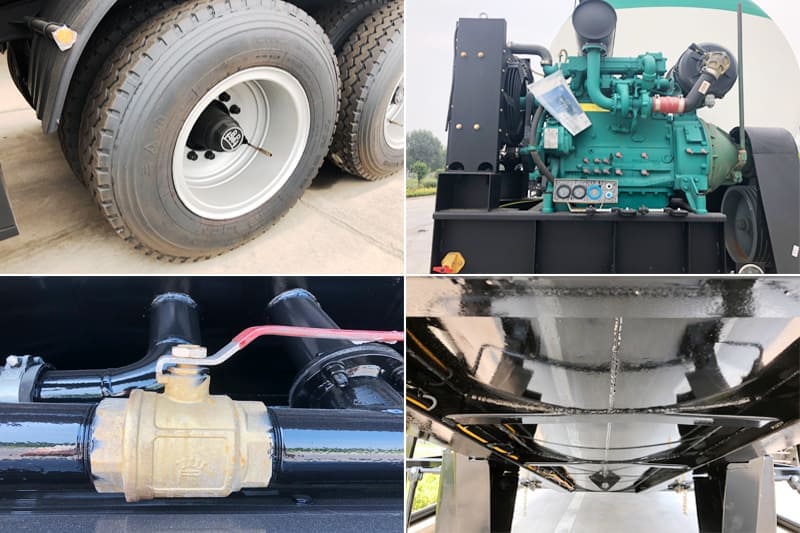
We set up the tanker for the full discharge route. Silo height, pipe length, pipe diameter, bends and filter condition all affect how hard the ash is to move.
A higher silo makes the ash travel farther upward. This adds resistance and can change the air-system setup.
A longer discharge pipe creates more pressure loss and can slow unloading.
Small or restrictive pipework and too many bends make the ash harder to move.
The silo must let air escape while fly ash enters. A blocked or undersized filter can cause backpressure, which means pressure builds up inside the silo.
We use the site conditions to match the air source, tank pressure and discharge setup.
A larger compressor cannot fix a blocked pipe or too much pressure inside the silo.
Start with the symptom. It usually tells you which part of the system to check first.
Follow the operating steps supplied with your final tanker setup.
Yes. We can build one tanker for both materials, but each material must have its own fully isolated compartment. We do not configure cement and fly ash to share the same tank compartment.
We use both payload requirements to split the compartment volume. We then calculate the total tank size and axle loads for the complete trailer.
Your route changes the tanker setup. We use your cargo, road, tractor and receiving site to choose the final tanker setup.
Your loading and unloading points are known and you run the same route often.
What we focus onThe tank becomes full before you reach the cargo weight you want.
What we focus onThe receiving site has a high silo, long discharge pipe, many bends or higher pressure inside the silo.
What we focus onThe tanker will run on rough roads, mine roads or other demanding routes.
What we focus onWe price the tanker for the job it needs to do. Tank size, axles, suspension and pneumatic equipment can all change with the cargo, destination and unloading route.
Send us your destination country, target payload and order quantity. If you know the fly ash density, tractor details, silo height and discharge distance, send those too. We use this information to prepare a project-specific setup instead of a generic model price.
Use these product pages as starting points. For your fly ash project, we still recalculate the tank volume, payload, axle loads and unloading setup.
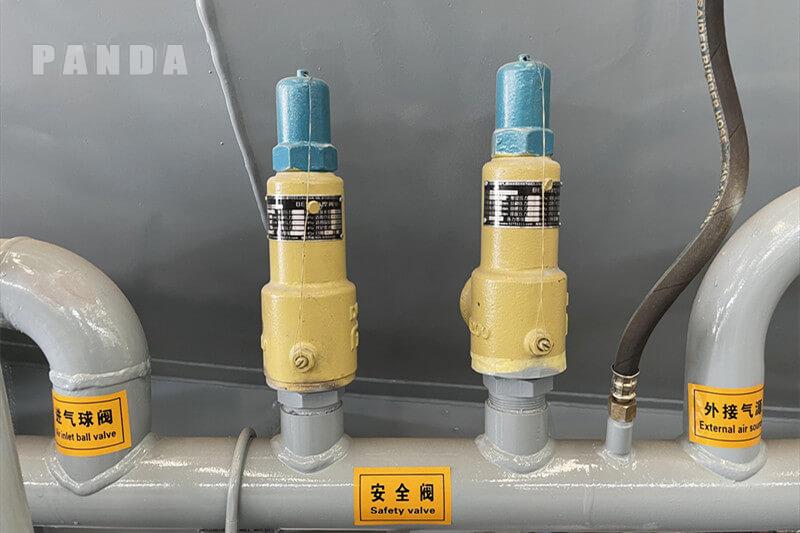
Start here to compare our dry bulk tanker range and common sizes. We will then adjust the fly ash setup for your project.
View Pneumatic Tanker Range →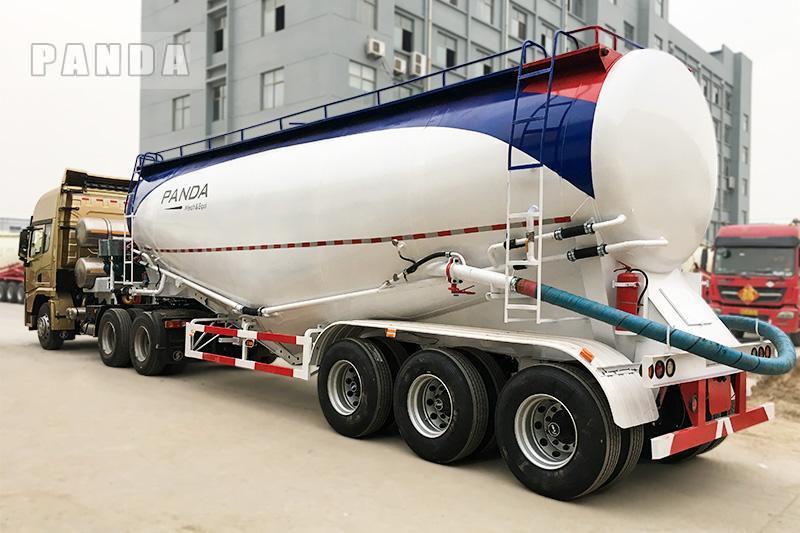
Use this model as a starting point if its payload range is close to what you need. We still recalculate fly ash density, legal payload and unloading conditions before we confirm the final build.
View 3 Axle 50 Ton Model →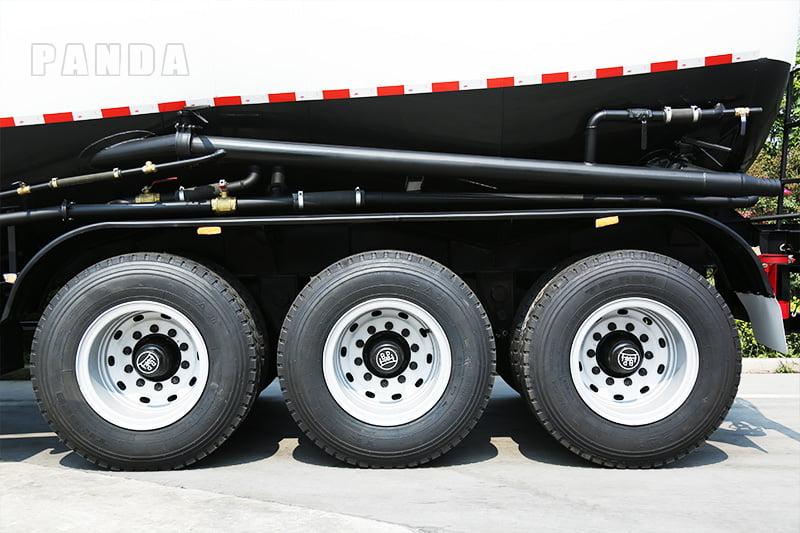
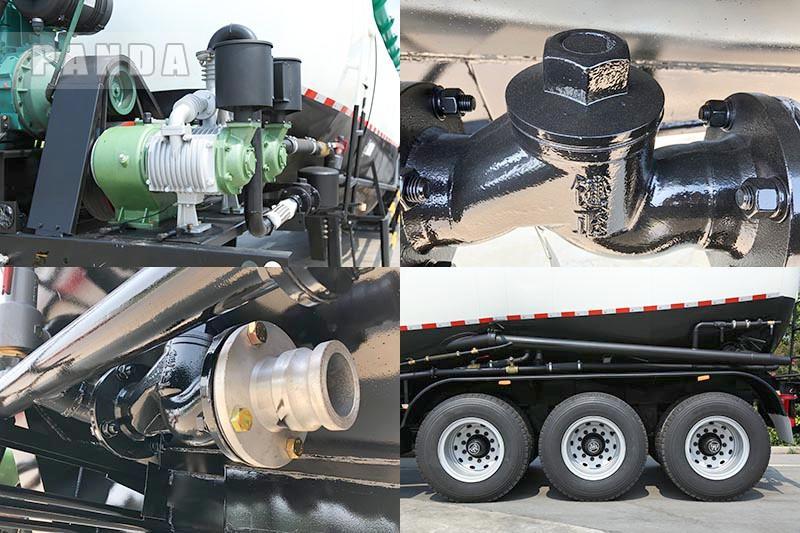
Panda Mech designs the tanker around your project and builds it in our own factory. We use your cargo, payload, tractor and receiving-site conditions to prepare the specification. We then control the main fabrication and inspection steps during production.
We build and inspect the tank body, internal parts and welded joints.
We install and check tank aeration, piping, valves and unloading parts.
We inspect the chassis, axles, suspension, brakes and electrical system.
We check the ordered setup and shipping protection before the tanker leaves our factory.
We start with your transport job, not a fixed catalogue model.
For a plant-to-silo route, we start with your target payload and fly ash density. We use them to calculate the cargo volume. Next, we check the empty trailer weight, axle limits and tractor. Finally, we match the pneumatic unloading system to the silo height and discharge distance.
For dry fly ash, we normally use a sealed pneumatic dry bulk tanker. It unloads the powder with compressed air into a silo. We size the tank from cargo density and payload, then match the axles, tractor and pneumatic system to your route.
Start with the payload you need on each trip. Divide that weight by the fly ash bulk density to estimate cargo volume. We then check empty trailer weight, axle loads, legal vehicle weight and working margin before we confirm the final usable tank volume.
Send the actual or supplier-specified bulk density if you have it. If not, send us the fly ash source and any cargo data you already know. We will tell you what else we need before sizing the tanker.
Yes. We can build one pneumatic tanker for both cement and fly ash. The two materials must use separate, fully isolated compartments. We size each compartment from its own payload and density, then check the finished trailer axle loads.
Yes. If one tanker carries both materials, cement and fly ash must stay in separate compartments. We do not configure them to share the same tank compartment.
Yes. Send us the tractor make and model, fifth-wheel height and available air source. If you use a power take-off (PTO), tell us that too. We check the tractor-trailer connection before production.
Yes. Tell us the silo inlet height, horizontal distance, pipe diameter, major bends and filter condition. We use this information to match the tank aeration, air source and discharge path to the receiving site.
Common causes are wet or compacted ash, poor tank aeration, air leaks or restrictive piping. A high silo, too many bends or pressure building up inside the silo can also slow unloading. We match the tanker to the full discharge route to reduce these problems.
Send us the destination country, fly ash type or source, target payload, quantity, road condition, silo inlet height and horizontal discharge distance. If you know the bulk density, tractor model, pipe diameter, local axle limits or target unloading time, send those too.
Our engineering team uses this information to set the tank volume, axle setup, tractor connection and pneumatic unloading system before we quote.