
Keep a spare only when the cement tanker downtime cost it can actually avoid is greater than its annual holding and deployment costs. Start with the failed equipment: a spare tractor, a spare pneumatic trailer and a spare unloading air package cover different problems. For repeated short repairs delayed by missing parts, a targeted parts stock may give a better return.
The useful comparison is annual cost for the same deliveries. Count the loads you would otherwise lose, subtract the operating expenses you would save, and compare the remaining loss with parts, replacement capacity and spare ownership. A parked truck with no available driver or compatible air source adds little protection.
Which spare asset would actually restore cement deliveries?
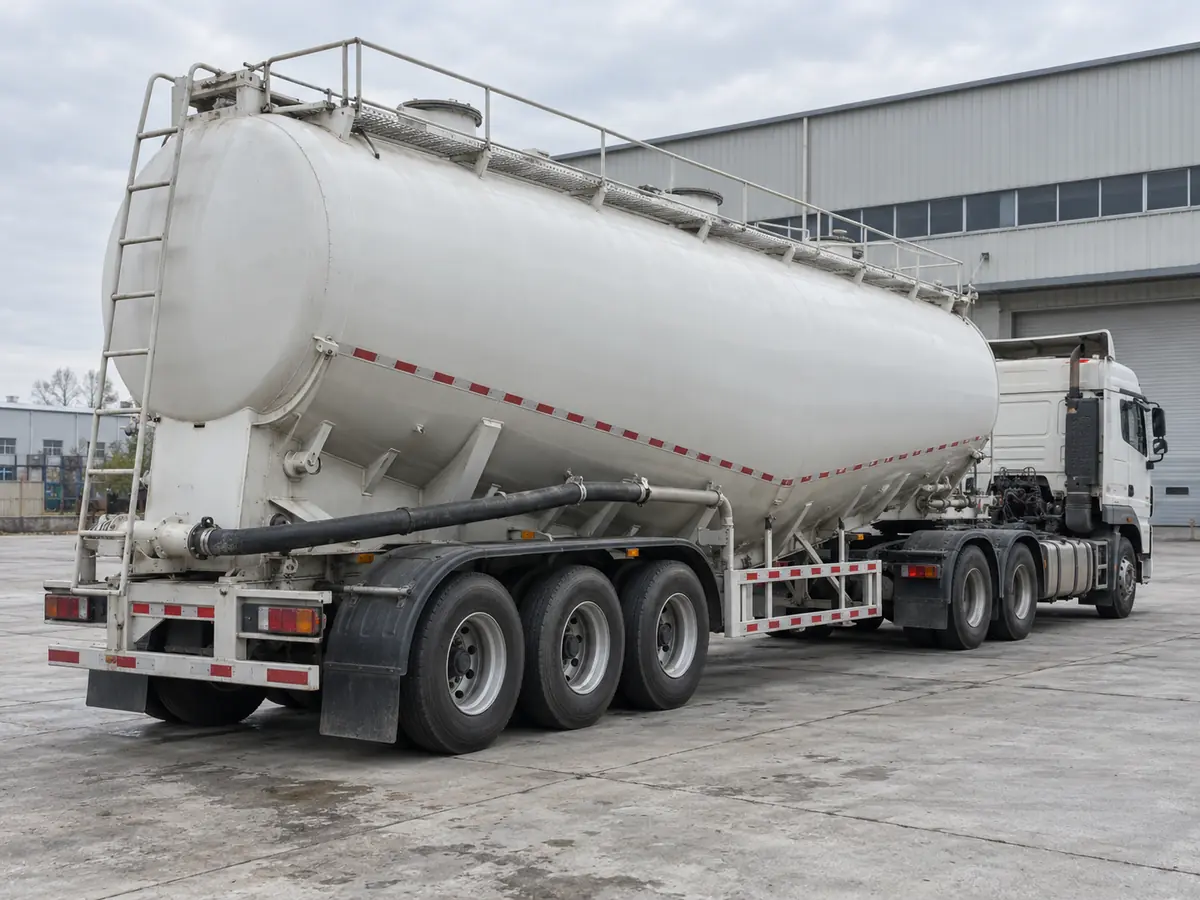
Choose the spare that replaces the failed part of the transport system while the rest of that system remains available. A spare trailer helps with trailer faults; a spare tractor helps with tractor faults. The unloading air source can change which substitution works.
| What stops the delivery? | Backup worth considering | What must still be available? |
|---|---|---|
| Tractor engine, transmission or roadworthiness fault | Compatible spare tractor | Serviceable loaded trailer, qualified driver and the required unloading air source |
| Empty trailer awaiting tank, valve or running-gear repair | Compatible spare pneumatic trailer | Tractor, driver, loading slot and receiving capacity |
| Failed compressor or its drive | Compatible replacement air package, or a vehicle carrying a working package | Suitable drive, airflow, connections and an approved installation |
| Two major systems unavailable together | Complete replacement combination or subcontracted tanker | Driver, cargo suitability and access to the job |
| No driver, no cement to load, or unavailable receiving silo | Staffing, dispatch or receiving-site action | A spare vehicle alone does not remove the restriction |
Trace the air supply before making a buying decision. The compressor may be tractor-driven or use a separate drive package. Gardner Denver’s Bulkline drive and package options show why the drive arrangement matters. If the working compressor leaves with the failed tractor, exchanging only the tractor may still leave the tanker unable to unload.
Also separate replacing transport capacity from recovering the cement already inside a disabled tanker. An empty spare trailer can take future loads. Moving an existing load out of a faulty tank is a separate recovery job, with its own equipment, time and cargo controls.
How do you calculate cement tanker downtime cost?
Calculate the income you cannot recover, less the operating expenses you genuinely avoid, then add the extra costs caused by the outage. Keep the repair invoice visible, but separate it from the losses that a spare could prevent.
Event cost = unrecovered freight revenue − avoided operating expenses + extra disruption costs + repair and recovery costs.
Suppose one cement delivery earns $650 and uses $350 of expenses that disappear if the trip is cancelled. These could include fuel, tolls and trip-based pay. The lost contribution—the amount left to cover continuing costs and profit—is $650 − $350 = $300 per lost load. Two unrecovered loads cost $600 before extra disruption expenses.
If your driver’s salary continues during the stoppage, it was not an avoided expense. Leave it out of the $350 deduction. Adding the same salary again would count it twice. Apply the same discipline to truck finance, insurance and existing office overhead: they still need funding, but a payment unchanged by the backup decision is not an extra saving from buying a spare. This follows ACCA’s relevant-cost approach to decisions.
| What happened to the load? | Cost to record |
|---|---|
| Cancelled and never replaced | Lost contribution plus separate extra expenses |
| Delivered later using otherwise unused capacity | Extra delay, overtime or recovery cost; record any work displaced by the late trip |
| Delivered by a subcontractor | Extra cost compared with your normal delivery cost, plus any remaining service loss |
| Delivered by your spare | Spare deployment cost and any remaining delay; allocate annual holding cost in the annual comparison |
Use actual contract charges or credits where they apply. Keep a possible future contract loss as a separate scenario with stated assumptions. It should not silently multiply every routine repair.
For a cement producer using its own fleet, use the extra delivered cost or the production contribution actually lost through a material shortage. Do not add a notional freight sale to the producer’s production loss. If silo stock or another delivery prevents a stoppage, record the cost of that response.
Which downtime days could a spare really recover?
Count the delivery windows a compatible spare could save after it arrives and is ready to work. Calendar repair days, missed working days and recovered deliveries are different measures.
Take the clock from the work order and dispatch records. Record when the fault stopped service, when diagnosis finished, when the part was ordered and received, when repair finished, and when the unit was released. Separately record when replacement transport could start its first useful delivery.
A truck can spend a weekend in the workshop without losing a scheduled load. A short weekday failure can miss the only loading slot that serves a customer’s receiving window. Use the dispatch plan to attach the economic loss to each event.
To estimate recoverable work, remove periods when:
- No delivery was required, or another vehicle already covered it without displacing work.
- The spare could not arrive before the loading or delivery window closed.
- A driver, suitable tractor, air source or receiving silo was unavailable.
- The spare was already covering another outage or was itself under maintenance.
Express partial recovery in loads or hours first. Convert it into equivalent working days only after using the same work rate. If a normal day is two comparable loads and the spare saves one, that is half a recovered day. When route margins differ, total the saved contribution load by load instead of applying one fleet average.
For a loaded disabled trailer, ask two questions: can the combination safely complete this delivery after the failed component is addressed, and can a spare take the following orders? Do not credit an empty spare with rescuing the existing cement load unless a workable recovery arrangement is included.
When does keeping a spare tanker break even?
A spare breaks even when the annual loss it avoids equals its annual holding cost plus its extra deployment cost. Compare each option with the same current response: leaving work unserved, hiring cover, or moving work within your fleet.
For deliveries that would otherwise be lost, use:
Annual net benefit = D × (M − K) − F
- D: equivalent working days the spare can recover each year, after overlap and availability checks.
- M: avoidable loss per recovered day, normally the lost contribution plus separately supported costs the spare prevents.
- K: extra cost per recovered day to deploy the spare, beyond normal trip costs already allowed for in M.
- F: annual cost of holding the spare, whether deployed or parked.
Include an annual lease or a consistent annual capital charge, insurance, registration, storage and calendar-based upkeep in F. For a purchase, finance can turn the purchase outlay and expected resale proceeds into an equivalent annual capital cost over the planned holding period. For an existing spare, include the value tied up by keeping it rather than selling it. Do not add the full purchase price, loan principal and depreciation to the same annual cost.
What does the break-even calculation look like?
In the following example, a spare trailer saves $2,000 a year against leaving deliveries unserved, and reaches break-even at 18 recovered working days. Suppose the fleet has 30 equivalent working days of outages, but the proposed spare can cover only 22. Assume $600 of avoidable loss per covered day, $100 of extra deployment cost per day, and $9,000 of annual holding cost.
| Annual comparison | Calculation | Result |
|---|---|---|
| Loss on the 22 days without cover | 22 × $600 | $13,200 |
| Spare deployment cost | 22 × $100 | $2,200 |
| Spare holding cost | Annual budget | $9,000 |
| Net benefit from the spare | $13,200 − $2,200 − $9,000 | $2,000 |
| Break-even coverage | $9,000 ÷ ($600 − $100) | 18 working days |
The eight uncovered outage days remain in both options. The original repair costs also remain unless the backup choice changes them. Leaving those common costs out of the difference keeps the comparison clear.
At 18 recovered days the options are equal; above 18, the spare is cheaper on these inputs. If avoidable loss falls to $400 per day, break-even rises to $9,000 ÷ ($400 − $100) = 30 days. At only 22 covered days, keep a lower-cost backup arrangement.
A complete spare combination costing $24,000 a year to hold would need 48 covered days at the original $500 daily saving. Use the full combination only if its wider coverage or service value justifies that cost. A trailer-only result cannot justify buying both assets.
Estimate your spare’s annual benefit
Enter recoverable days, avoidable daily loss, extra deployment cost and annual holding cost using one currency. The calculation below compares holding a spare with your chosen current response. When reliable hired cover already preserves the deliveries, enter the hire cost the spare would avoid in M, rather than the full lost contribution.
The result is D × (M − K) − F. Break-even days are F ÷ (M − K) when M is greater than K. If M is no greater than K, each deployment fails to cover its extra running cost, so increasing the number of deployments does not pay for a positive holding cost.
Should critical parts come before a spare trailer?
Prioritize parts when repeated outages are mainly waiting for identifiable components that local technicians can replace quickly. Prioritize replacement capacity when repairs remain long even with the parts available, or a missed delivery window cannot wait for the repair.
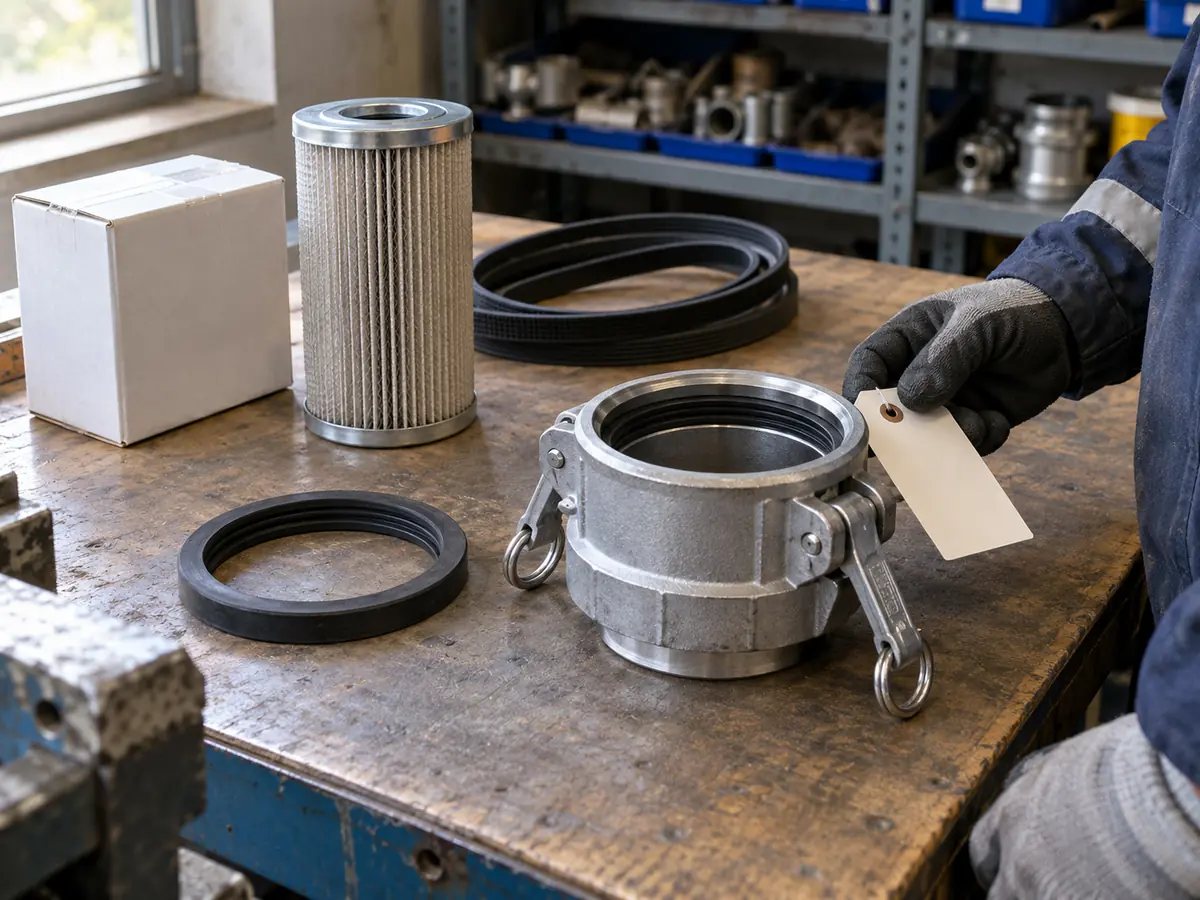
Start with the components that caused the most lost delivery contribution. A cheap seal with a long delivery time may deserve stock before an expensive assembly that rarely fails. Stocking a part only helps when diagnosis, fitting, testing and release can also happen in time.
| Parts group | What makes the stock useful? |
|---|---|
| Seals and service kits | Correct material, dimensions, component model and storage condition |
| Discharge hose and coupling assemblies | Matching bore, ends, seals and required pressure/temperature ratings |
| Filters, belts and approved service items | Exact air-package and drive identification, plus a technician able to do the work |
| Valve or air-system assemblies | Confirmed configuration, installation requirements and a release test |
| Running-gear parts | Correct axle, brake or suspension identification and qualified repair access |
Build the list from part numbers, equipment serial numbers, failure findings and supplier delivery dates. Keep the photographed identification plate with the record. Similar appearance is a poor substitute for a matching specification. Our cement tanker maintenance schedule explains how service triggers and defect records fit together.
Count annual inventory carrying, storage, expiry or obsolescence risk, and extra planned service spending. Replacement parts consumed in the same repair under both options are a common cost; do not treat the whole first stock purchase as a recurring annual penalty.
Suppose a $1,800 annual parts-and-service program removes eight of the 22 recoverable days in the earlier example. At $600 per day, its net benefit is 8 × $600 − $1,800 = $3,000. The spare would then cover only 14 remaining days. Adding it after the parts program gives 14 × $500 − $9,000 = −$2,000.
Choose the parts program first on those assumptions. Adding the spare would reduce the combined saving from $3,000 to $1,000. Recalculate from the remaining outages whenever a maintenance improvement removes work that the spare was meant to cover.
When are rental or subcontracted tankers cheaper?
Use hired cover when compatible capacity can arrive in time and its annual extra cost is lower than holding and deploying your own spare. Own the backup when availability, response time or repeated demand makes hired cover unreliable or more expensive.
Separate a tractor rental, a pneumatic trailer rental and a complete subcontracted cement delivery. They provide different equipment and labor. Ask what the offer includes: driver, air source, mobilization, extra mileage, cleaning, waiting and a minimum hire period.

For the same 22 covered days, suppose external cover costs $250 per day more than the normal delivery cost, including mobilization spread across those days. Annual cover costs $5,500. The spare costs $9,000 + $2,200 = $11,200. Hired cover is $5,700 cheaper if it preserves the same loads and timing.
If a subcontractor quotes a full freight price, subtract your normal avoidable delivery cost to find the premium. Do not compare the subcontractor’s full invoice with only the spare’s extra deployment cost. The normal trip costs must be treated consistently.
For remote routes, a low day rate means little if the substitute arrives after the customer’s receiving window. Obtain the response time and availability terms along with the price. Match previous cargo, tank condition, legal load, loading access, couplings and unloading air supply to the cement job.
A mixed plan can work well: parts for repeated short delays, one shared spare for time-critical compatible work, and an agreed external carrier for overlapping events. Size the owned part of that plan from the remaining demand for cover.
How should you test and size your backup plan?
Replay actual outages against actual delivery windows, then test how long the backup takes to produce its first useful delivery. An annual average cannot show whether two failures compete for the same spare on the same morning.
Use a full operating cycle that includes busy and quiet periods. For each event, keep:
- Tractor and trailer IDs, fault location, cargo state and out-of-service timestamps.
- Diagnosis, parts arrival, repair completion and release times.
- Planned loads, actual deliveries, customer windows and contribution per load.
- Spare location, readiness, existing assignment, driver and air-source availability.
- Mobilization, extra labor, external cover and actual contract charges.
- The first delivery restored and any load still lost or displaced.
Walk forward through the records in time order. Assign the spare only once at any moment. Include travel between depots, inspection and the return from its previous job. If two compatible trailers are down together, one spare can cover only the work it can physically complete. Price the uncovered work before adding another unit.
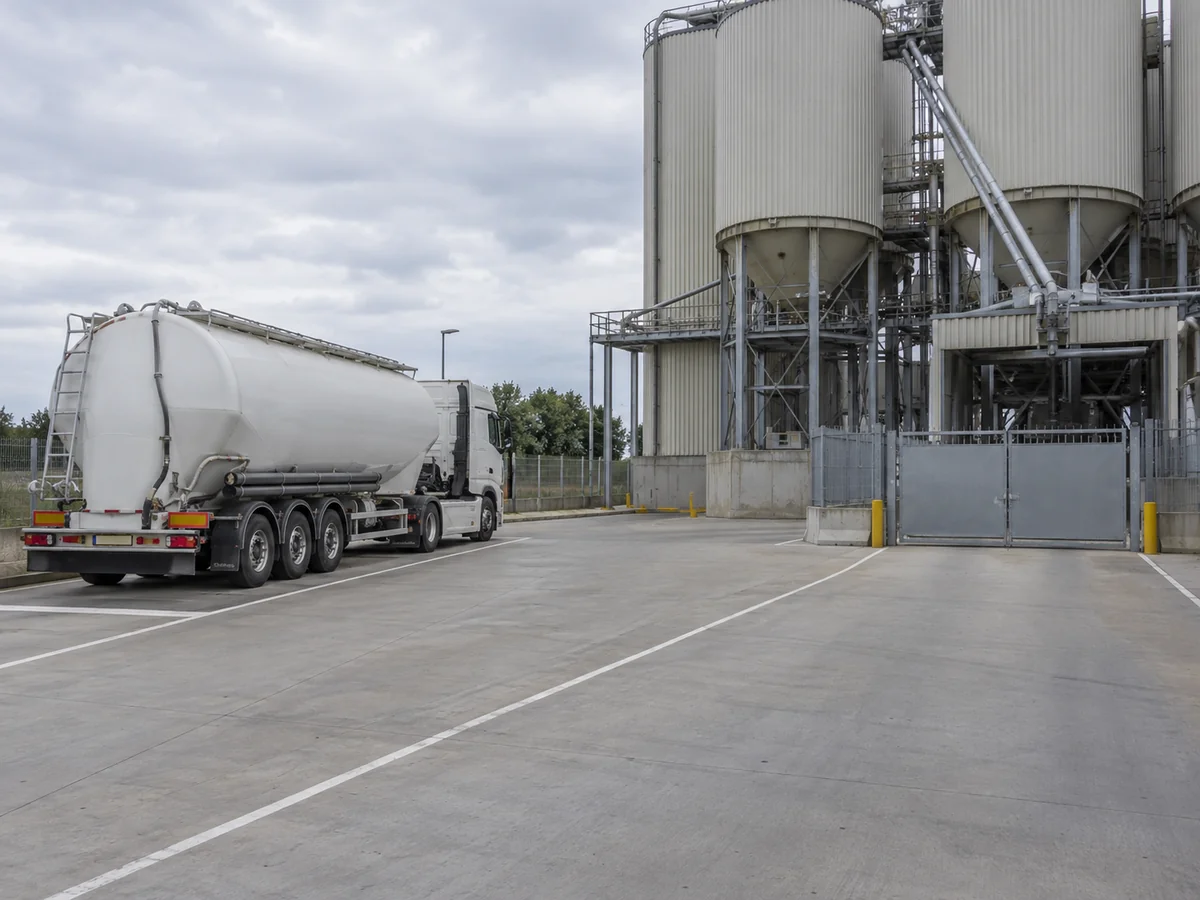
For a cement plant, compare the backup arrival time with usable silo stock and the expected consumption rate. If there is time to arrange another delivery before stock runs out, that response may cost less. If stock runs out first, evaluate the production contribution at risk on the uncovered period, alongside the actual backup cost.
Run an agreed backup exercise before relying on the plan. Time dispatch approval, driver allocation, coupling checks, travel and the first representative loading/unloading cycle. Keep the assigned personnel and operating conditions with the result. If the load arrives too late, move the spare closer, improve dispatch access or choose faster external cover, then repeat the affected part of the exercise. Never shorten inspection or pressure-system release work to meet the target.

For a spare trailer order, match the tractor connection, brakes, road payload, cargo and pneumatic equipment with the existing fleet. Our 50 ton cement tanker trailer is a product option to compare for compatible bulk-cement work. The model name alone does not establish the payload allowed on your route or replace a failed tractor. Common component specifications can also simplify your parts stock.
What should you choose first?
Reduce recurring parts delays first when they explain most lost deliveries; keep a compatible spare when the remaining recoverable loss pays for it. Where dependable hired capacity costs less, use that cover and reserve owned capacity for the work it serves better.
Cement tanker downtime cost becomes useful when it is tied to a specific failed asset, an unserved delivery and a cost your response can actually avoid. Start with the outage records and the dispatch plan, calculate the annual difference, and test the proposed backup against the receiving window.
Send us your cement type, route and required load, tractor and air-source arrangement, receiving-silo details, and the equipment you need to cover. For parts support, include the trailer and component identification plus the fault description. Use our contact form to begin the configuration or support discussion.
Cement tanker downtime and spare-vehicle FAQs
Is an older, fully paid-off spare truck free to keep?
No. A paid-off vehicle still ties up its resale value and needs insurance, storage and upkeep. Compare keeping it with selling it and using parts or hired cover. Use its present condition, expected sale value and future costs; the original purchase price is already spent.
Can two depots share one spare cement tanker?
Yes, if travel time and overlapping demand still allow it to meet the delivery windows at both depots. Include the move from its actual location, the driver and any change in air-source arrangements. Give time-critical work a clear allocation rule, and arrange a second response for conflicts.
Does a spare trailer solve a breakdown when the tanker is already loaded?
It covers future loads; the existing load needs its own recovery decision. If the tractor alone has failed, a compatible replacement tractor may move the serviceable loaded trailer. If the tank, running gear or unloading system is faulty, arrange the specific safe recovery or repair before crediting the spare with that delivery.
Should planned maintenance during the quiet season count as lost income?
Count lost income only when the maintenance removes work that could otherwise have been completed. Keep the maintenance expense and equipment-unavailable time in the records even when no load is lost. If the same job moves into a busy period, update the delivery impact rather than applying the quiet-season result.
How often should a standby tanker be checked or exercised?
Keep its calendar-based service current and set readiness checks around storage conditions and the planned response time. Use the applicable component service triggers and the fleet’s inspection program. Before relying on it for an urgent job, close open defects and record a successful dispatch and unloading exercise; set later exercises from the problems and gaps found.
Can a carrier count the customer’s whole factory shutdown as its downtime loss?
Only include costs the carrier actually bears, such as an applicable contract charge or an agreed recovery expense. A customer’s production loss belongs to that customer’s business unless the carrier is responsible for it. A producer operating its own fleet can include the production contribution actually at risk after allowing for stock and alternative supply.

ZAC
Hello, I’m ZAC, a cement trailer and semi-trailer specialist with over 20 years of industry experience. My technical approach starts with real operating conditions, including how cargo characteristics, road conditions, and loading and unloading methods affect trailer performance. I place particular emphasis on structural reliability, component compatibility, and ease of maintenance. I look at both everyday performance and how reliably a trailer operates over time, as well as how easily it can be inspected and serviced.


